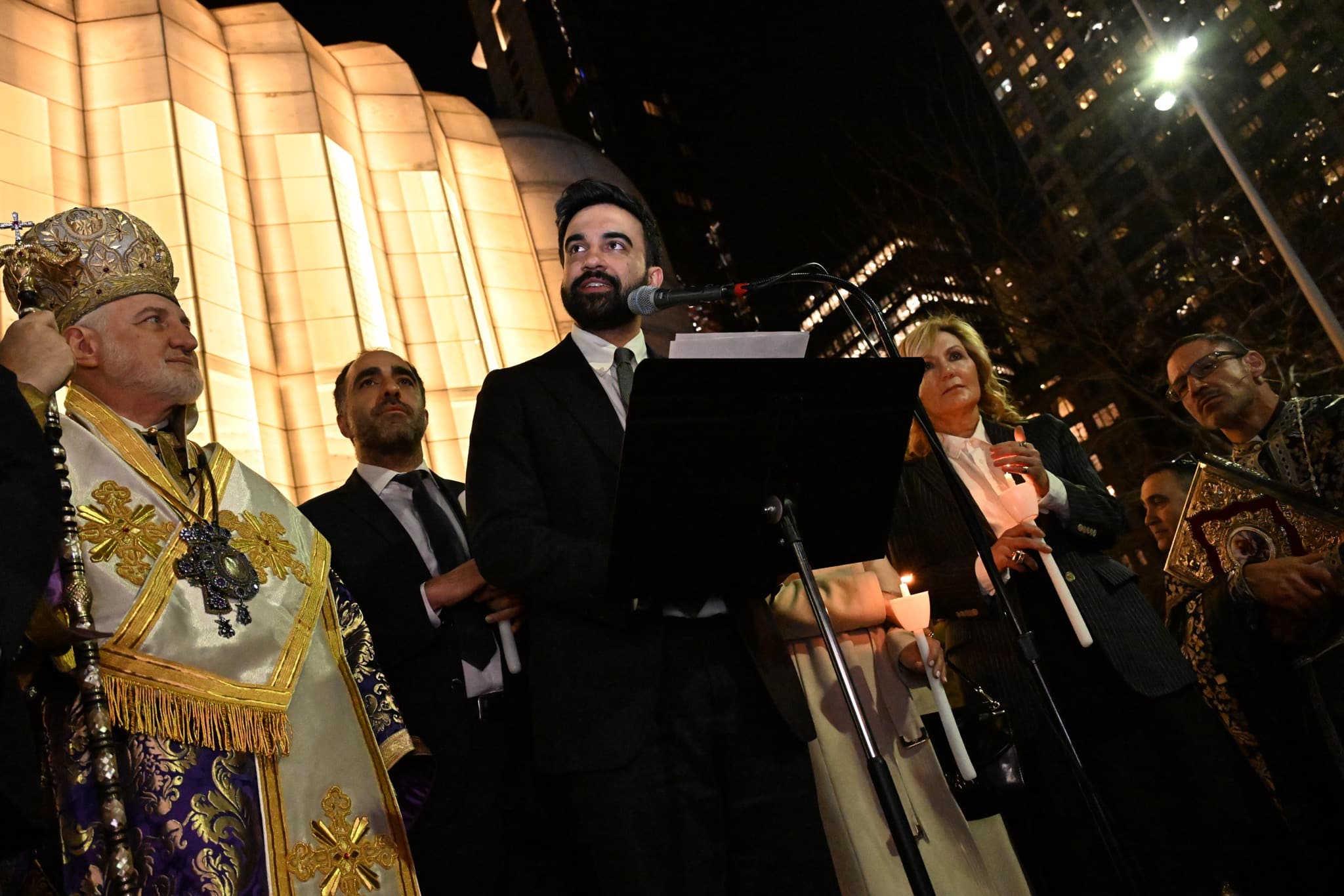
Members of the Turkish-American community gathered in Times Square on Sunday to protest New York City Mayor Zohran Mamdani’s endorsement of the Armenian Genocide.
They also protested his views on the recent conflict in the region known as Artsakh to Armenians and Nagorno-Karabakh. The demonstration, supported by various Turkish associations, was a response to a social media post shared by Mayor Mamdani on April 24.
New York Belediye Başkanı Mamdani’nin Türkiye’yi soykırımla suçlayan açıklamaları Times Meydanı’nda protesto edildi.pic.twitter.com/y52Gt5fVin https://t.co/gINc2HGiHe
— Mahfil (@mahfildijital) April 27, 2026
Protesters carried placards and chanted slogans, arguing that the Mayor’s characterization of history and the recent geopolitical developments in the region is inaccurate. The organizers stated that as a public official representing a diverse city, Mayor Mamdani’s remarks risk alienating the Turkish-American community.
The controversy stems from a post by Mayor Mamdani on X, where he stated:
“Today marks the 111th anniversary of the Armenian Genocide. As we honor the 1.5 million Armenians murdered by the Ottoman Empire across modern-day Turkey, Syria, and Armenia, we must refuse to let history repeat itself. In 2020, the military forces of Azerbaijan and Turkey attacked the Armenian population in Nagorno-Karabakh [Artsakh]. In 2023, Azerbaijan expelled over 100,000 Armenians from Nagorno-Karabakh, continuing the genocidal campaign that had begun over 100 years prior. On this day of remembrance, we reaffirm the right of the Armenian people — and all people — to freedom, safety, and self-determination.”
Today marks the 111th anniversary of the Armenian Genocide. As we honor the 1.5 million Armenians murdered by the Ottoman Empire across modern-day Turkey, Syria, and Armenia, we must refuse to let history repeat itself.
In 2020, the military forces of Azerbaijan and Turkey…
— Mayor Zohran Kwame Mamdani (@NYCMayor) April 24, 2026
The dispute centers on fundamentally different interpretations of the events that occurred between 1915 and 1923. While the vast majority of international historians and many nations classify the systematic killing and deportation of Armenians as genocide, Turkey maintains a firm policy of non-recognition.
For Armenians and many international scholars, these events are a documented reality of systematic ethnic cleansing that led to the near-total removal of the Armenian presence from their historic homelands in Anatolia.
This historical narrative is deeply linked to the modern-day struggle over Artsakh, a region Armenians consider their ancestral heartland, while Azerbaijan asserts its sovereign right over the territory, which it refers to as Nagorno-Karabakh.
Related: The Haunting 100-year Parallel Between Greeks and Armenians