The Trojan War, one of the most dramatic conflicts in Greek mythology, wasn’t just a clash between two cities. It drew in allies from across the ancient world. The Trojans were backed by forces from Anatolia and even as far away as Thrace, turning the war into a sprawling, international struggle. But what about the Amazons, the legendary warrior women feared and admired in equal measure? Did they ride to Troy’s defense in its hour of need, or did they see an opportunity to strike a weakened city?
The first mention of the Amazons in any legend concerning the Trojan War actually comes from the Iliad, the earliest legend of them all. This was composed by Homer in the seventh century BC. Although he does not include the Amazons in the Greek Catalogue of Ships, nor in the Trojan Battle Order, Homer does mention the Amazons in one particular place.
This is in a passage in which Priam recounts his past activities. Speaking to Helen, he says:
“Ere now have I journeyed to the land of Phrygia, rich in vines, and there I saw in multitudes the Phrygian warriors, masters of glancing steeds, even the people of Otreus and godlike Mygdon, that were then encamped along the banks of Sangarius. For I, too, being their ally, was numbered among them on the day when the Amazons came, the peers of men.”
This reveals that Priam had formerly battled against the Amazons in Phrygia. The location of the battle was near the Sangarius River, hundreds of miles away from Troy. In this conflict, Priam fought as an ally of the Phrygians against the Amazons.
However, in the narrative of the Trojan War itself, Homer never refers to the Amazons as participating. Of course, we should remember that the Iliad does not cover the final part of the war.
An epic poem which covered a slightly later portion of the Trojan War was the Aethiopis, from the seventh century BC. Unfortunately, the text of this poem is now lost to us. However, there are ancient summaries and references to it which enable us to understand the broad strokes of the account.
From a certain Proclus, possibly of the first century BC, we have the following summary:
“The Amazon Penthesilea, the daughter of Ares and of Thracian race, comes to aid the Trojans, and after showing great prowess, is killed by Achilles and buried by the Trojans.”
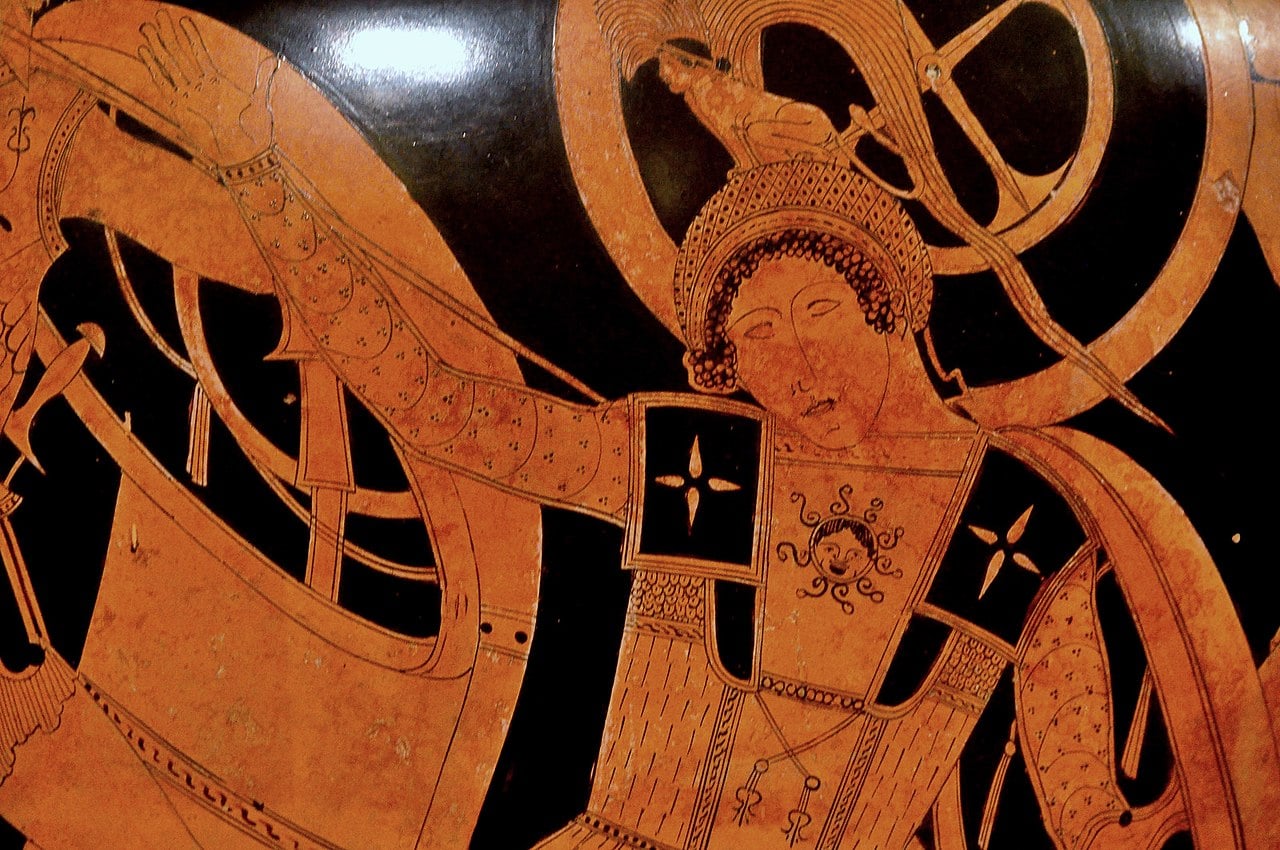
This brief summary reveals that the Amazons did, according to legend, participate in the Trojan War, but what was their role? They actually arrived as defenders of Troy, fighting against the Greeks. Penthesilea, an Amazon queen of Thracian origin, fought powerfully but was eventually killed by Achilles.
Despite this clear and simple tradition in the Aethiopis, the true nature of the Amazons’ involvement in the Trojan War is more complicated. As we saw earlier, the Amazons fought against both the Trojans and Phrygians earlier in Priam’s reign. Would they really have been allies of the Trojans just a short while later?
Perhaps their allegiance simply changed due to the invasion of the Greeks. However, even in the legendary narratives, their support of the Trojans is surprising. In the account attributed to Dictys Cretensis, perhaps dating to the first century BC, we find the following:
“After a few days news was suddenly brought that Hector and a few other men had set out to meet Penthesilea, the queen of the Amazones. Why she was coming to Priam’s aid, whether for money or simply because of her love of war, was uncertain; her race, being naturally warlike, was always conquering the neighboring peoples and carrying the Amazon standards far and wide.”
This makes it clear that no one expected the Amazons to support the Trojans. While Hector was on the way to meet Penthesilea, Achilles ambushed him and killed him. The account then says:
“Some of them believed that the army which Penthesilea had brought to aid Priam was now joined with Achilles.”
While the account presents this as a mistaken belief, the earlier Aethiopis noted that Achilles allegedly fell in love with Penthesilea. If she was purely an enemy of the Greeks, this would be unusual.
The most explicit piece of evidence for an alternative account comes from a lost poem by Stesichorus from around 600 BC. This narrative explicitly presented Penthesilea as killing Hector, the Trojan prince. Might this be connected to the tradition seen in Dictys Cretensis’ account about Hector being killed by Achilles on the way to see Penthesilea?
Interestingly, Diodorus Siculus (a Greek historian of the first century BC) presents the following version of events:
“During the time of the Trojan War, Penthesileia, the queen of the surviving Amazones, who was a daughter of Ares and had slain one of her kindred, fled from her native land because of the sacrilege. And fighting as an ally of the Trojans after the death of Hektor she slew many of the Greeks.”
Notice that Penthesilea is specifically said to have fought as an ally of Troy after Hector’s death. This is interesting partly because it is yet another example of the Amazon queen being mentioned in association with the death of this Trojan prince. However, it is also interesting for the implication that she was not an ally of Troy before that time.
When we combine these various accounts, could it be that the Amazons actually fought against the Trojans at first? Might Penthesilea have been involved in helping Achilles kill Hector, and it was only after this that—for some reason—she switched sides? It is true that no single account explicitly presents this as being what occurred. However, such an original scenario would comfortably account for the contradictory versions that do exist.
Is it possible that this legend actually has a historical origin? There are two issues to bear in mind in relation to this. The first is that the Amazons are closely connected to the Scythians. An ethnic group which was culturally almost identical to the Scythians were the Cimmerians. Interestingly, Orosius explicitly associated the Amazons with the Cimmerians along with the Cimmerians’ famous incursion through Anatolia.
The second issue to bear in mind is that some scholars, such as Dr. Peter Gainsford, have argued that the legend of the Trojan War likely reflects events much more recent than the Bronze Age, such as the Greek colonization of the Troad in the eighth century BC.
With these two factors in mind, could the legend of the Amazons participating in the Trojan War originate in the historical Cimmerian raids through Anatolia in the eighth and seventh centuries BC? It is certainly a distinct possibility.