
All humans, either willingly or unwillingly, love perfect proportions. Centuries before Photoshop or fitness influencers, the quest for the “ideal” body and perfect proportions reached a major milestone in Ancient Greece. While his peers were trying to capture the gods by building massive, heavily decorated monuments, a sculptor named Polykleitos took a completely different approach and started looking inward.
For the master from Argos, beauty was certainly a matter of taste, but it definitely wasn’t a happy accident. Polykleitos believed that beauty was objective and came down to hard, calculable mathematics. By treating his sculptor’s studio like a scientific laboratory, he fundamentally changed how we picture ourselves and how we define beauty. Therefore, he set a standard that would stick around for over two thousand years.
The core of this artistic revolution was a book that Polykleitos wrote called the Kanon (or Canon), which is unfortunately lost to history. From secondary sources, we know that in this manuscript, Polykleitos argued that a perfect statue required a strict system of ratios whereby every single body part related harmoniously to the others. Even though some of his contemporaries might have seen this as extreme perfectionism, it ultimately tied into the Pythagorean idea that numbers actually govern the universe.
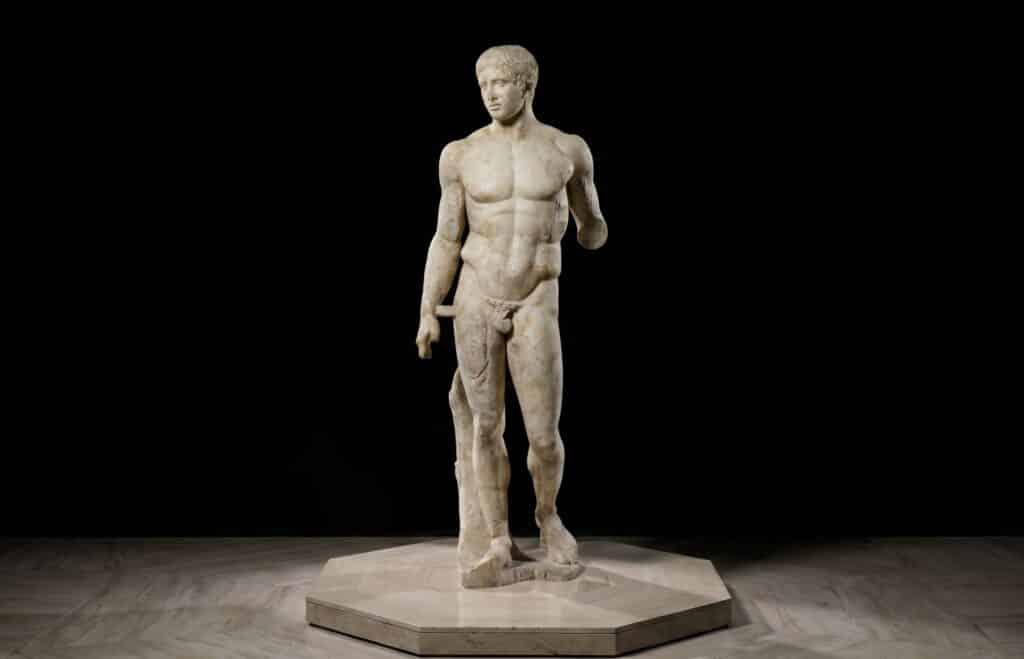
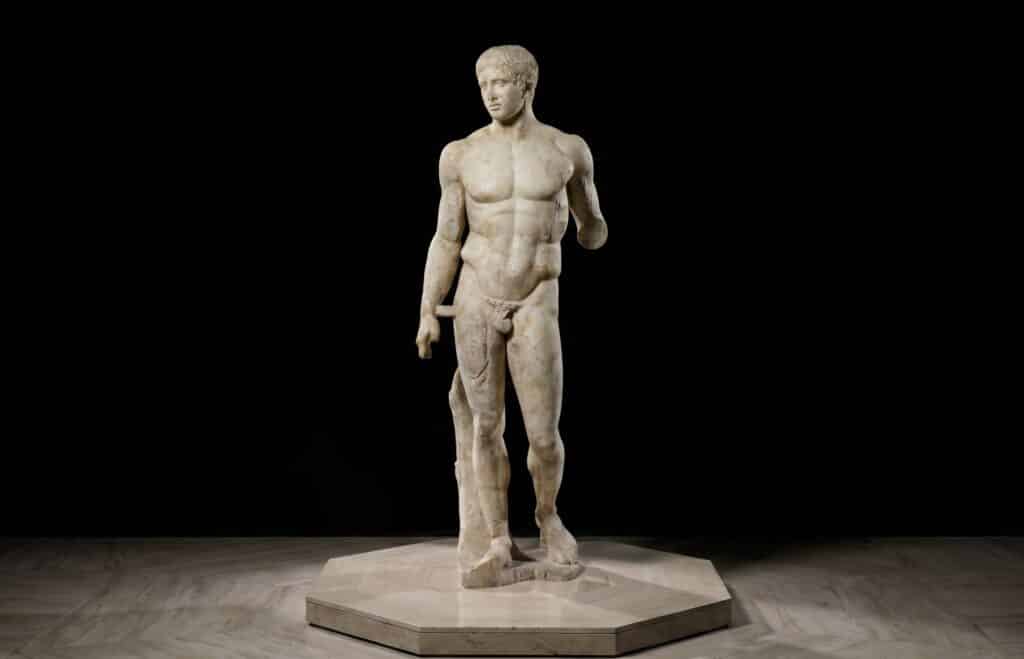
Polykleitos proved his theory with a bronze masterpiece known as the Doryphoros (the Spear-Bearer). It was essentially his textbook and theory brought to life. He utilized a concept known as symmetria, meaning the length of a finger mathematically dictated the size of the palm, which dictated the wrist, and so on up the arm. Nothing was random; it was all connected.
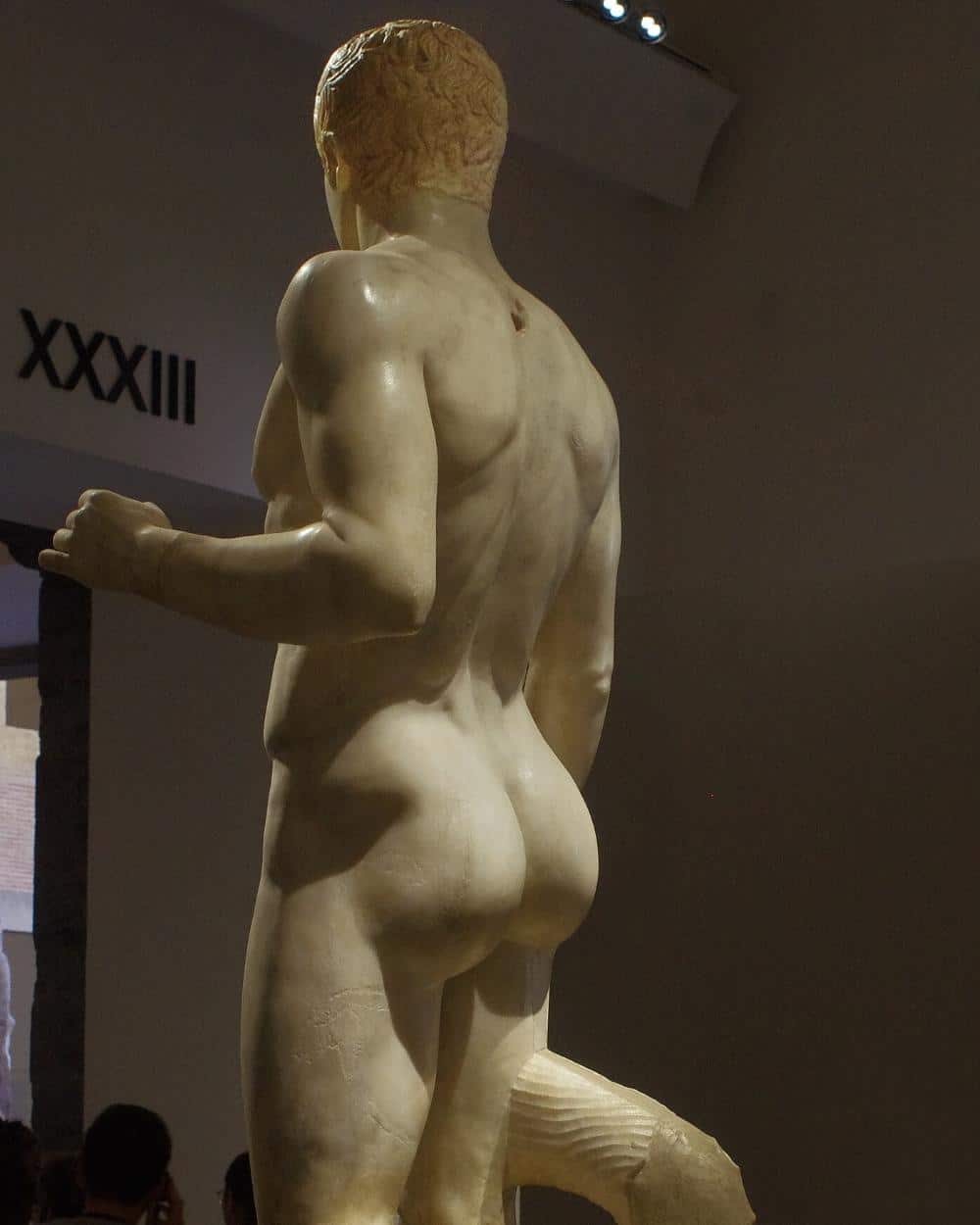
However, what is worth noting is that the statue doesn’t look like a stiff mathematical model. Polykleitos completely mastered the use of contrapposto, that incredibly natural pose where a person rests their weight on one leg while the other relaxes. It results in this beautiful cross-balance of tension and relaxation. Hence, instead of a frozen chunk of metal, he managed to create a figure that looks like it just paused to take a breath. It’s that exact mix of cold math and warm, breathing life that made his workshop such an innovative hotspot in the ancient world.
Some people might think ancient bronze casting has nothing to do with us today, but Polykleitos and his influence survived the fall of the classical world. During the Renaissance, masters like Michelangelo and Da Vinci were practically unearthing the Ancient Greek past to discover the anatomical principles when it came to creating their masterpieces.
Even in practice today, we still use his playbook. Think about the ridiculously flawless digital avatars we build in video games or the aesthetic goals pushed by the modern fitness industry. That deep-seated idea that physical perfection somehow reflects inner, moral excellence comes straight out of the Greek tradition.
At the same time, his methods are applicable to our modern technology. Just as Polykleitos relied on the mathematics of his day to decode human beauty, today’s creators use algorithms and biometric data to construct “perfect” CGI models in cinema and advertising. The underlying logic hasn’t changed at all. We still believe there is a hidden code to beauty, and if we can just figure it out, we capture a kind of magic.
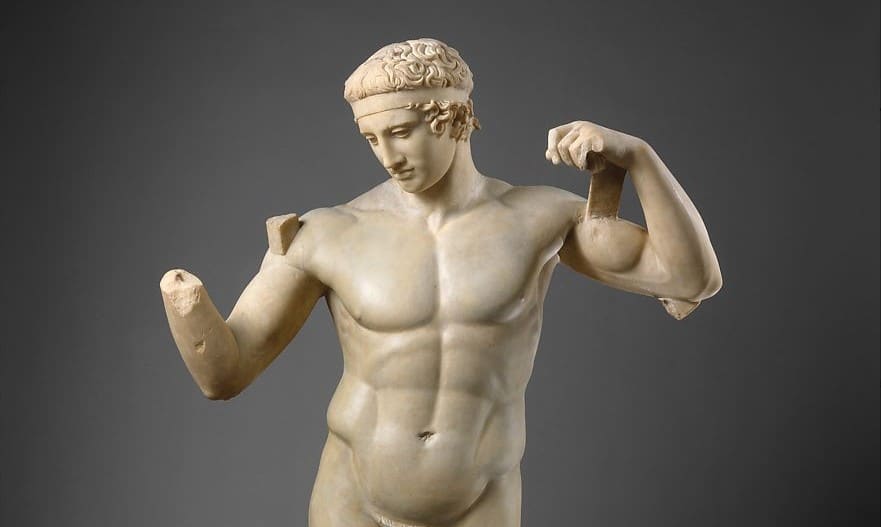
While Phidias decorated the Parthenon in Athens with epic myths, Polykleitos quietly perfected the solitary human figure in his hometown of Argos. His studio quickly turned into a magnet for young artists tired of the stiff, older styles. Thanks to him, the “Argive” way of doing bronze became the absolute gold standard for generations.
Additionally, his students learned how to make metal feel like it had the potential to move. They developed a meticulous understanding of how muscles worked and exactly how skin shifted over bones when a person shifted their weight.
That said, a Polykleitan statue is rarely a portrait of a specific local athlete. It is a broad representation of “Man” in his absolute, ultimate state. By focusing on a young athlete at his physical peak, Polykleitos captured an archetype of human beauty. He managed to grab a fleeting moment of human perfection and lock it into indestructible bronze, providing a template still in use to this day.
Polykleitos wanted and actually succeeded in finding a neat, mathematical order in the messy chaos of nature. In a world where things feel so subjective and like they’re constantly changing, his work showed that some ideas—mathematical, aesthetic, and moral—never fade. Standing before a Roman copy of a Polykleitan statue is practically like coming face-to-face with the exact moment Western art turned into a profound investigation of what it means to be beautiful.



