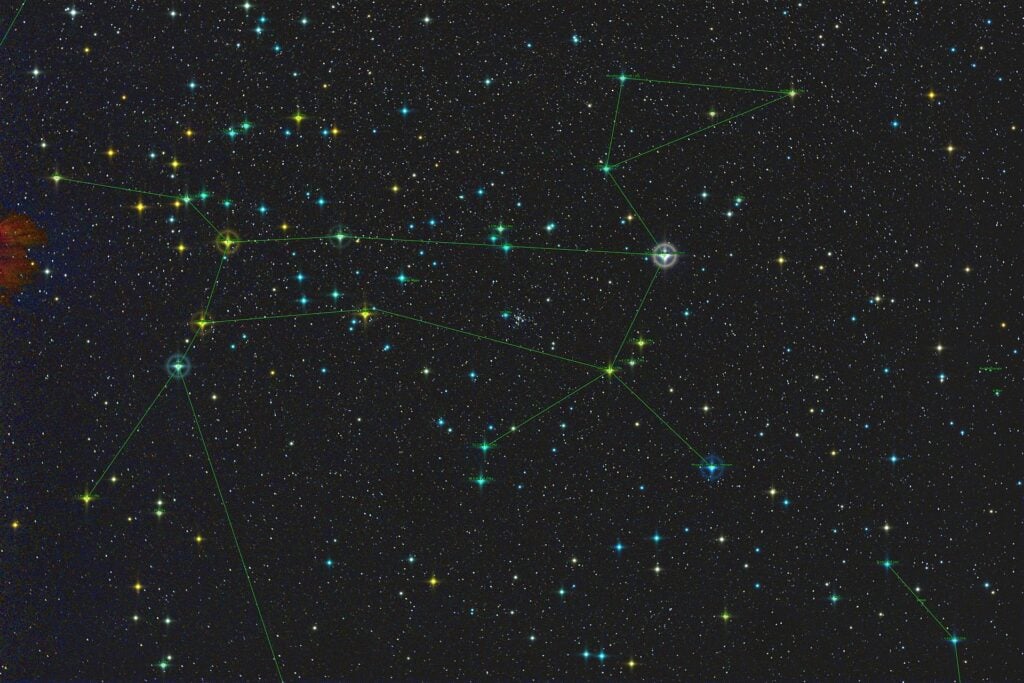
The “dog days of summer” is a phrase that originates from ancient Greece. It describes the hottest days of the season marked by the brightest star in the night sky, Sirius.
It appears that the phrase would stem from the lovely canines that look especially lazy and tend to lie down when it is quite hot. However, it actually has to do with the fact that the ancient Greeks tracked the seasons by observing the sky.
The ancient Greeks relied on the perceived movements of the sun. Of course, it is the Earth that orbits around the sun. However, the Greeks believed the sun, moon, and stars revolved around the Earth and moved east to west. They were aware, nonetheless, that the Earth is spherical.
Sirius appears in the sky in July and August, the hottest months of the year in the Mediterranean Sea. It is twenty times brighter than the sun, and its temperature astronomically exceeds that of the sun. The sun only seems brighter because it is our closest star.
Sirius belongs in the constellation Canis Major (Greater Dog), which, if diagrammed, resembles man’s favorite animal. Hence its nickname, “Dog Star.”
The Greeks observed that the hottest days of the year were the forty days in the early summer when Sirius rose and set with the sun. Hence its Greek name, “Sirios” (Greek: Σείριος), meaning glowing or scorching.
As with all natural phenomena, the ancient Greeks wove a fascinating myth around the origin of Sirius. According to Greek mythology, Sirius was the dog of the hunter Orion. Orion appears for the first time in literature in Homer’s Odyssey.
Later on, the ancient Romans placed the brightest of stars in the constellation Canis Major (Latin for “Greater Dog”). The Romans named the period during which the rising sun converged with the appearance of Sirius the “dies caniculares” or “days of the dog star.”
Both the ancient Greeks and Romans felt inconvenienced by the coming of the dog days. This was because that period was accompanied by especially hot weather. Drought and discomfort were common during those days. If there was rain during the dog days of summer, this was considered a sign of impending bad luck.
In ancient Egypt, when the Nile flooded each year, usually in late June, the people called it Inundation. It was a welcome phenomenon because flood waters enriched the soil so that crops would grow in the desert. Eventually, the Egyptians noticed the water would begin to rise when Sopdet began to rise earlier than the sun. Sopdet was what the Egyptians’ called Sirius. They then connected this to the goddess Isis.
Sopdet and the rising of the Nile became so important to the Egyptians’ survival that they began their new year with the new Moon that followed the dog star’s first appearance on the eastern horizon. They called Sopdet the Fair Star of the Waters and the Opener of the Year.
When Egypt came under Greek and Roman rule, Sopdet became Sirius and received the canine connection. The image of Sirius as a dog appears in cultures throughout the world from ancient Mesopotamia and China, where Sirius is a wolf, to Indigenous North America. Tribes like the Blackfoot referred to it as Dog-Face, and the Inuit called it the Moon Dog.
By the 1500s, the phenomenon of the “dog days of summer” became widely known in the English world, and this period was marked in astronomical calendars.
Due to a wobble in the Earth’s rotation that shifts the position of the stars in the night sky, the dog days of summer now fall weeks later on the calendar than was the case thousands of years ago. The ancient Egyptians noticed Sirius’ heliacal rising, which would occur just prior to the annual flooding of the Nile River and the summer solstice.
Today, the precise dates vary by latitude. The Old Farmer’s Almanac reports the traditional timing of the dog days in the United States to be between July 3rd and August 11th. Due to the Earth’s unsteady rotation, there are certain shifts in the sky every so often. Astronomers believe that in approximately 10,000 years, the rising of Sirius prior to sunrise could occur later in the year. In other words, future civilizations in the northern hemisphere could see the dog days of winter instead.