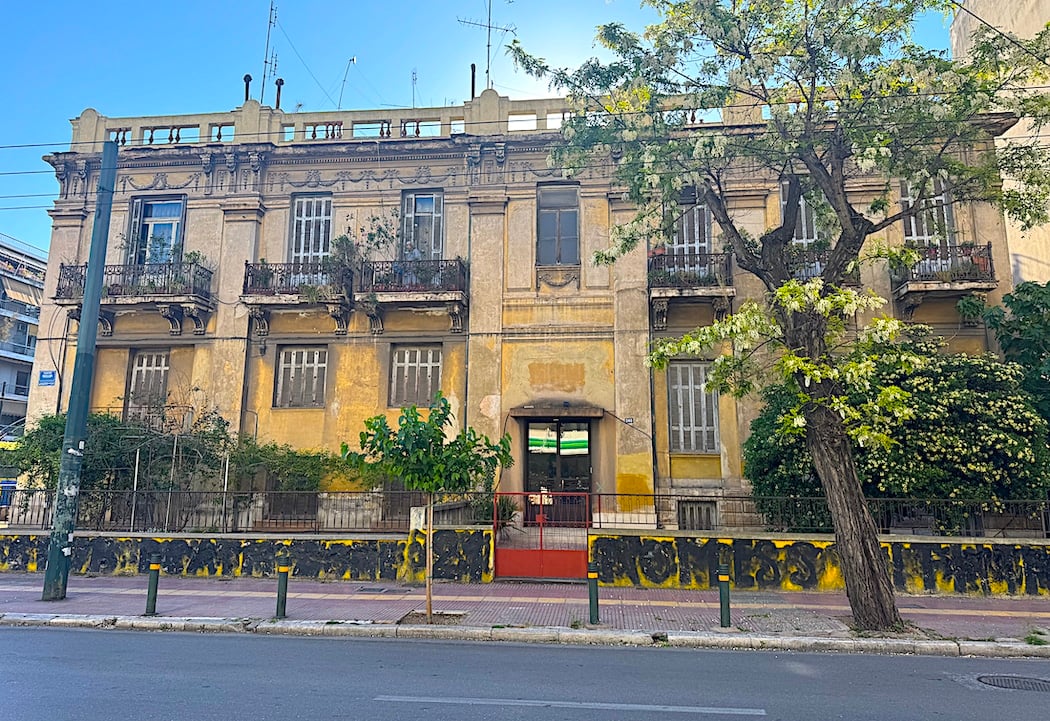

In the heart of Athens, near Victoria Square, stands the oldest apartment block of the Greek capital.
Constructed between 1922 and 1923, the residence at 5, Heiden Street is recognized by architectural historians as the first true “polykatoikia” in the capital.
Designed by the pioneering architect Vasilios Tsagris, the building represents a transition from the neoclassical mansions of the 19th century to the modern urban living that defines Athens today. Unlike the uniform concrete blocks that would dominate the city decades later, this building is a masterpiece of Eclecticism, blending Neoclassical, Art Nouveau, and even Gothic elements.

When it was built, it wasn’t intended for the masses but for the Athenian elite. The apartments featured high ceilings, oak floors, and intricate plasterwork.
It was one of the first buildings to utilize a central staircase and a “light well” (fotagogos) to provide natural light and ventilation to every floor—a revolutionary concept at the time.
While many surrounding historical buildings were demolished during the “antiparochi” construction boom of the 1950s and 60s, 5 Heiden Street survived, eventually being declared a listed monument by the Ministry of Culture.
The building doesn’t just represent architectural history; it represents a social shift. It marked the moment Athenians began moving from single-family homes into shared, multi-story vertical communities.
Today, it remains a “living” part of the city, housing both residences and professional spaces, standing as a silent witness to a century of Athenian history.
While most people associate the Athenian “polykatoikia” with the gray concrete sprawl of the post-war era, 5 Heiden Street reminds us that the concept began with architectural ambition and European elegance.
It remains a rare example of how the city intended to modernize before the pressures of overpopulation took hold.