Christopher Nolan’s upcoming epic The Odyssey is already drawing attention for a detail that some fans say looks more medieval than ancient Greek: the armor. The criticism centers on what appears to be heavy, plated body armor, a style more commonly associated with late medieval European warfare.
After the latest trailer dropped on May 5, excitement quickly spread online over Nolan’s cinematic retelling of the ancient Greek story. The footage offered a dramatic glimpse of Odysseus’ long journey home after the Trojan War, combining mythological creatures, sweeping coastal imagery, and the director’s familiar sense of large-scale spectacle.
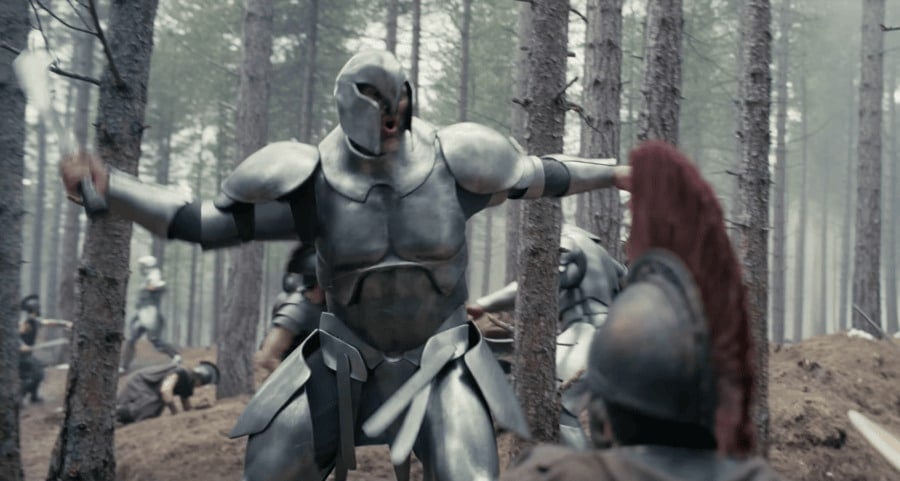
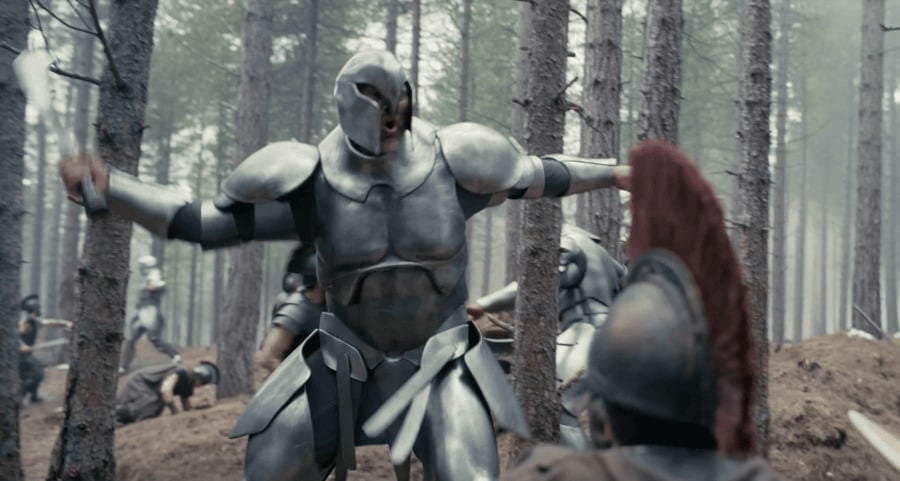
But one image from the production shifted part of the conversation away from the cast and toward the costumes. Viewers on X pointed to what appeared to be heavily plated armor worn by figures believed to be the Laestrygonians, asking whether the design looked closer to medieval Europe than to the world of The Odyssey.
“Who in ancient Greece had full plate armor?” one user asked, capturing the reaction of many who argued that the costume choice seemed out of place for a story rooted in ancient Greek myth.
The debate focuses on the impression that some of the armor shown in The Odyssey resembles full plate armor. That is where the medieval comparison comes from. Full plate armor is usually associated with much later European warfare, particularly the late Middle Ages, rather than the ancient Greek world.
For viewers familiar with Greek military history, the design appears far removed from the bronze helmets, shields, cuirasses, greaves, and other equipment usually linked with ancient Greek warfare. It also seems distant from the Mycenaean and Late Bronze Age setting often associated with the world behind the Trojan War.
The issue, however, is not entirely simple. Homer’s epics are connected with memories of the Bronze Age, but they were shaped through oral tradition and also reflect later Greek cultural elements. That gives filmmakers some space to create a visual world that is not strictly archaeological.
Question: who in ancient Greece had full plate armor? pic.twitter.com/gdWeKOuROX
— Jon Del Arroz | Pop Culture & Gaming
(@jondelarroz) May 5, 2026
The latest reaction builds on earlier criticism of Nolan’s visual choices in The Odyssey. When early footage and images of Matt Damon as Odysseus appeared, some viewers noticed armor that looked closer to later ancient Greek hoplite equipment than to strictly Mycenaean gear.
One earlier point of discussion involved Odysseus’ helmet. Some fans compared it to a Corinthian-style helmet, one of the most recognizable forms of ancient Greek armor. Corinthian helmets were typically made of bronze and covered much of the head and face, with openings for the eyes and mouth and protection over the nose.
In Nolan’s version, however, the helmet appears more open at the front, a choice that may have been made to keep the actor’s face visible on screen. That kind of adjustment is common in historical epics, where visual clarity and performance often compete with strict accuracy.
Agamemnon’s armor has also drawn attention. Earlier footage showed him with a more enclosed helmet that seemed inspired by ancient Greek forms, though some critics argued that it looked unusually thick, dark, and sculpted compared with the brighter and more ornate descriptions often associated with Homeric tradition.
The controversy raises a larger question: should The Odyssey be judged as historical fiction or mythological cinema?
Homer’s epic is not a documentary account of the ancient Greek world. It is a mythological story filled with gods, monsters, giants, witches, sea dangers, and supernatural trials. Odysseus encounters figures such as the Cyclops, Circe, Calypso, the Laestrygonians, Scylla, and Charybdis, moving through a world where realism and fantasy constantly overlap.
That gives Nolan room to create a heightened visual language. The armor may not satisfy viewers looking for archaeological precision, but it could fit a darker, more mythic interpretation of Homer’s world.
Still, the debate matters because Nolan is known for immersive filmmaking, practical effects, and a strong sense of realism. When a director with that reputation takes on one of the most important works of Greek literature, audiences tend to examine every visual detail closely.
Beyond the armor debate, the trailer presents The Odyssey as one of Nolan’s most ambitious projects to date.
Matt Damon stars as Odysseus, the Greek king of Ithaca trying to return home after the fall of Troy. Anne Hathaway plays Penelope, his faithful wife, who waits in Ithaca while pressure grows from the suitors seeking power in Odysseus’ absence.
Robert Pattinson appears as Antinous, the most arrogant and dangerous of the suitors attempting to force Penelope into marriage and seize control of Ithaca. Tom Holland plays Telemachus, Odysseus’ son, whose search for answers about his missing father gives the story an emotional center at home as well as at sea.
The trailer also provides a first look at the Cyclops, rendered with the kind of physical intensity and large-scale realism associated with Nolan’s filmmaking. Its appearance signals that the film will not avoid the mythological core of Homer’s epic.
Rumors that Elliot Page may portray the legendary Greek warrior Achilles in The Odyssey have sparked intense reactions online, with social media users debating the film’s casting choices.
While Page has officially been confirmed as part of the film’s star-studded cast, no studio announcement has verified which character he will play. Nevertheless, speculation surrounding the possible casting of Achilles has fueled debate across social media, with some viewers praising Nolan’s unconventional approach to the ancient epic and others questioning how closely the film will follow traditional interpretations of Greek mythology
Elliott Page is rumoured to play Achilles in The Odyssey pic.twitter.com/fiebwIuQxY
— Z finds movies (@Zfindsmovies) May 9, 2026
Armor is not the only visual detail that has attracted scrutiny. Earlier discussion of Nolan’s The Odyssey also focused on the ships seen in the footage.
Homeric ships are generally imagined as light galleys with a single deck, one sail, and dark hulls, likely because of pitch. They are also often associated with a colored front section and a prominent cutwater projecting from the bow.
Some of Nolan’s ships appear to match parts of that image, including the dark color, single sail, and single-deck structure. However, critics have argued that they lack some features commonly linked to ancient Greek galleys, including the prominent cutwater. Others said the ships looked closer to Viking vessels than to the world of ancient Greece.
That criticism adds another layer to the wider debate over how far Nolan’s film is moving away from historical or literary detail in favor of a broader cinematic style.
Despite the criticism, the trailer’s visual power has already fueled anticipation. The film’s imagery appears closely tied to Greece and the wider Mediterranean, with rugged coastlines, natural light, ancient-looking landscapes, and dramatic sea views helping shape the world of Odysseus.
The footage suggests that Nolan is treating the journey not only as an adventure across the sea, but also as a psychological trial shaped by memory, fate, loss, and survival.
That approach could make The Odyssey feel less like a conventional sword-and-sandals epic and more like a mythic journey through an ancient world where history, legend, and imagination collide.