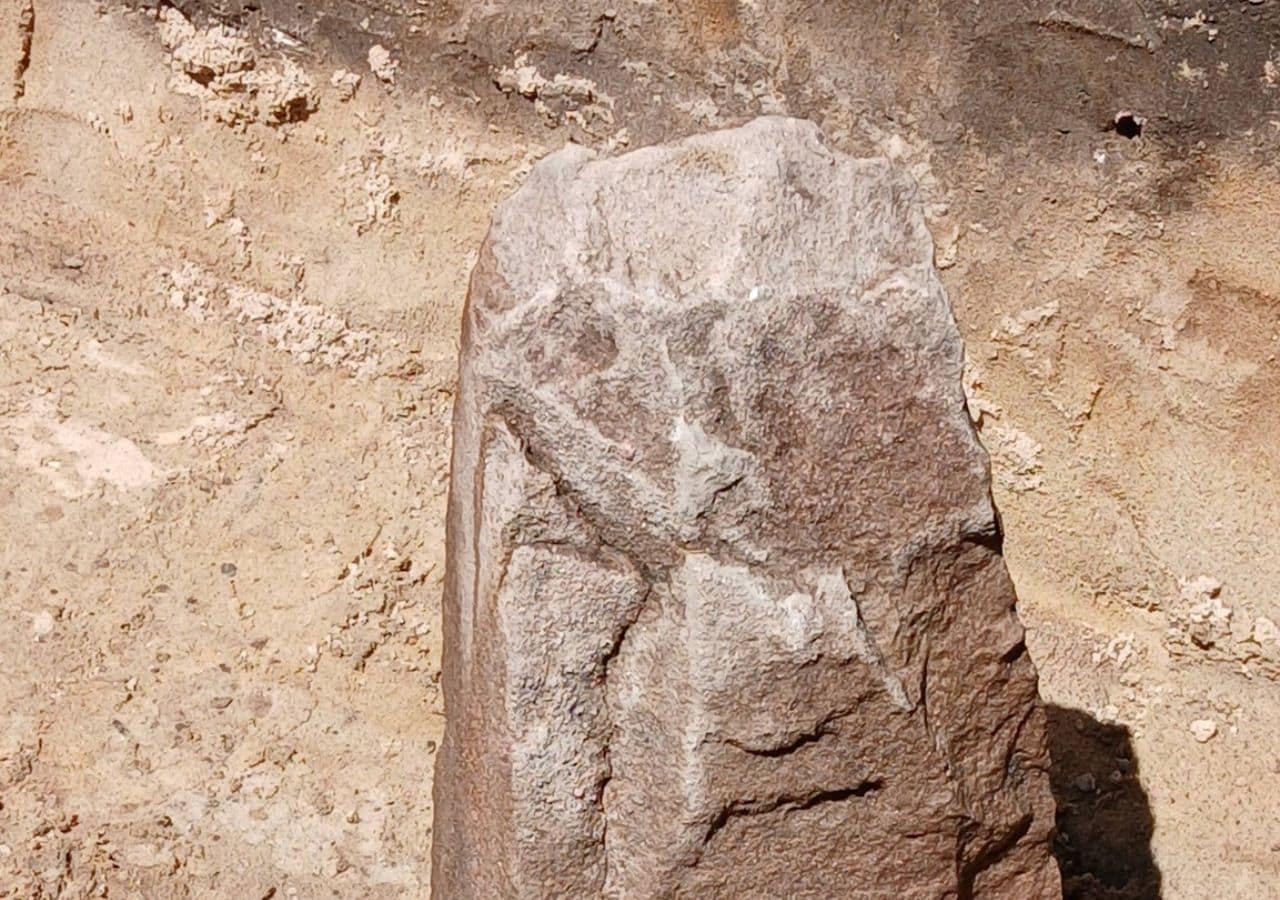
Archaeologists have uncovered a standing stone at Longis Common on the island of Alderney that appears to feature a carved face, adding a notable prehistoric find to a site that has already produced discoveries from multiple periods of history.
Dr. Jason Monaghan, secretary of Dig Alderney, said the stone was found upright in the ground, indicating it was placed there deliberately in prehistoric times. According to Monaghan, the carved face becomes visible under certain lighting conditions, though whether the stone was meant to represent a human figure remains unclear.
The standing stone is believed to date to the European Middle Bronze Age. Monaghan said it may have served as a boundary marker or been used for ritual purposes. Its location near previously found Iron Age graves has also led researchers to consider whether it may have marked a burial site.
The stone is made of local Altonné sandstone and measures at least 1.12 meters (3.7 feet) in length. Its base appears to have been shaped into a rectangular form to keep it anchored in the ground.
The surface is worn and pitted from extended exposure. Researchers plan to examine it for tool marks and carry out dating work in the coming months to determine whether the facial features were deliberately carved or shaped by natural weathering over time.
Groundwater has complicated the investigation. The stone sits about 1.5 meters (4.9 feet) deep, and rising water has blocked access to its base. Getting a fuller picture of how the stone relates to its surroundings would require a much wider excavation, which may be planned for a later date.
Dig Alderney has been working at Longis Common since 2024. Alongside the stone find, researchers extended a trench by 12 square meters (129 square feet) after recovering quantities of prehistoric pottery, flint, and stone tools.
About ten to eleven tools have come from that area, including a small beveled-end piece known locally as a limpet knocker, a name tied to one of its likely uses. Work on a third trench has also begun, where pottery, flint, and what may be a mound have been identified. A fourth trench on higher ground is producing mostly modern material. The team is in its final week on site.
Earlier work at Longis Common turned up Iron Age pottery and ammunition from the German occupation of Alderney during World War II. Excavations are also ongoing at Whitegates and Paddock.
Monaghan said the range of finds confirms the area supported human activity across thousands of years. The team hopes the stone will deepen understanding of Alderney’s prehistoric connections to Brittany and northern France, where comparable stones have been documented.