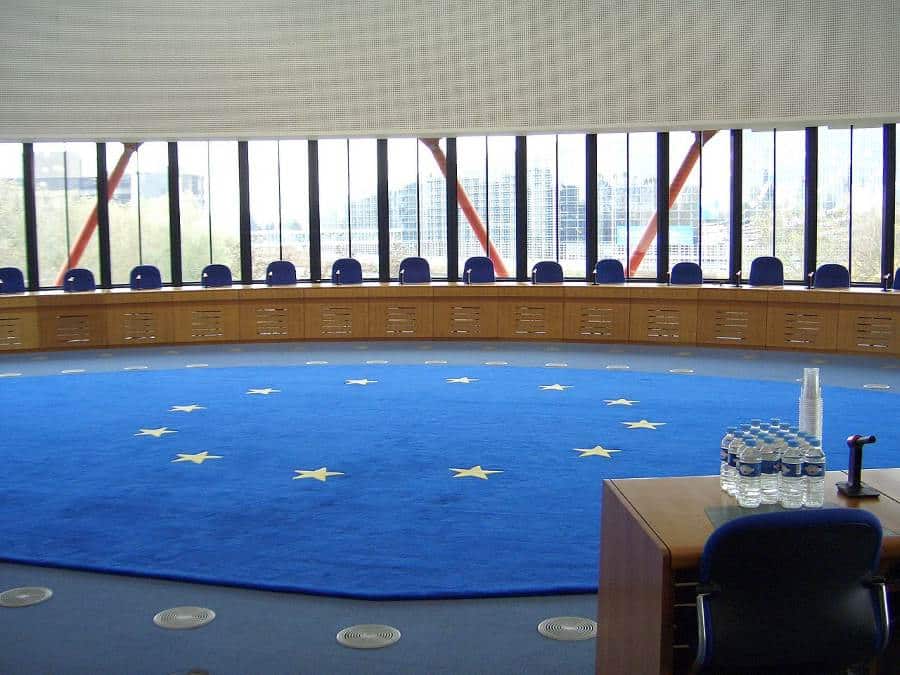
The European Court of Human Rights has condemned Turkey for violating the rights of Greek Orthodox clergy who were barred from seeking election to the administrative boards of minority religious foundations.
The Strasbourg court ruled that Turkey violated freedom of religion and conscience, as well as freedom of association, in a case brought by two clergymen of the Ecumenical Patriarchate. The decision is being described as historic by the Patriarchate’s legal team.
The case was brought by the late Gennadios, born Nikolaos Mavrakis, and Georgios Kasapoglou, both clergymen of the Ecumenical Patriarchate. They had been prevented by Turkish authorities from serving on the boards of Greek Orthodox vakıflar, or community foundations, vital for the survival of the minority group. These religious public benefit institutions manage churches, schools, hospitals, charitable organizations, and other community assets.
Paris Asanakis, legal counsel to the Ecumenical Patriarchate, explained that the legal struggle lasted fifteen years, first in Turkey and then before the European Court of Human Rights. “This is a historic decision,” Asanakis said, noting that it overturns a century-old position maintained by Turkey’s Directorate General of Foundations.
According to Asanakis, Turkish authorities had long argued that the Treaty of Lausanne and its annexes prevented Greek Orthodox clergy from exercising administrative duties in minority foundations. The court found that this position had no basis in statutory law, decree, or other regulatory act.
The ruling is significant because it marks the first time the European Court of Human Rights has found that Turkey violated Article 9 of the European Convention on Human Rights, which protects freedom of thought, conscience, and religion, in a case involving members of the Greek Orthodox community. The court also found a violation of Article 11, which protects freedom of association.
The judges stressed that associations created to protect cultural, spiritual, religious, or minority heritage play an essential role in democratic society. They also underlined that pluralism depends on the genuine recognition and respect of cultural, ethnic, and religious diversity.
Vakıflar are self-governing foundations rooted in the Islamic legal and religious tradition. In the context of Turkey’s non-Muslim minorities, they manage religious, educational, charitable, and community institutions, including churches, schools, hospitals, and homes for the elderly.
During negotiations for the Treaty of Lausanne, the Turkish delegation sought the removal of the Ecumenical Patriarchate from Turkish territory. The institution ultimately remained in Istanbul following strong opposition from Great Britain. The Treaty of Lausanne refers to the Vakıflar in Articles 42 and 43.
In 2008, after an agreement between then-Greek Foreign Minister Dora Bakoyannis and Turkish Foreign Minister Abdullah Gül, Turkey introduced legislation allowing elections for the administrative boards of non-Muslim Vakıflar. However, Turkish authorities continued to deny clergy of the Ecumenical Patriarchate the right to stand for election, allowing only lay members of the Greek Orthodox community to serve. The community’s numbers, however, have continued to decline.
Gennadios Mavrakis had served as headmaster of the Fener High School for Boys, also known as the Great School of the Nation. As a layman, he had participated in the administration of the foundation. After his retirement, he was ordained as a priest and later elected to the governing body of the same institution. Turkey’s General Directorate of Foundations removed him from the list of elected members, claiming that the Treaty of Lausanne barred priests from holding administrative roles.
The appeals also concerned elections to two other foundations: the Church of the Nativity of the Mother of God, also known as the Old Bath Church, in Beşiktaş, and the historic Church of Saints Constantine and Helen in Samatya. Two additional appeals by priests on similar grounds remain pending before the European Court.
The ruling could also have implications for the Balıklı Greek Hosptial Foundation, which manages extensive properties, including a hospital, a nursing home, and the historic monastery. No elections have been held at the Balıklı Foundation for thirty-five years since 1991.