Historian Anthony Kaldellis, Professor of Classics at the University of Chicago, challenges the long-held idea that the Fall of Constantinople in 1453 was inevitable, arguing that the siege should be understood through the specific military and tactical factors that shaped its outcome.
Speaking to Greek Reporter about his new book, 1453: The Conquest and Tragedy of Constantinople, Kaldellis explains that historians cannot prove that an event was inevitable because they have only one historical timeline to go by. “In a sense, nothing in history is inevitable,” Kaldellis tells Greek Reporter. “We can’t go back and run experiments to see if we change certain variables what would happen.”
His argument is directed against the idea that Constantinople’s fall was inevitable, a view he noted appears across scholarship, novels, journalism, and online commentary. Rather than reading 1453 backward from its outcome, Kaldellis argues that the event should be examined through the variables that determined the result “one way or another.”
The “aura of inevitability” surrounding the Fall of Constantinople, Kaldellis points out, is partly the result of the fact that the city did fall. Because later readers know the outcome, they often assume it had to happen. He also pointed to the way some eyewitness sources presented the final stages of the siege. As the fall approached, these accounts increasingly framed events through omens, signs, miracles, and a sense of preordained tragedy.
“These are literary devices,” Kaldellis maintains, explaining that historians in retrospect often dramatized events through supernatural signs rather than focusing on the precise military mechanisms at work. In his account, this has helped obscure the actual dynamics of the siege. The defenders of Constantinople, he emphasized, successfully repelled the various types of attacks launched by Sultan Mehmed II.
Kaldellis rejects the idea that the defense of Constantinople was merely a desperate or doomed effort. Mehmed II, in his account, was inventive and launched numerous types of attacks, but nearly two months passed without a breakthrough. One of the aims of the book is to restore balance to the historical picture by showing that Mehmed himself was under serious pressure.
Rather than presenting the Ottoman victory as a foregone conclusion, Kaldellis characterizes the final assault as a last major attempt by the Ottoman ruler to force a result. “What happened at the end was a last-ditch effort for him to throw everything that he had at the city and hope that through some accident or whatever he prevailed,” the professor explains. The outcome, he added, was “very, very close.”
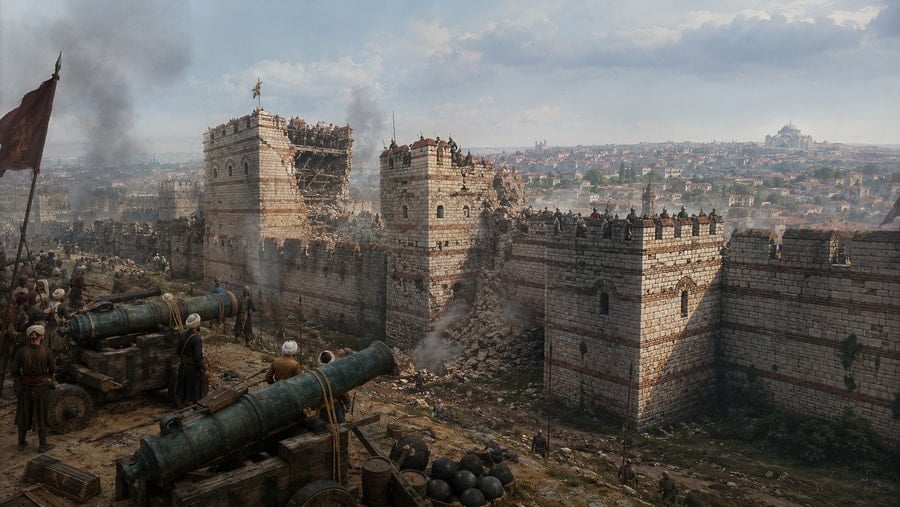
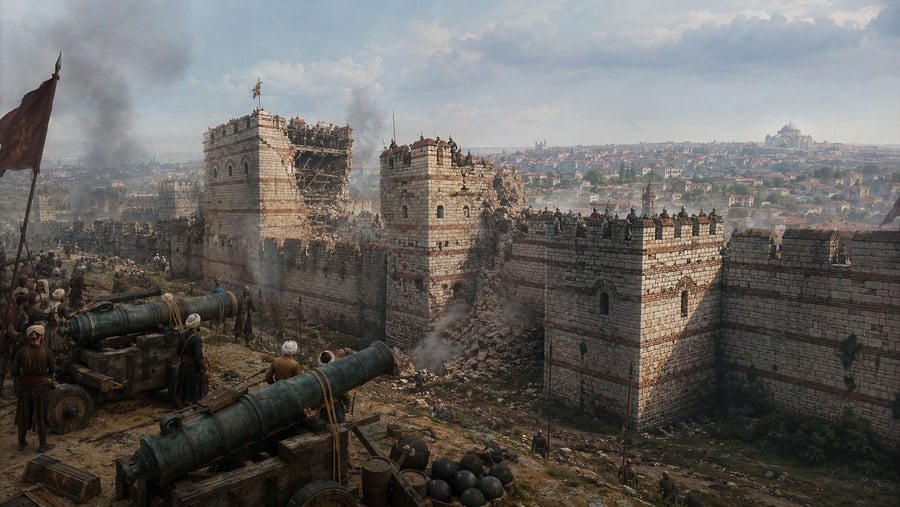
The decisive factor, according to Kaldellis’ account, was the prolonged Ottoman bombardment of Constantinople’s land walls. “What I think made the difference in the end were the cannons that reduced the walls to rubble,” he said. The bombardment allowed Ottoman soldiers to try to swarm through breaches in the walls, something that had not happened in their thousand-year history.
Kaldellis distinguishes between the walls being overcome in the traditional sense and being destroyed by artillery. In his account, the land walls of Constantinople were not simply surmounted by a land army. They were blown apart after a prolonged bombardment. “So I think that the bombardment of the walls over two months…was ultimately that which made the difference,” he said.
Emperor Constantine XI Palaiologos appears to have made the top-level decisions in the city’s defense, according to Kaldellis. One of his most noteworthy decisions was to delegate military command to the people most capable of handling the most vital sectors of the defense. The Venetians were placed in charge of the harbor, while the Genoese commander Giovanni Giustiniani and his heavily armored men were assigned to the critical section of the land walls.
“Constantine put the most capable people in charge of the most critical areas of the defense,” Kaldellis said. The defenders also sealed off the harbor with what is often described as a chain. Kaldellis further explains that it was technically closer to a boom made of wooden blocks connected by iron bands or chains. This helped limit the city’s exposure to attack along the sea walls and allowed the defenders to concentrate their limited manpower on the most important land-wall sector around the Romanos Gate. For Kaldellis, this was essentially the strategy available to the defenders, and they followed it for most of the siege.
Mehmed II and the Ottoman army faced major difficulties before finally taking Constantinople. One problem was that the Ottomans could not make effective use of cavalry, one of the strongest elements of their army, against the city’s defenses. Another issue was at sea. When several Genoese ships and one ship belonging to the emperor arrived in late April, the Ottoman fleet was unable to stop them from entering the harbor with supplies and reinforcements. “They were completely outmatched at sea,” Kaldellis concludes.
Although the Ottomans had superior numbers of infantry, that advantage was limited as long as the soldiers could not directly engage the defenders behind the walls. The walls of Constantinople were probably the greatest tactical obstacle facing Mehmed. No land army had ever been able to overcome them from the land side. In that sense, Kaldellis argues, even Mehmed did not overcome them in the usual meaning of the word. They were “blown to pieces” rather than surmounted.
The siege also placed serious financial and political pressure on Mehmed II. The Ottoman ruler had assembled a large army with extensive equipment, and every additional day increased the cost of the operation. Kaldellis reveals that, in his book, he calculates how much of the empire’s economic output was being poured into the campaign.
Each failure also appears to have produced recriminations and internal tension in the Ottoman camp and court. A preserved letter, he noted, reveals internal bickering and doubt. Mehmed was still a young ruler and had placed much of his authority behind the success of the siege. Failure would have put him in a very difficult position. “So he was under a lot of stress,” Kaldellis asserts.
One of the broader conclusions of Kaldellis’ book is that 15th-century Constantinople had adapted to the world around it. The city was surrounded on land by the Ottoman Empire and was also tied to Italian trading routes that passed through the straits, connecting the Black Sea and the Mediterranean.
Constantinople had found a way to maintain its significance as a place of Orthodox faith, Hellenic scholarship, and Roman imperial prestige. He notes that even Western Europeans recognized its ruler as an emperor, despite the fact that he controlled very little territory by that point. “So Constantinople had adapted,” he asserts. “It was not a place that was just kind of waiting for history to come along and sweep it away, necessarily.”
The aftermath of the conquest is another part of the story that Kaldellis believes needs to be understood more clearly. The city was not simply conquered and immediately smoothly transformed into the capital of the Ottoman Empire. “No, it’s emptied out,” Kaldellis remarks. “Its entire population is removed and enslaved, and the city has to begin from scratch again.” Constantinople then had to be rebuilt with people brought in by the sultan, a process that took quite a while.
Kaldellis also notes that Mehmed does not appear to have immediately decided what he was going to do with Constantinople. For a few years, the city’s fate remained precarious. The city’s history, he reveals, was “paused” and then “reset” and “it wasn’t a smooth transition.” In Kaldellis’ reading, 1453 was not the inevitable end of a doomed city but a close siege whose outcome depended on artillery, strategy, political pressure, leadership, and chance.