
The invasion of the Byzantine Empire by the Normans is a fascinating chapter of Roman history that is often overlooked.
Imagine descendants of Viking raiders, now known as Normans after settling in northern France, setting their sights on southeastern Europe and threatening the Eastern Roman (Byzantine) Empire. Eager to expand their influence beyond their French territories, these ambitious warriors turned their attention to the wealthy Byzantine lands. What followed was a century-long struggle that would fundamentally reshape the balance of power in medieval Europe.
The first signs of trouble appeared around AD 1017, when small groups of Norman knights began turning their attention toward southern Italy, initially in search of mercenary work. The Byzantines, who still controlled significant territories on the Italian peninsula, believed these foreign fighters could prove useful in defending their holdings. After all, they needed additional manpower to deal with local rebellions as well as the frequent Arab raids originating from Sicily.
What the Byzantine administration failed to grasp early on was that the Normans came from a culture that placed extraordinary value on land acquisition above almost everything else. In Normandy, in northern France, younger sons were often left landless due to inheritance laws that favored the eldest child. Southern Italy, with its patchwork of competing communities and loosely defined borders, therefore looked like an ideal opportunity for expansion.
The Byzantines would learn this lesson the hard way. Within a few decades of their arrival, the Normans—initially seen as hired help—had begun establishing permanent bases across the region. Although Norman groups often fought one another in the early years, a more unified front gradually emerged. They would accept Byzantine payment for military service, only to use their positions to seize territory for themselves and steadily challenge Byzantine authority throughout the region.
A man who would play a crucial role in what followed was Robert de Hauteville, better known as Robert Guiscard, “the Cunning.” This Norman was not the eldest son nor was he especially wealthy, and he was certainly not expected to carve out lands and establish his own realm. Nonetheless, he did so anyway.
Guiscard arrived in southern Italy around AD 1047 and immediately set about strengthening and consolidating Norman power. He possessed an almost uncanny ability to turn enemies into allies and allies into subjects. Through a combination of strategic marriages—a common practice at the time—military strength, and sheer boldness (which others might have called recklessness), he gradually unified the fragmented Norman factions under his leadership.
It would take until AD 1071 for Byzantine Italy to finally collapse. Guiscard captured Bari, the last major Byzantine stronghold on the Italian peninsula. For the Byzantines, the loss was deeply symbolic. For more than five centuries, the Eastern Roman Empire had maintained a presence in Italy, a living link to the legacy of the Western Roman Empire and the origins of the Roman world itself. That connection was now severed by a band of opportunistic outsiders.
The conquest of southern Italy was only the beginning for the Normans. Robert Guiscard’s ambitions extended far beyond the Italian peninsula. His ultimate goal was Constantinople itself. In AD 1081, he launched what can only be described as one of the most audacious military campaigns of the Middle Ages.
The plan was bold in scope. Guiscard intended to cross the Adriatic Sea, establish a beachhead in what is now Albania, and then march overland toward the Byzantine capital through northern Greece. His first objective was Dyrrhachium, the critical fortress controlling access to the main route into the Greek mainland.
Emperor Alexios I Komnenos suddenly found himself confronting a nightmare scenario. The Normans had already demonstrated their ability to seize and hold territory, and now they were effectively at his doorstep, threatening the survival of the Byzantine Empire itself. To make matters worse, his army was a patchwork force of mercenaries, including (ironically) Anglo-Saxon refugees who had fled the Norman conquest of England.
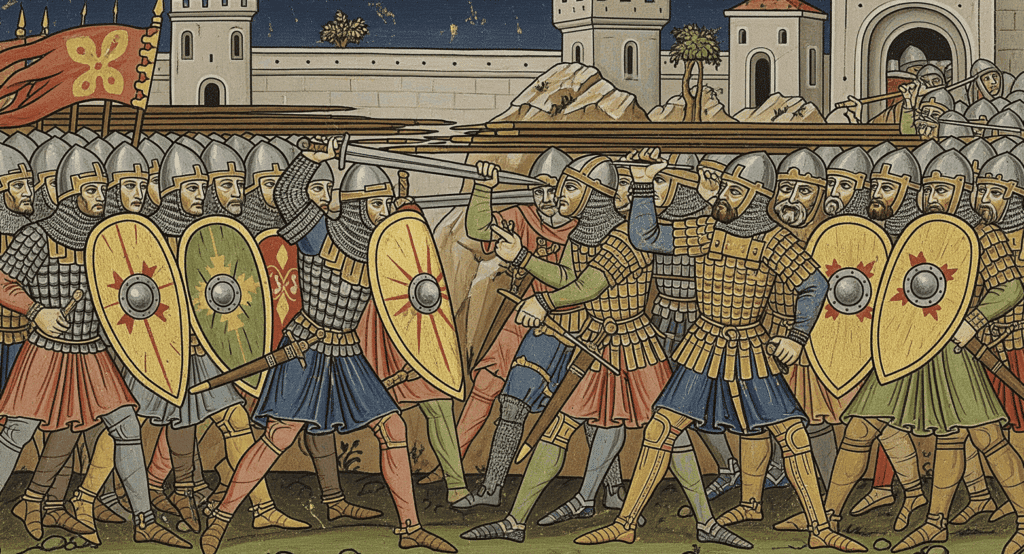
The Battle of Dyrrhachium in October AD 1081 proved disastrous for the Byzantines. Guiscard’s tactical skill, combined with his son Bohemond’s aggressive cavalry charges, shattered the imperial army. The road to Constantinople lay open, and for a brief moment, it seemed as though the thousand-year-old Eastern Roman Empire might actually fall to these descendants of Viking raiders.
Alexios I was many things, but he was not a man to surrender easily. Faced with the possibility of total collapse, he executed one of the most impressive diplomatic maneuvers of the medieval world. First, he effectively bribed the Holy Roman Emperor Henry IV to attack Norman territories in Italy, forcing Guiscard to divide his attention across two fronts. Then, in a move that would have lasting consequences, he granted extensive trading privileges to Venice in exchange for naval support against the Normans.
These concessions were enormous for an empire like Byzantium. The commercial rights awarded to Venice would eventually help transform the city-state into one of the wealthiest powers in Europe, often at Byzantium’s own expense. However, in AD 1082, Alexios was fighting for survival, and generosity was not a choice but a necessity.
The strategy worked—but only just. Guiscard was compelled to return to Italy to confront the German intervention, leaving Bohemond to continue the eastern campaign against Constantinople. What followed was several years of brutal mountain warfare across the Balkans, with neither side able to secure a decisive victory and both remaining locked in a tense stalemate.
Although Robert Guiscard’s ambition to destroy the Byzantine Empire ultimately failed, the Norman-Byzantine conflict did not end with his death in AD 1085. A few years later, Bohemond attempted to revive the campaign in AD 1107, launching another invasion that also ended in failure. The final (and perhaps most devastating) Norman assault came in AD 1185, when a joint Norman-Sicilian force captured and sacked Thessaloniki, the empire’s second-largest city.
The events in Thessaloniki were brutal. Contemporary sources describe widespread slaughter of civilians and the systematic destruction of the city. The scale of devastation shocked even medieval observers, who were accustomed to the violence of war. For the Byzantines, the psychological impact was profound. It demonstrated that no part of the empire was truly safe from Norman ambition, as even its greatest cities could fall to such overwhelming force.
The Norman campaigns against Byzantium had consequences that extended far beyond Thessaloniki. They helped establish a powerful Catholic kingdom in southern Italy that would remain a persistent rival to the Byzantine Empire for centuries. More importantly, they drained Byzantine resources at a time when the empire was increasingly pressured by Turkish advances in the east.
The prolonged conflict also deepened the divide between the Greek Orthodox and Roman Catholic worlds, turning former Christian counterparts into bitter adversaries. The Normans saw themselves as champions of Latin Christendom, while the Byzantines regarded them as little more than barbarian raiders. This growing hostility would ultimately culminate in the Fourth Crusade, when Crusader forces turned against Constantinople itself and sacked the city.
Even today, traces of this once-forgotten conflict remain scattered across the Mediterranean. Norman castles still stand along the coastlines of southern Italy and Sicily.