
Al-Masudi, the “Herodotus of the Arabs”
Categories:


It is difficult to overstate just how unusual and ingenious Al-Masudi was for his time.
Most history written in the 10th century is what we would consider “conventional” history. It consists of lists of kings, battles, and religious lineages, page after page of people remaining in one place, explaining why they were in power and why they should be remembered. Then there was Abu al-Hasan ‘Ali al-Mas’udi, a historian born in Baghdad as the 9th century was drawing to a close.
Al-Masudi seems to have decided that sitting still was a waste of life and that historians, up to that point, had largely overlooked what mattered most. Western textbooks often refer to him as the “Herodotus of the Arabs,” one of those labels we tend to apply to make unfamiliar figures feel more recognizable. Yet Al-Masudi was not looking to the past for inspiration. He was a geographer, a philosopher, and a wanderer who appeared to believe that if you had not seen a place with your own eyes, you had little business writing about it. He called this autopsia, or eyewitnessing.
That idea may sound obvious today, but at the time it was a radical position. While many of his contemporaries remained comfortably in the libraries of the Abbasid Caliphate, recycling familiar accounts, Al-Masudi was sailing across the Indian Ocean. He was traveling to the far reaches of China. He was exploring the shores of the Caspian Sea. Rather than relying solely on official court records, he wanted the details of everyday life—the food, the landscapes, the unusual local customs. Before writing about a place or an event, he wanted to experience it firsthand.

When reading The Meadows of Gold and Mines of Gems (a title that certainly does not lack confidence), one does not encounter the usual historiographical treatise. Instead, one finds a vast, sprawling attempt to explain the entire world in a single work.
Al-Masudi wrote about the Slavs. He explored the religions of India. He did not simply dismiss such subjects as “barbarian” curiosities or regard distant peoples and events as too remote to be useful or interesting. Instead, he did his best to understand the rationality behind them. In doing so, he shifted the focus of history from “who begat whom” to “how do people actually live?” By modern standards, his work resembled early anthropology more than a conventional chronicle.
He also had a fascinating and complex relationship with the Byzantine Greeks. To him, they were the “Rumi.” He respected them but largely because he viewed them as the heirs of the Ancient Greeks. Al-Masudi admired the Greeks—Aristotle, Galen, and the rigorous logic of the Hellenistic world. Yet when he looked at the Byzantines of his own day, his assessment was far less favorable. In essence, he believed they had lost sight of that intellectual legacy.
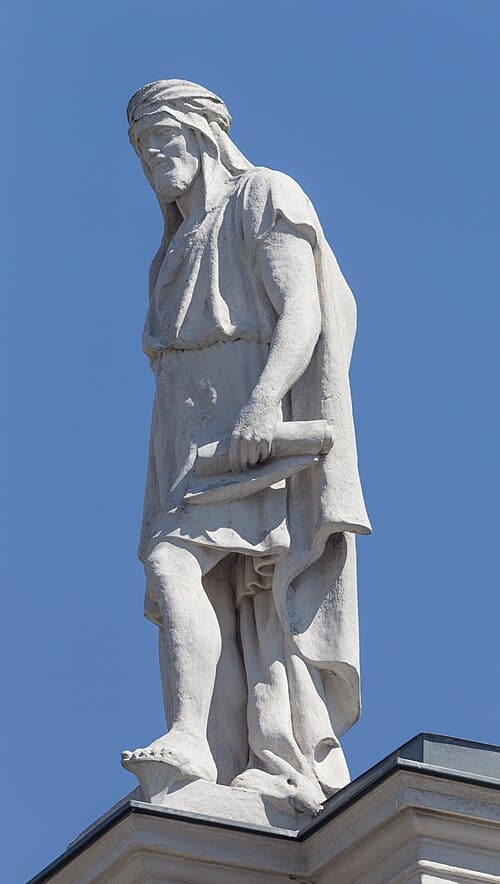
He argued that in embracing increasingly complex Christian theology, the Greeks had abandoned the scientific rigor of their ancestors. It was a sharp and far-reaching critique. It also serves as a reminder that the Mediterranean was never a barrier. It was a messy, porous frontier where ideas were constantly exchanged, borrowed, and debated. It was a sea that connected rather than separated.
We like to think we invented the idea of the “global citizen,” but Al-Masudi arrived at it nearly a thousand years earlier. We live in an age when history is often used as a blunt instrument, a way to draw lines on a map and declare, “We were here first.” Al-Masudi’s work offers an alternative perspective. He was fascinated by connections rather than divisions and understood that truly knowing who you are requires, at least for a time, seeing the world through someone else’s eyes. It means looking at the “other” and recognizing a person rather than a caricature.
Al-Masudi looked at a fragmented world filled with competing empires and diverse peoples and sought to weave it into a single narrative, ultimately rejecting the dry historical lists of his time in favor of a radical, eyewitness approach that documented cultures across the known world.