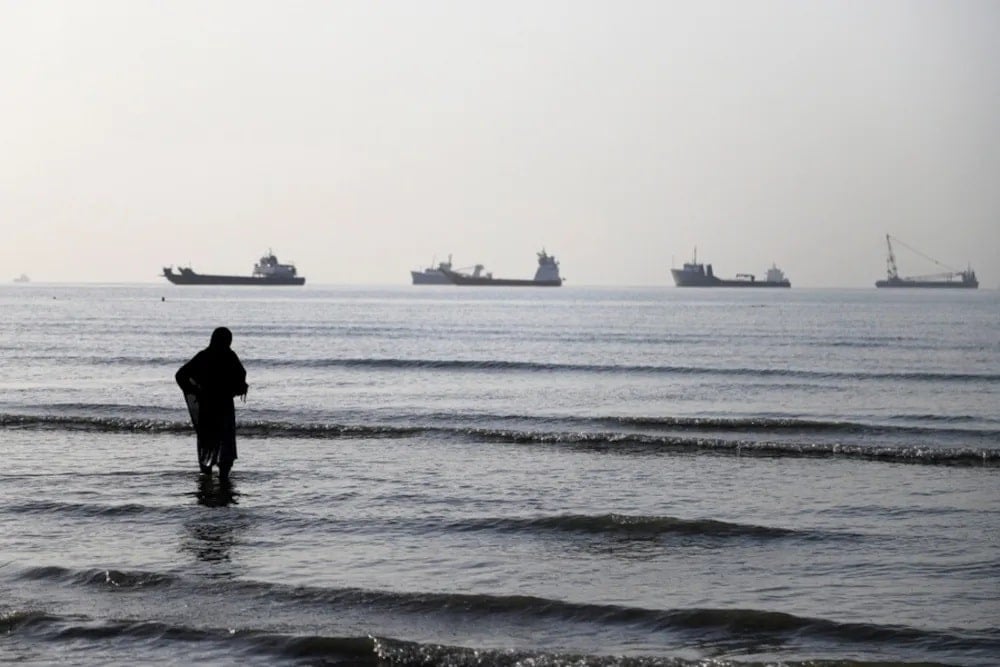
US and Iran exchanged strikes on targets in the Straits of Hormuz on Thursday and Friday and accused one another of violating the terms of a ceasefire that was agreed on last week.
As a consequence of the new strikes, the UN’s International Maritime Organization (IMO) paused its planned evacuation of more than 11,000 seafarers stranded in the shipping lane.
The strait was reopened as a result of an interim truce deal between the US and Iran earlier this month, whereby the two countries agreed to end hostilities under a 14-point memorandum of understanding that called for Iran to use its “best efforts for the safe passage of commercial vessels with no charge for 60 days”.
Earlier this week, Iran’s Islamic Revolutionary Guard Corps (IRGC) warned that attempts to evacuate the strait along the route designated by the IMO would be “unacceptable and completely dangerous” and vessels should coordinate with Tehran instead.
The U.S. military attacked Iran on Friday in response to an Iranian drone strike on a cargo ship the day before.
“U.S. aircraft struck Iranian missile and drone storage locations and coastal radar sites after Iran hit M/V Ever Lovely on June 25 with a one-way attack drone,” U.S. Central Command (CENTCOM) said in a statement accompanied by a grainy black-and-white video of an explosion labeled “unclassified.”
The Singapore-flagged cargo ship M/V Ever Lovely was exiting the Straits of Hormuz along the Omani coast at the time it was attacked by Iran.
Tehran, however, has claimed that a projectile struck the area around a pier in Sirik in southern Iran, and that Iranian naval forces responded to the incident by striking U.S. military targets in the region, Reuters reports.
https://t.co/CckXLJSpah pic.twitter.com/NoMQ7cNtN5
— U.S. Central Command (@CENTCOM) June 27, 2026
“The unwarranted aggression against commercial shipping by Iranian forces clearly violated the ceasefire. Furthermore, Iran’s dangerous behavior undermined freedom of navigation as commerce increasingly flows through the vital international trade corridor,” CENTCOM commented on X.
Meanwhile, Israel and Lebanon signed a framework agreement in Washington on Friday following talks to end the fighting between Israel and Iran-backed Hezbollah militants. The Israel-Hezbollah conflict broke out in early March, when the armed group launched air and ground attacks on Israel days after the U.S. and Israel attacked Iran.