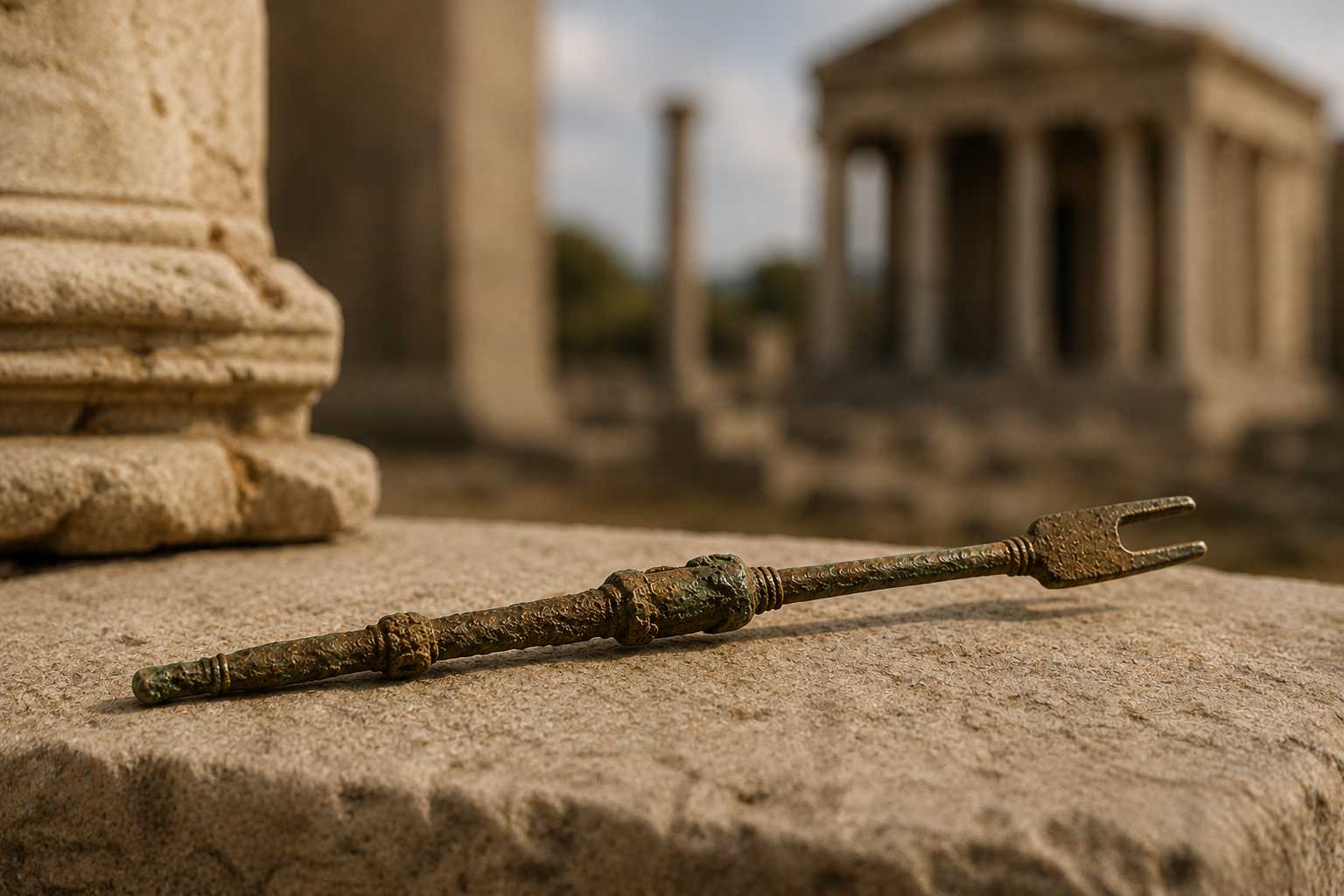
Archaeologists have uncovered an exceptionally rare ancient surgical instrument once used to remove bladder stones during excavations at the ancient Greek city of Heraclea Sintica (Greek: Ἡράκλεια Σιντική) in southwestern Bulgaria.
The discovery was announced Friday by excavation director Dr. Lyudmil Vagalinski, who said the artifact was found inside a room next to the Temple of Hercules. Researchers believe it is one of the rarest medical instruments ever recovered from the ancient world.
According to the available scientific literature, only one comparable example has previously been identified, in Italy. The discovery offers rare evidence of the advanced surgical knowledge practiced by physicians during the Roman era.
Dr. Vagalinski identified the artifact as a lithoulkos, a specialized Greco-Roman instrument used by ancient surgeons during operations to remove bladder stones.
Bladder stone surgery was considered one of the most difficult and dangerous medical procedures of antiquity. Even so, doctors operated because untreated stones could cause severe pain and other serious complications.
Although incomplete, the newly discovered instrument has survived remarkably well. Archaeologists recovered its bronze handle, which is decorated with embossed rings. The curved hook tips that formed the working end of the tool have not survived.
Researchers say the artifact provides valuable insight into the design of ancient surgical equipment and the specialized skills required to perform complex operations.
Dr. Vagalinski said the discovery reflects the high standard of medical care available in Heraclea Sintica during the first three centuries of the Roman Empire, when the city experienced significant economic growth.
Archaeologists have uncovered an exceptionally rare Roman-era surgical instrument used in bladder stone surgery at the ancient Greek city of Heraclea Sintica in Bulgaria.#Greekcity #AncientGreece pic.twitter.com/J4fFHDCrRc
— Tom Marvolo Riddle (@tom_riddle2025) July 3, 2026
Ancient physicians used a wide range of surgical instruments, including scalpels, needles, curettes and spoons. However, highly specialized tools such as the lithoulkos are rarely found, making the discovery especially significant.
Researchers believe only a well-trained surgeon would have been capable of performing the delicate bladder stone procedure using such an instrument.
Ancient Roman author Pliny the Elder described bladder stones as among the most painful medical conditions. Researchers also point to the 3rd-century B.C. physician Ammonius of Alexandria, who is credited with developing a surgical method for removing bladder stones and designing specialized instruments for the operation. His work earned him the nickname “Lithotomos,” or “The Stone Cutter.”
The location of the discovery has prompted archaeologists to explore whether the building served a medical purpose alongside its religious role.
Dr. Vagalinski said the room’s position beside the Temple of Hercules supports a working hypothesis that pilgrims seeking healing through the cult of the mythical hero may have received treatment there.
Researchers stress that the idea remains preliminary. They expect a clearer understanding of the room’s function after analyzing all of the artifacts recovered during the excavation. The instrument has been stratigraphically dated to the 3rd century A.D.
Excavations at the site are continuing with a team of seven archaeologists and 34 workers. Heavy machinery is being used to remove thick river sediments around the temple before archaeologists continue careful manual excavations to document the surrounding architecture and uncover more evidence about the ancient complex.