
In Ancient Greece and Rome, pets occupied a cherished place in daily life, valued for companionship, loyalty, and even status. Literary sources, inscriptions, and archaeological finds reveal that these animals were more than laborers. They were friends, confidants, and sources of affection.
Alongside guard dogs and mousers, households kept songbirds, monkeys, and other curious creatures. In this way, animals became integral to the rhythms of daily life, inspiring grief, pride, humor, and devotion. Even in societies often imagined as stern and heroic, tenderness toward animals flourished.
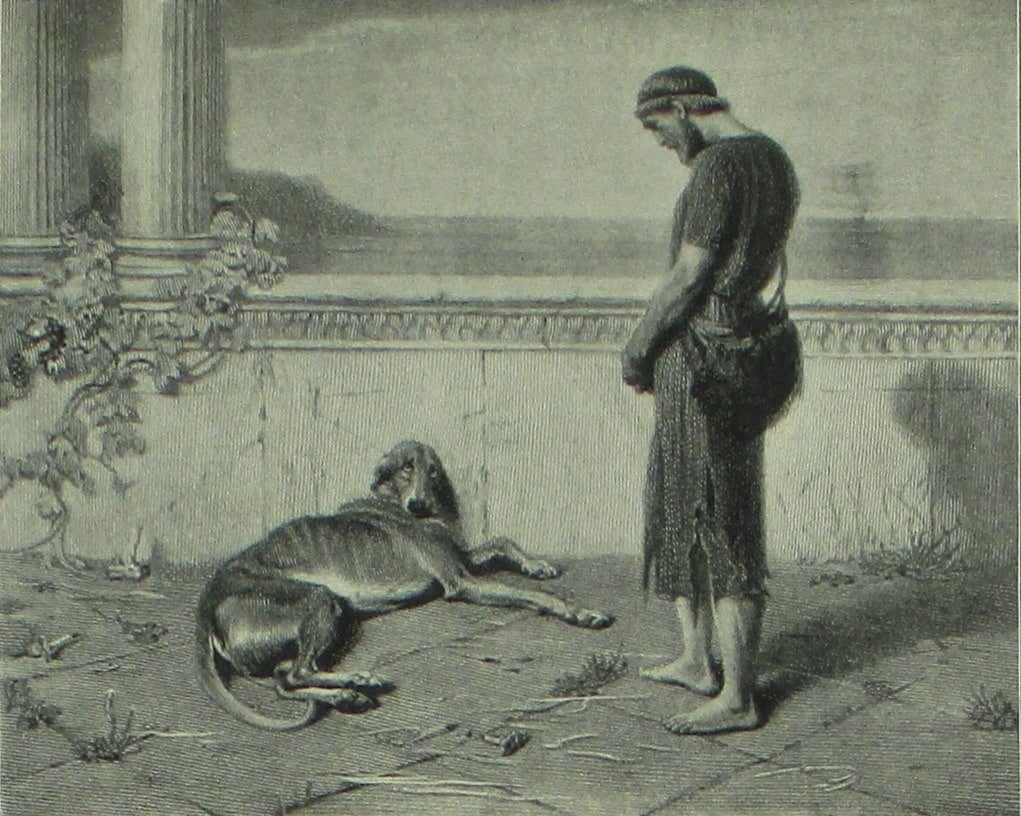
To begin with, Greek literature offers one of the most moving examples. In Homer’s Odyssey, Odysseus returns to Ithaca after twenty years of absence. His palace lies overrun by suitors. Disguised as a beggar, he enters unnoticed. Even so, his old dog Argos recognizes him at once. Argos, once a swift hunting hound, now lies neglected on a dung heap. He lifts his head, wags his tail, and dies after seeing his master again. Homer uses no elaborate ornament. Instead, he simply shows a bond that time and hardship could not erase. Argos embodies loyalty beyond glory and war.
Greek literature offers one of the most poignant examples of the bond between humans and pets. In Homer’s Odyssey, Odysseus returns to Ithaca after twenty years of absence to find his palace overrun by suitors. Disguised as a beggar, he enters unnoticed, but Argos recognizes him instantly. Once a swift hunting hound, he now lies neglected on a dung heap. Argos lifts his head, wags his tail, and dies after seeing his master again. Homer offers no elaborate ornamentation; he simply portrays a bond that neither time nor hardship can erase. Argos embodies loyalty that transcends glory and war.
Beyond epic poetry, Ancient Greek grave markers demonstrate that such affection extended into everyday life, much as it did in Rome. In Attica, families erected stelai for cherished dogs. One commemorates a dog named Parthenope, while another is in remembrance of a small Maltese dog. These epitaphs speak in intimate tones, addressing animals as friends and companions and expressing sorrow without irony. The investment of money and artistry in these memorials highlights emotional depth rather than mere utility, showing that pets held a genuine place in family life.
Children, too, often formed close bonds with pets in Ancient Greece and Rome. Vase paintings depict young girls cradling doves or small dogs and boys playing with puppies or pet hares. Collectively, these images suggest domestic intimacy and indicate that pets served as companions during formative years. Aristotle even remarked on children’s fondness for animals, recognizing that affection for pets contributed to ethical development.
Birds also occupied a special place in households. Songbirds, such as nightingales and blackbirds, delighted owners with music, while wealthier families imported exotic parrots from India or Africa. These birds fascinated onlookers and signaled both status and access to far-reaching trade networks. In the Hellenistic world, as commerce expanded across the Mediterranean, pets and other animals traveled alongside spices, textiles, and other coveted goods, becoming part of a sophisticated, interconnected cultural landscape.
In Rome, as in Ancient Greece, the appreciation of pets intensified most particularly through the display of exotic animals. Elite households proudly showcased monkeys, peacocks, and rare birds. Martial, the sharp Roman epigrammatist, wrote tenderly about a little dog named Issa, who belonged to his friend Publius. Martial described the dog as playful, pure, and beloved, claiming that her portrait would preserve her charm forever. His poem blends wit with sincerity, treating Issa as a cherished member of the household.
Archaeological evidence further reinforces this view. In Pompeii, mosaics depict small dogs guarding thresholds, including the famous warning “Cave Canem.” Yet beyond their role in protection, other finds reveal lapdogs curled in domestic scenes. Excavations uncovered collars bearing either the owner’s name or affectionate messages. Together, these objects testify to personal attachment rather than mere practicality.
Similarly, Ancient Romans honored pets through funerary inscriptions. One epitaph commemorates a dog named Margarita, praising her loyalty and sweetness. Another stone mourns a parrot that delighted its mistress. In these cases, memorials reveal grief that mirrors human loss. By immortalizing animals in stone, owners framed memory as enduring and dignified.

A particularly vivid example from Roman history illustrates the playful and prestigious role of pets. In Rome, much like in Ancient Greece, animals—whether dogs, birds, or other companions—could serve both as companions and sources of entertainment. According to the historian Macrobius, after the Battle of Actium in 31 BC, Octavian returned to Rome in triumph. Amid the celebration, a man approached him with a trained raven that, on command, proclaimed, “Hail Caesar, the victorious commander.” Octavian delighted in the spectacle and paid the owner twenty thousand sesterces for the bird.
The man had a partner who expected a share of the payment, but the first trainer vanished without delivering. The betrayed partner therefore sought justice, presenting another raven to Octavian. This bird greeted him with, “Hello Antony, the victorious commander.” The trainers had anticipated either outcome at Actium, preparing whichever bird matched the victor.
Remarkably, Octavian responded with amusement rather than anger, purchasing the second raven as well. Later, a shoemaker attempted to train his own raven to impress Augustus and earn a reward, but despite repeated efforts, the bird refused to cooperate. Frustrated, the shoemaker exclaimed repeatedly, “Nothing to show for the trouble and expense!” The raven quickly learned to mimic the complaint, much to the emperor’s delight.
When the shoemaker finally presented himself before Augustus, the raven screeched its famous line, prompting laughter from the emperor and a generous reward for the trainer. In this episode, pets became instruments of humor and prestige, demonstrating that even imperial dignity could bend before the wit of an avian companion.
In both Ancient Greece and Rome, pets played meaningful roles across social strata, from emperors to ordinary citizens. Even rulers embraced unusual companions. According to Suetonius, Tiberius cherished a pet snake, feeding it with care, while Caligula allegedly adored his horse, Incitatus.
Beyond the imperial court, ordinary Romans kept more modest pets. Ferrets hunted rodents in homes, and mice and dormice served both as pets and delicacies. Tortoises wandered courtyards, while snakes occasionally lived in household shrines as guardians of the genius loci. In these contexts, animals bridged sacred and domestic space, embodying protection and continuity.
Trade networks further facilitated this diversity. Rome’s empire stretched across continents, enabling merchants to transport peacocks from Asia Minor. Exotic pets symbolized wealth, cosmopolitan taste, and access to distant lands. Yet simpler animals such as dogs and doves crossed class boundaries, showing that affection for pets did not depend solely on status.
Philosophers also reflected on human–animal relationships with nuance. Plutarch argued for kindness toward animals and suggested that abstaining from meat represented an ideal ethical stance. He criticized cruelty in spectacle and hunting. Although he did not equate pets fully with humans, he recognized their capacity for feeling, indicating a moral awareness that extended beyond mere utility.

In both Ancient Greece and Rome, the language of epitaphs often mirrored human grief, reflecting the deep bonds between people and their pets. Owners described animals as sweet, faithful, and gentle, mourning their shortened lives while promising remembrance. Through such vocabulary, strict boundaries between species softened, and affection emerged as both natural and honorable.
Attachment to animals also appeared in military contexts. Roman soldiers sometimes adopted stray dogs near camps, and inscriptions from frontier regions record pets with affectionate nicknames. These small traces hint at companionship amid harsh conditions, showing how soldiers far from home found comfort in loyal animals.
The emotional resonance of pets extended into myth as well. Artemis, goddess of the hunt, often appears with hounds, while Dionysus travels with panthers, reinforcing the symbolic and cultural presence of animals in both daily life and storytelling. Ultimately, ancient societies balanced practicality with tenderness. Dogs guarded estates and hunted game, cats controlled vermin, and birds entertained or displayed status. Yet beyond function, affection endured. Owners grieved loss, carved names in stone, and composed verses of praise.
The story of Argos captures this enduring bond. Odysseus achieved glory and cunning victory, yet Homer paused to honor a dog, reminding readers that heroism does not erase intimacy. Likewise, Augustus ruled an empire but still delighted in the humor of a talking raven.
Thus, the ancient Mediterranean world embraced pets as companions and symbols. From humble shoemakers to emperors, people found joy in feathers and fur, laughed at clever birds, and wept for loyal dogs. In these shared emotions, antiquity appears vividly human.