
Researchers have confirmed that an underwater helmet hoard off Spain’s eastern coast near Benicarló is medieval, not ancient Roman as long assumed. The finding places the collection in the late 14th or early 15th century, during a period of intense maritime conflict along the Valencian coast.
The research was led by Manuel Frallicciardi, a doctoral student jointly supervised by the University of Alicante and the University of Salerno, and published in the journal Antiquity. It marks the first time radiocarbon dating has been applied to iron helmets from an underwater site.
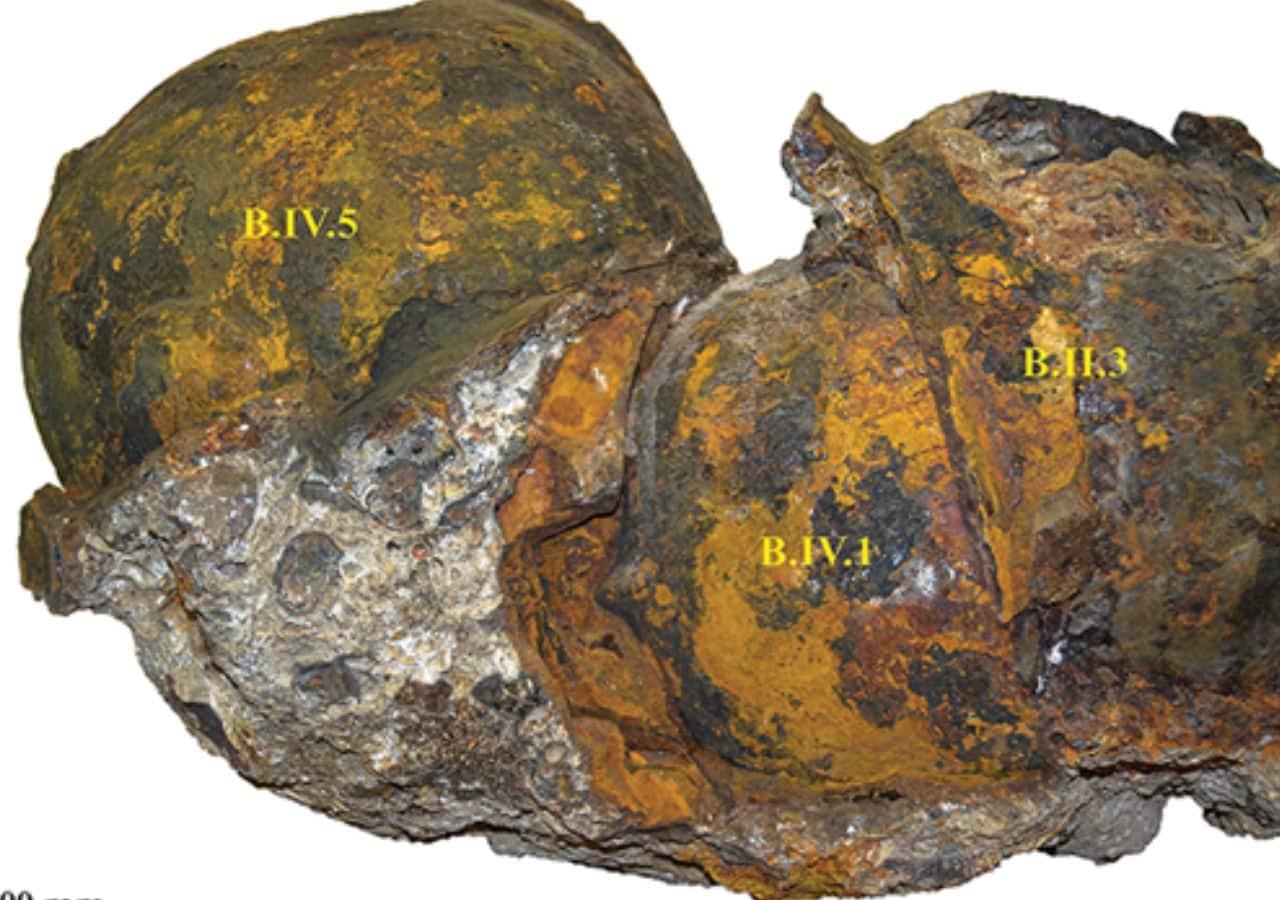
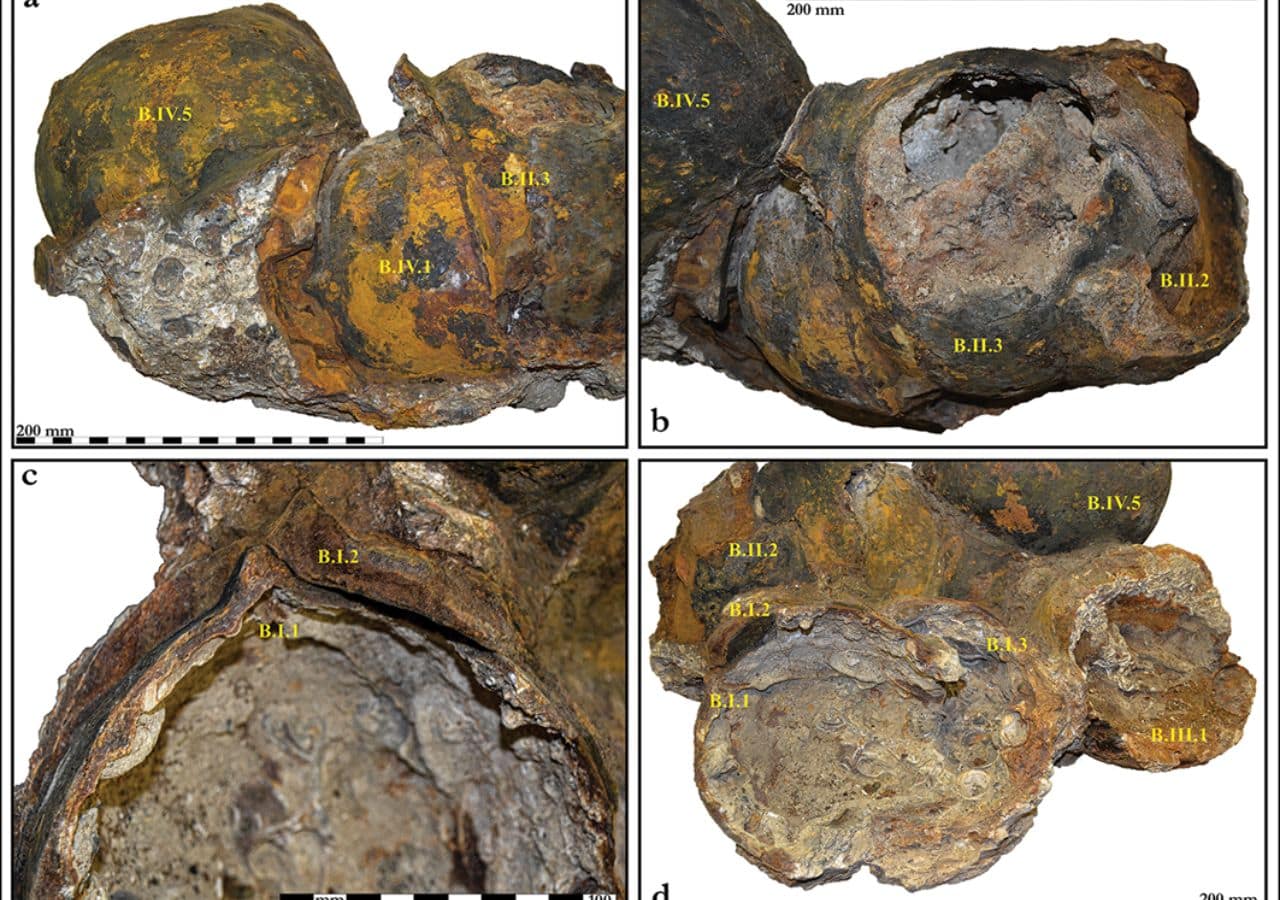
Divers recovered the helmets in 1990 from Piedras de la Barbada, a submerged site about six meters (20 feet) deep near Benicarló in eastern Spain. At least 43 helmets were identified. They are split between two institutions: most are stored at the Museu de Belles Arts de Castelló, while two conserved pieces are on display at the Museo de la Ciudad de Benicarló.
Because the site had also yielded Roman-era artifacts, including ancient amphorae and Punic War-era bronze helmets, early researchers assumed the iron helmets belonged to the same ancient period.
Frallicciardi and his team found organic evidence trapped inside the helmets. Marine sediment had sealed fabric linings in place, protecting them from full decay.
The fibers, identified as plant-based bast material in a plain tabby weave, were sent to two laboratories: Beta Analytic in Miami and the Curt-Engelhorn-Zentrum Archaeometrie in Mannheim, Germany.
Four of the five radiocarbon results clustered between the last quarter of the 14th century and the early 15th century.
One sample returned a date roughly 150 years later than the rest. Researchers linked this to post-depositional contamination. That helmet sat in a more exposed position, and microscopic analysis showed its fibers were more degraded, conditions that could allow younger carbon to infiltrate the sample.
The helmets fall into two types. Most have rounded skull caps with a central ridge, resembling simplified infantry helmets documented in medieval sources, including the Holkham Bible from around 1330 to 1340 and a fresco painted by Jacopo Uccello around 1378.
One helmet has a six-panel faceted construction comparable to a kettle hat depicted in a 1437 altarpiece by Hans Multscher.
Frallicciardi noted the helmets predate the era when large Italian and German workshops standardized European armor production. Their simple construction points to smaller regional workshops supplying local infantry markets.
The historical context strengthens that picture. From the 1370s onward, Islamic piracy along the Valencian coast intensified sharply, peaking in the final decades of the 14th century.
Communities responded by building coastal towers, fortifying settlements, and mobilizing local militias. Researchers believe the helmets were most likely lost at sea during this period of sustained maritime insecurity.