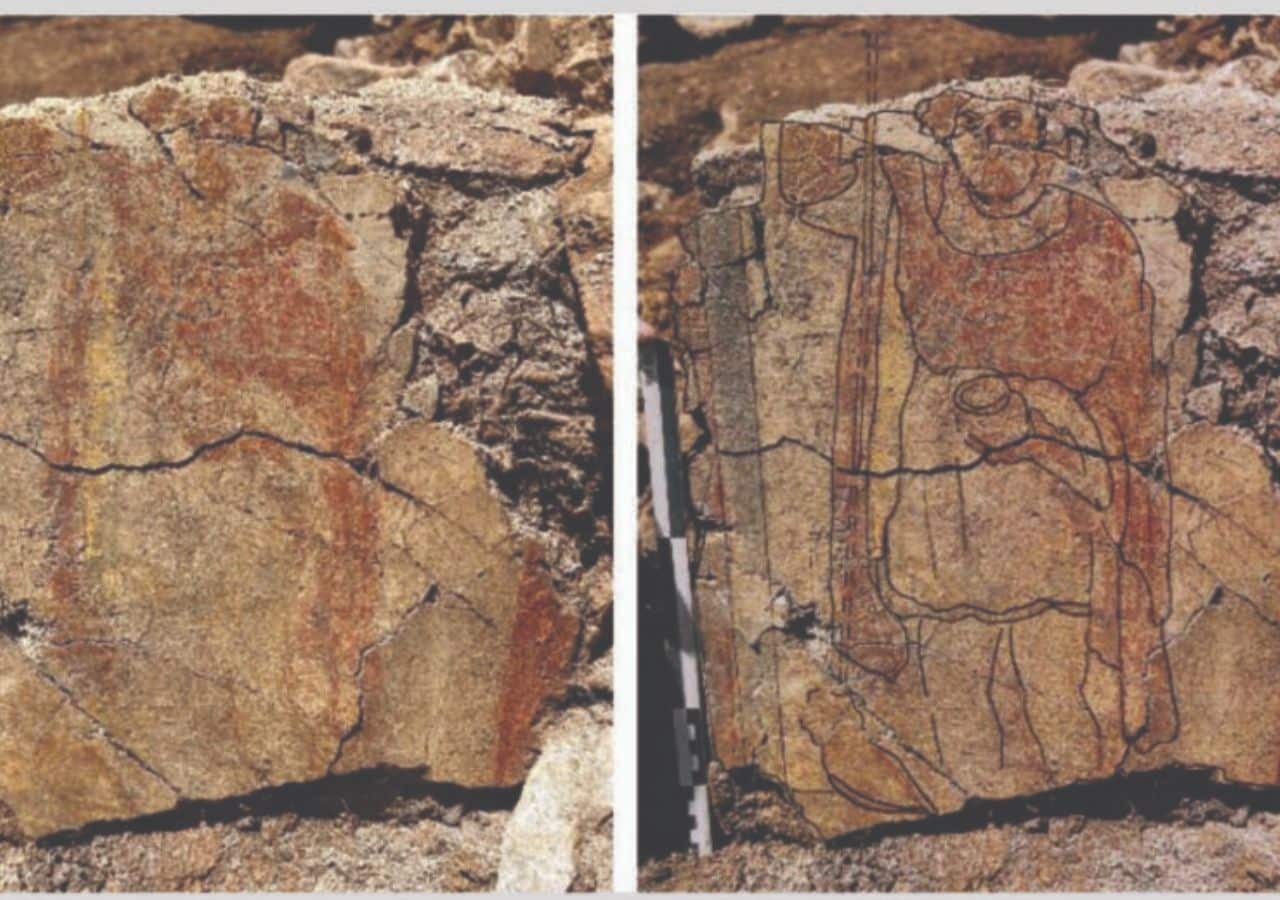

Archaeologists in eastern France have uncovered what appears to be the only known painted image of the Celtic god Sucellus at a Roman sanctuary, offering a rare look at ritual life in late antiquity. The discovery comes from the ancient sanctuary of Mancey, near Tournus, where researchers are excavating a hilltop religious complex that remained in use for centuries.
The finding was made in a small temple known as Monument M3, one of two main structures under excavation at the site. The sanctuary includes six stone mounds and likely covered about one hectare, with organized paths and gathering areas. Researchers say the layout and the large amount of material recovered point clearly to a cult site, not a rural settlement.
The painted image of Sucellus appeared on one face of a small masonry altar covered with painted plaster. It was found among a striking group of stone ritual furnishings left in the abandoned sacred room. That group also included two statue bases, a large stone table, and a tabular altar with a raised edge.
Grégory Compagnon of the Archeology and Archaeometry Laboratory (ArAr) in France leads the research. Excavations show that M3 had a vestibule opening into a sacred room and was used in several phases from the late third century to the late fourth century A.D.
One of the earliest signs of ritual activity came from a clay floor dated to the 280s A.D. There, archaeologists uncovered a deposit of 17 coins, including an aureus of Tetricus. Researchers say it was likely a foundation deposit.

The temple was later remodeled around A.D. 325. A vestibule was added, the floor level was raised, and the sacred room was fitted with benches and what researchers interpret as a cult podium.
The room’s use layer preserved nearly 10,000 remains. They included piglets, chickens, small birds, pike and tench, along with ceramic and glass cups, many coins, pins, beads, and a gold ornament.
Researchers say this material likely reflects ritual meals and offerings left behind by worshippers. The quality of the finds suggests the temple may have served people of high status, perhaps a local elite.
The most dramatic evidence came after the temple fell out of use in the late fourth century. Stratigraphy shows the sacred room was first damaged and stripped. After that, some stone features were set upright again in the ruins.
A hearth was built near one of the statue bases. Around it, researchers found animal remains, cup fragments, and many coins, echoing the earlier ritual pattern inside the temple.
A pit dug into the collapse layers held another remarkable deposit: about 100 coins, a distinctive cult lamp, and 10 white clay figurines of mother goddesses from the Autun workshop of Pistillus. Researchers interpret that deposit as one of the final ritual acts at the sanctuary.
Even after destruction, worship did not end immediately. Coin offerings and cup fragments show that people kept visiting the ruined monument until the end of the fourth century, long after the sanctuary had begun to collapse into stone mounds.