Archaeologists have uncovered a monumental sixth-century B.C. funerary complex in a tomb in central Italy, providing new insight into the powerful Picene elite who lived around Mount Conero more than 2,500 years ago.
The discovery was made during preventive excavations in the town of Sirolo by ArcheoLab under the supervision of the Superintendency of Archaeology, Fine Arts and Landscape for the provinces of Ancona and Pesaro-Urbino, in collaboration with the Municipality of Sirolo.
Researchers say the burial complex forms part of the extensive Picene necropolis of Mount Conero, one of the most important cemeteries associated with the ancient Picene civilization.
The excavation has also allowed archaeologists to reconstruct the original context of the famous warrior’s tomb discovered on Via del Leccio in 2020.
Rather than being an isolated burial, the warrior’s grave formed part of a large aristocratic family cemetery centered on a monumental princely tomb. The discovery allows researchers to examine an entire burial landscape and better understand how the ruling families of the Conero region displayed wealth, reinforced their status and passed authority from one generation to the next.
The warrior, who lived during the second half of the sixth century B.C., was buried with a helmet, spear, long sword and dagger. His grave also contained luxury objects, including a finely crafted Greek-Etruscan bronze oinochoe, a vessel used to pour wine.
Archaeologists say the imported artifact reflects long-distance exchange networks across the Adriatic and highlights the presence of Greek prestige goods among the Picene elite.
Among the most remarkable finds was an exceptionally rare diphros, or folding stool, regarded as one of the highest symbols of authority in pre-Roman Italy.

At the center of the cemetery, archaeologists uncovered the grave of a high-status man buried with a currus, a two-wheeled chariot believed to have been placed intact inside the tomb before it was sealed.
Similar chariots have been found in elite burials across ancient Picenum and other parts of pre-Roman Italy, where they symbolized wealth and political influence.
The burial also contained a helmet, axe, and other weapons, together with several artifacts that may represent forms of political authority rarely documented in Picenum. Many of these objects are still undergoing restoration and detailed study.
The excavation revealed an unusual feature that distinguishes the Sirolo monument from other large Picene funerary circles.
Until now, archaeologists believed these monuments were enclosed by ring-shaped ditches that marked the symbolic boundary between the living and the dead. Instead, the Sirolo complex was enclosed by a circular wooden palisade, identified through a regular pattern of postholes.
At the base of each posthole, archaeologists found carefully selected ceramic fragments that appear to have been placed as ritual offerings during construction of the monument.
Inside the princely tomb, archaeologists also uncovered several large bronze-sheet vessels sealed with ceramic lids. The containers still held organic material, pottery fragments and animal bones. Researchers believe they preserve the remains of a funerary banquet or food offerings placed in the grave to accompany the deceased into the afterlife.
Adjacent to the central burial, archaeologists discovered the grave of a woman with exceptionally well-preserved textiles, ornaments and footwear fitted with metal decorations.

Numerous fibulae, or brooches, remained in their original positions across her chest, shoulders, pelvis and feet, showing how her garments and burial shroud had been fastened. A large fibula with an amber core recovered behind her head may have formed part of an elaborate headdress or hairstyle.
Researchers say the burial provides rare evidence of how elite women displayed wealth, prestige and social standing within ancient Picene society.
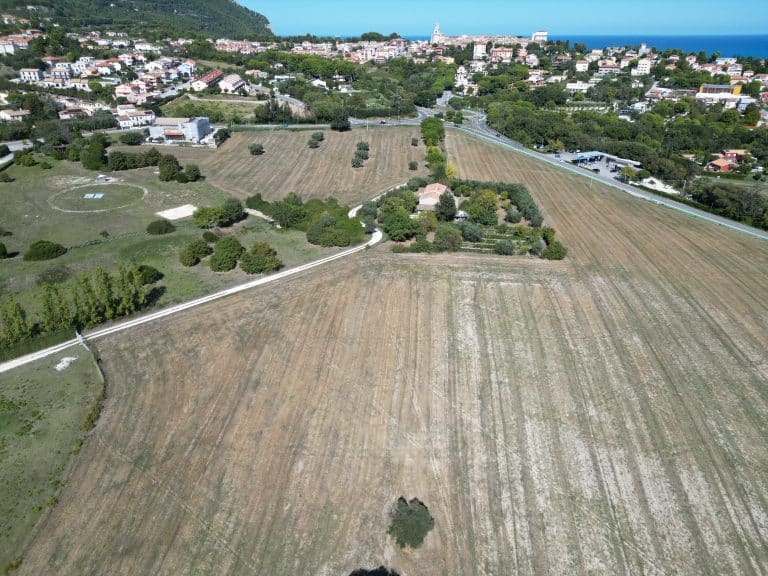
The burial complex lies near the famous “Queen’s Tomb” and the Pini Necropolis. Evidence from the excavation, together with geophysical surveys and other non-invasive investigations, suggests the cemetery extended much farther than previously believed and formed part of a carefully organized funerary landscape.
The burial circle occupies a gentle rise overlooking the surrounding countryside. Archaeologists believe the prominent location was deliberately chosen to make the monument highly visible and reinforce the status of the aristocratic family buried there.
The discovery also places the warrior’s tomb found in 2020 within a much larger cemetery organized around a princely chariot burial, allowing researchers to study an entire aristocratic burial group rather than individual graves.