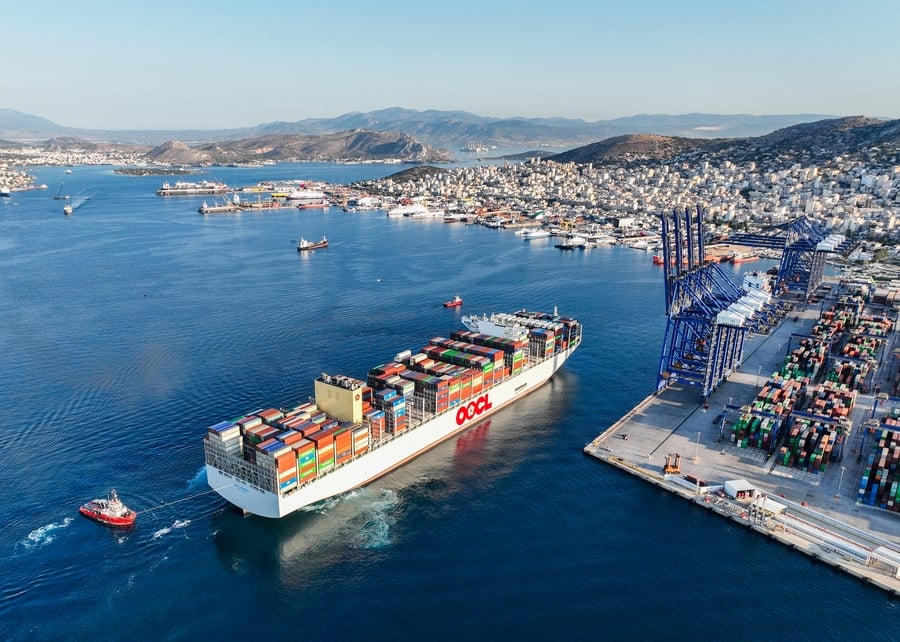
Greece and the European Public Prosecutor’s Office (EPPO) are expanding their investigation into Operation Calypso, a major customs fraud and corruption case centered at the port of Piraeus and linked to suspected tax evasion worth hundreds of millions of euros, according to a report by Kathimerini.
The case focuses on imports from China, including clothing, fabrics and electric bicycles, that allegedly entered Greece through a network of private operators and customs officials. Authorities have not yet determined the full extent of the alleged fraud, as hundreds of containers remain under inspection.
Information from an insider reportedly triggered the investigation. That testimony became the starting point for the probe, which the European Public Prosecutor’s Office launched in June 2025, with assistance from Greece’s Internal Affairs Service. During a Greek police operation that same month, authorities arrested eight people in the act. The suspects included customs brokers and employees of the Piraeus customs office, as well as a Chinese couple allegedly linked to the import network.
Two of those arrested remain in pretrial detention. Their lawyers argue that the decision is inconsistent, since authorities are holding the suspects on the grounds that they could commit new offenses, even though they have already been suspended from their duties as part of disciplinary proceedings.
Investigators describe a Chinese couple as central figures in the alleged scheme. The sixty-year-old husband, reportedly known by the nickname “Spenser,” and his wife, known as “Kelly,” allegedly coordinated with traders in China and arranged imports into Greece through Piraeus.
A sixty-year-old customs broker is described as a direct associate of the couple. According to the investigation, she allegedly supported the operation by issuing false bills of lading and customs declarations in exchange for large payments. Authorities believe she received the money in cash before an associate transferred it to her company’s offices in Perama.
A Greek prosecutor working at the European Public Prosecutor’s Office has also charged three additional customs officials, including two retirees, with alleged involvement in the scheme.
In total, the case has so far led to the arrest of eight people, including the Chinese couple and six active or retired customs officials. A sixty-year-old customs official allegedly served as the main contact for the Chinese couple.
As part of Operation Calypso, authorities initially froze 2,500 containers shipped from China to Greece after identifying signs of possible links to the alleged network. The European Public Prosecutor’s Office ordered their detention and full inspection.
According to Kathimerini, 1,750 containers remain impounded. Customs officials and the Independent Authority for Public Revenue have prioritized five hundred containers for inspection. So far, authorities have completed checks on 250 containers, leaving roughly 1,500 containers still to be inspected before they can determine the full scale of the suspected fraud.
Officials also point to the creation of a centralized Customs Audit Center as a key factor in improving oversight. Planning for the center was completed in February 2025, and it began operating in August 2025, shortly after the EPPO launched its investigation at Piraeus.
The new structure changes how customs checks are handled. An independent unit now reviews documents for container clearance instead of local staff in Piraeus, reducing direct contact between inspectors and traders. The central authority also decides which containers should undergo physical inspection. It then receives and reviews the final inspection reports, instead of leaving that responsibility to customs staff operating at the port.
Authorities recently completed the first auction of seized electric bicycles connected to the case. The auction generated €122,000 (about $143,215) in revenue.
Although the amount was limited compared with the suspected scale of the fraud, officials from the Finance Ministry and the Independent Authority for Public Revenue viewed the auction as symbolically important. They see it as the first financial recovery step involving seized goods linked to the investigation.
The case has already had a measurable fiscal impact. Taxes recovered through Operation Calypso contributed to an 11% increase in customs revenue, amounting to €420 million ($493.1 million) in 2025 despite an overall decline in imports, according to authorities.
Finance Minister Kyriakos Pierrakakis praised the joint work between Greek authorities and the European Public Prosecutor’s Office after meeting with European Public Prosecutor Laura Kövesi. According to Pierrakakis, Operation Calypso shows that cooperation between national and European authorities can deliver significant results in the fight against customs and tax fraud.