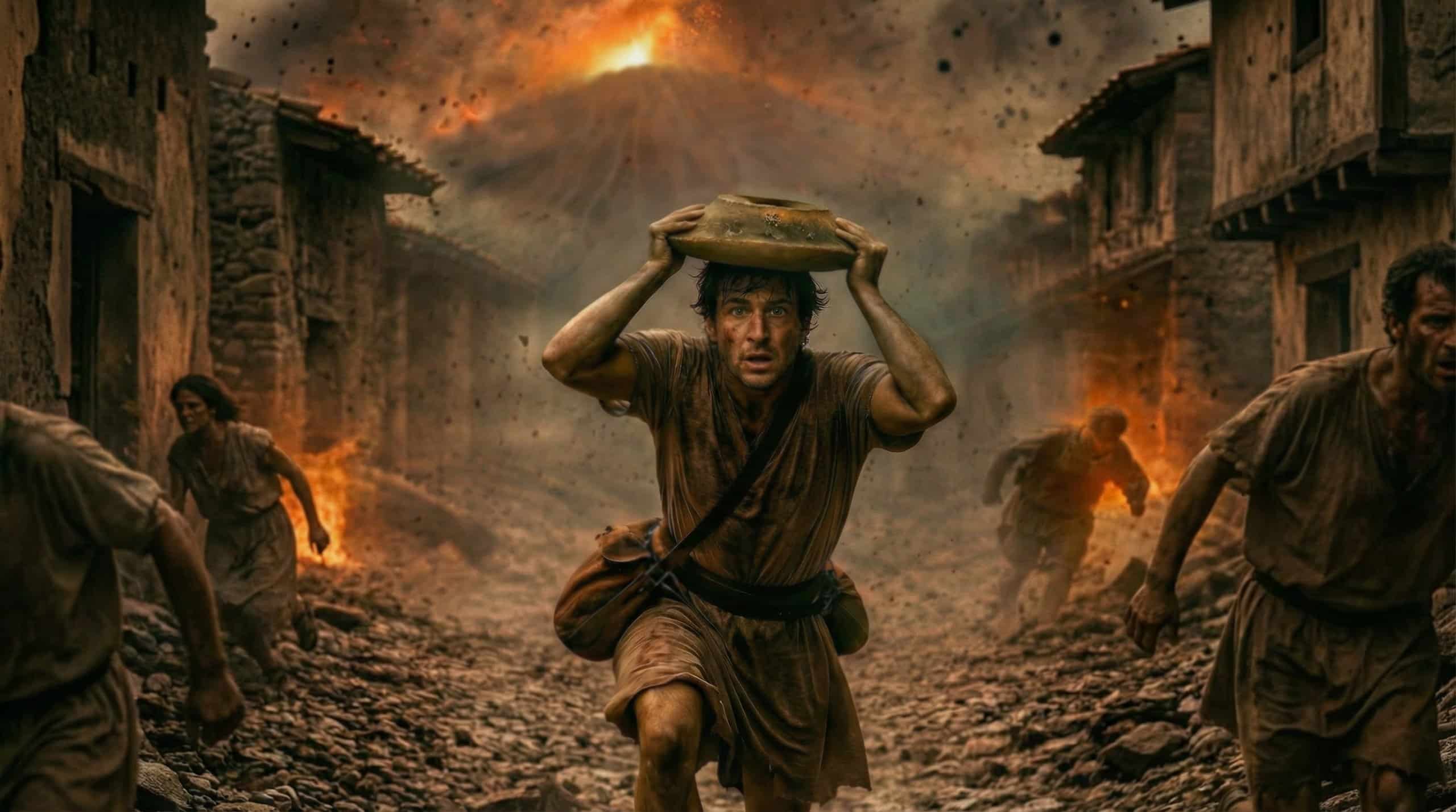
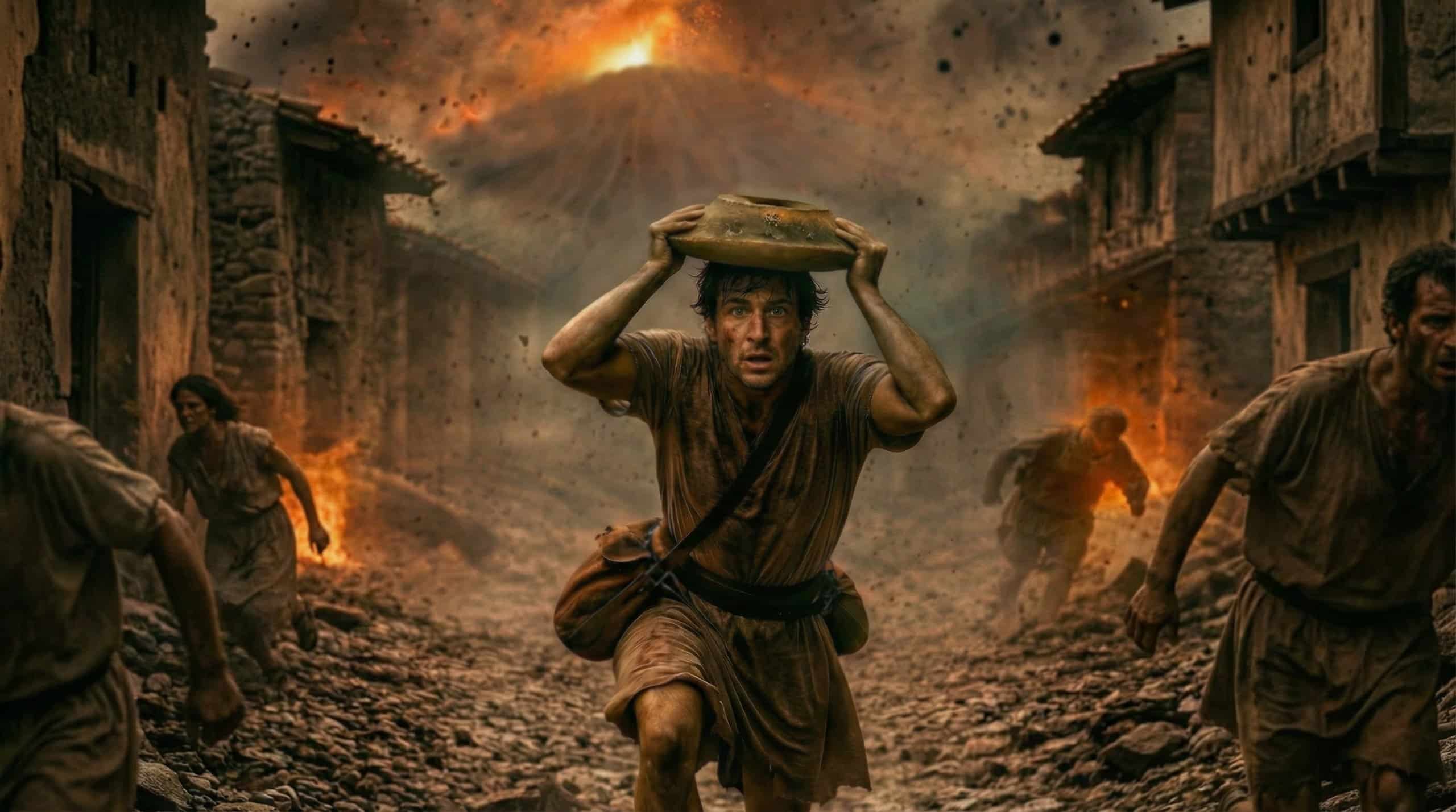
Archaeologists at Pompeii have used artificial intelligence (AI) to reconstruct the final moments of a man who died trying to escape the eruption of Mount Vesuvius in 79 A.D. The reconstruction, developed in collaboration with the University of Padua, shows the man fleeing the ancient city while holding a clay mortar over his head to shield himself from falling volcanic debris.
The discovery came during recent excavations at the Necropolis of Porta Stabia, just outside the city walls. Researchers were completing an investigation into the tomb of Numerius Agrestinus Equitius Pulcher when they uncovered the remains of two men who had tried to escape toward the coast during the disaster.
The two men died at different points in the eruption. The older man perished earlier, caught under a heavy shower of volcanic rocks. His body was found beside a fractured clay mortar that he had apparently held over his head for protection. He also carried a ceramic oil lamp, a small iron ring on his left little finger, and ten bronze coins.
The younger man likely died later, overtaken by a pyroclastic surge, a fast-moving current of ash and toxic gases, as he tried to move away from the city.
The act of using a vessel as head protection mirrors accounts by Pliny the Younger, an eyewitness to the eruption, who described people tying cushions to their heads or using objects to guard against falling material while fleeing.
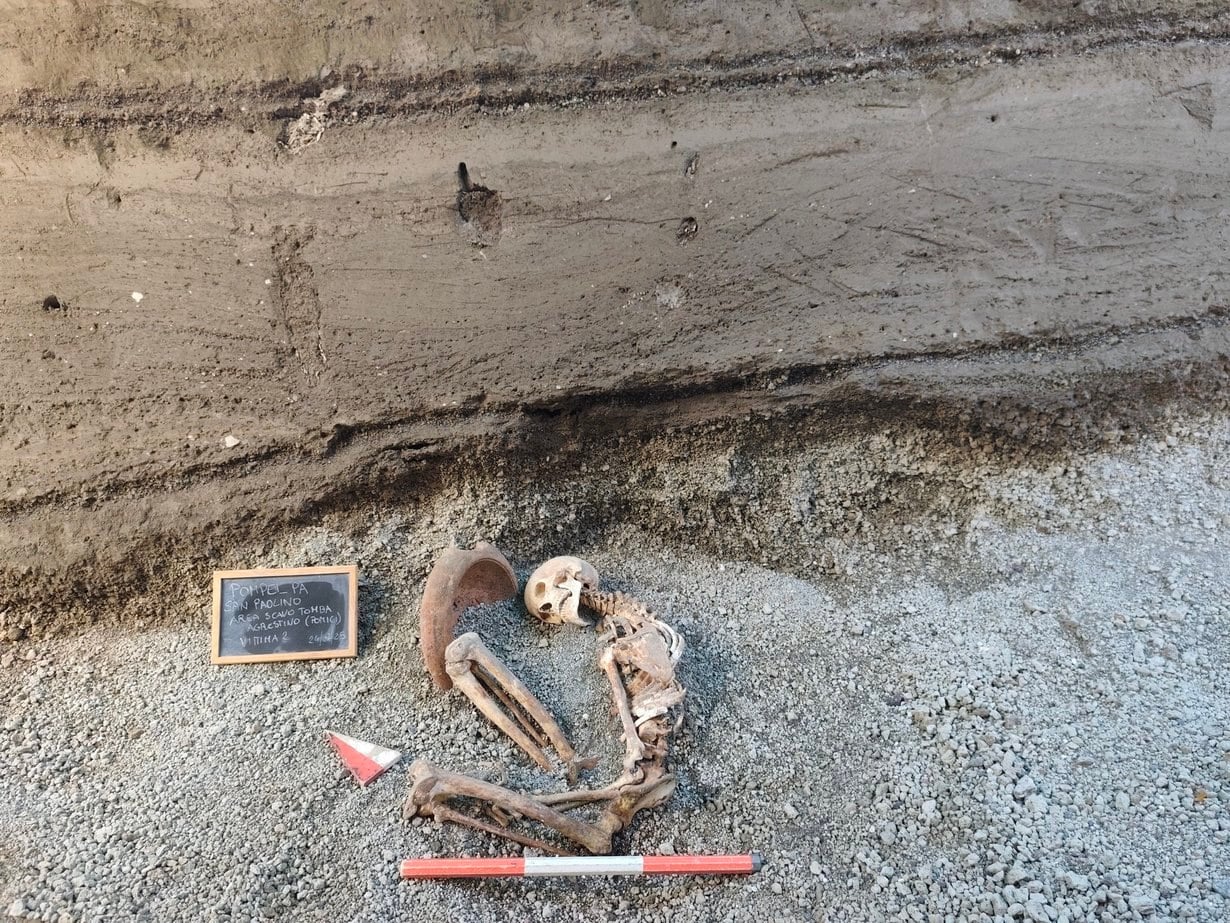
The Pompeii Archaeological Park and the University of Padua’s Digital Cultural Heritage Laboratory produced the AI reconstruction of the older victim using a combination of AI software and photo editing techniques.
Researchers aimed to create a scientifically grounded image that a general audience could understand and connect with.
Gabriel Zuchtriegel, director of the park, said the massive volume of archaeological data at Pompeii now demands AI tools to properly protect and communicate findings. He emphasized that archaeologists must lead this work themselves, rather than leaving it to those without the required scientific and humanistic foundations.
University of Padua professor Jacopo Bonetto said AI can support interpretive models and improve how discoveries are shared, but its application must remain carefully controlled and always guided by specialists.
Luciano Floridi, founding director of the Digital Ethics Center at Yale, said AI extends the reach of archaeological work without replacing those who do it.
He cautioned that the greater danger is not AI producing errors, but researchers losing the habit of critical thinking while relying on it. He said the humanities remain essential in separating reconstruction from imagination.