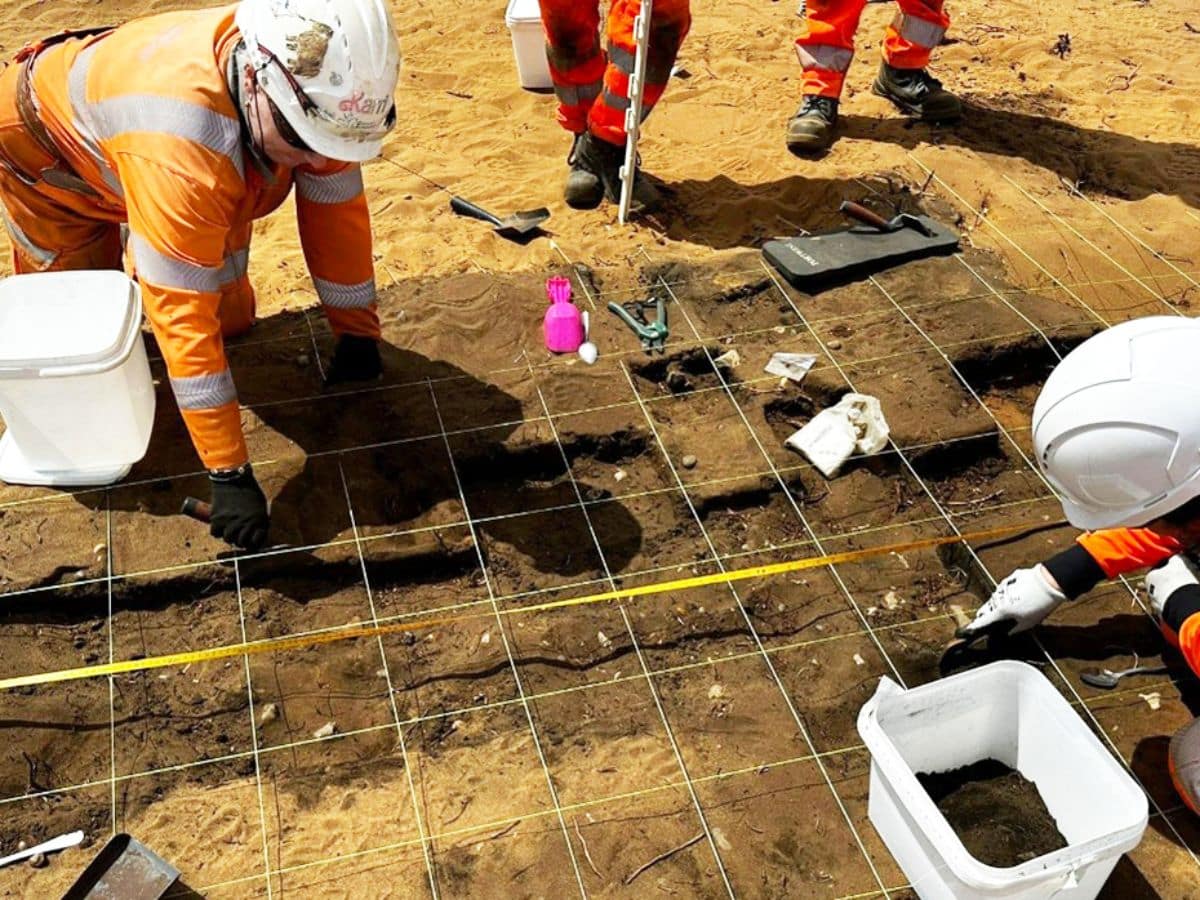
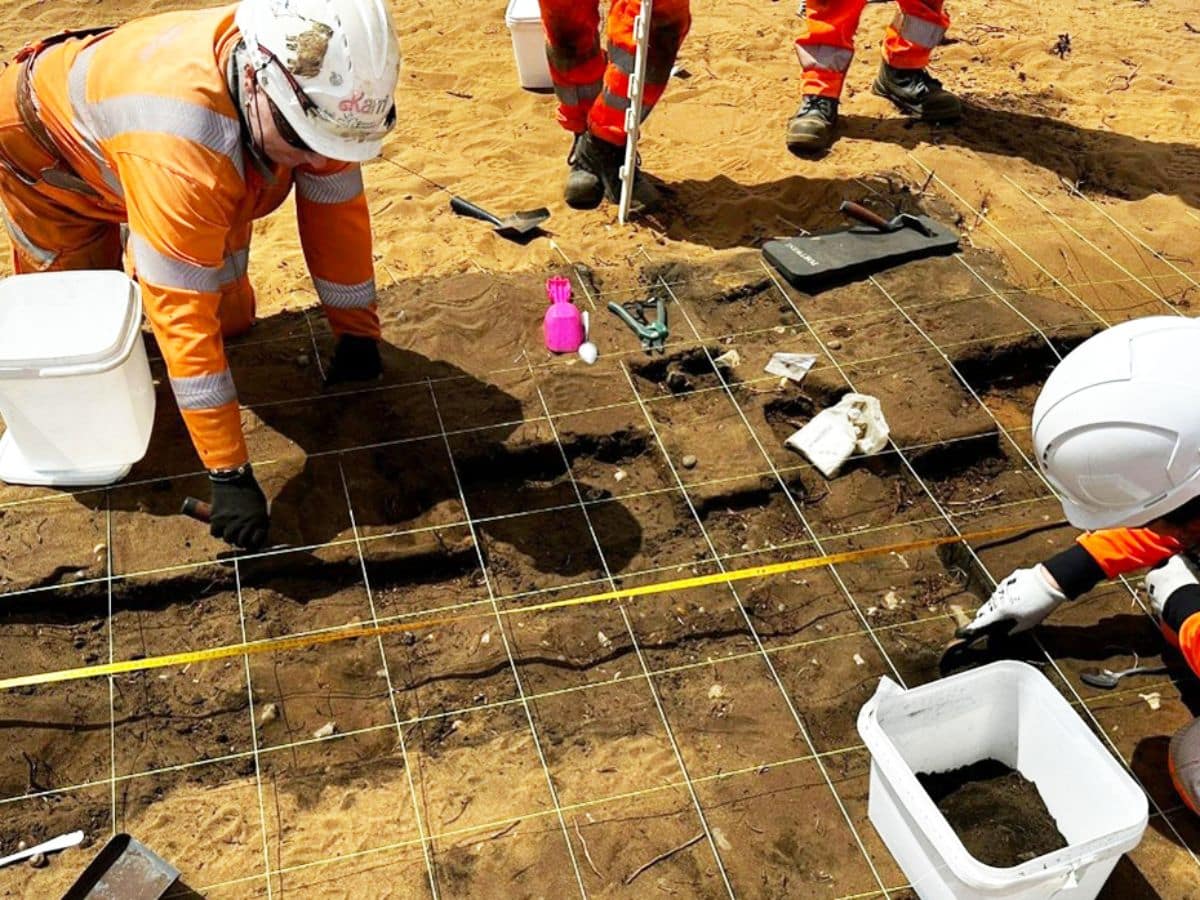
Archaeologists working on the Sizewell C project have uncovered the remains of an ancient cremation pyre at Goose Hill, a rare find in England that researchers describe as important. The structure sat on a slope with a clear southward view toward the present-day coastline.
Built from wooden beams stacked in a lattice formation, the pyre measured approximately three meters (10 feet) by two meters (6.6 feet) and stood about a meter and a half (5 feet) tall. Dry brush and small combustible material were packed into the core.
Posts driven into the ground around the perimeter held the structure upright. The body of the deceased was placed on top before the pyre was lit. Cremation was practiced across multiple periods, including prehistoric, Roman, and early Anglo-Saxon times.
Military training during World War II disturbed portions of the site, though researchers still describe the discovery as rare and significant. Excavators uncovered a rectangular spread of dark, carbon-rich soil embedded with small fragments of burnt bone.
Sandy patches discolored pink by intense heat were scattered throughout the deposit. Six postholes marked the outer boundary, three along one long side and one at each short end.
The bone fragments will be examined to determine whether they are human and what they may indicate about the person’s age, sex, and physical condition.
Bone was found in limited quantities. Researchers believe most remains were collected after the cremation and placed in a ceramic vessel for burial at a separate location.
Burials across the wider site were sparse. Only a Bronze Age cremation in a Collared Urn dated between roughly 1950 and 1600 BC was found, along with one additional possible urn burial on record.
Cremation pyres are rarely preserved in the archaeological record in England, as surface features are easily lost to ploughing. The pyre sat off-center within a ring ditch, suggesting a burial mound once covered it before farming activity removed it.
Whether the ring ditch was built alongside the pyre or predated it remains unclear. No central burial survived within the ditch, possibly removed by a later ditch cut through the interior.
An Iron Age pit was found cutting into the already-filled ring ditch, placing the construction of the feature before 700 BC. A polished stone axe from the Neolithic period was also recovered from within the ditch. Researchers believe it had been around for a long time before it was deposited there.
Researchers plan to submit bone and charcoal samples for radiocarbon dating. They will also study objects placed on the pyre alongside the body.
The goal is to learn more about the burial rite, including the person’s social standing, the fuel used, and what the surrounding environment looked like at the time.
A comparable pyre was previously found at an Anglo-Saxon cemetery about eight kilometers (5 miles) southwest at Snape. Evidence of that period at Goose Hill is limited, however, leading researchers favor a prehistoric date, most likely the Bronze Age or Iron Age.