Greece could consider Floating Nuclear Power Plants as part of its future energy strategy, according to a new report by the Deon Policy Institute that examines how the technology could fit within the political, social, economic, legal and regulatory framework of a European country.
Using Greece as a case study, the report draws on research carried out by CORE POWER, Athlos Energy and ABS. Its full findings are expected to be published later this year.
The discussion comes as nuclear energy returns to Greece’s public policy agenda. Greece has historically avoided nuclear power, but Prime Minister Kyriakos Mitsotakis announced in March 2026, at the 2nd Nuclear Energy Summit in Paris, that the country will examine the possible role of Small Modular Reactors in its energy mix. He also said a dedicated ministerial committee would submit concrete proposals to the government.
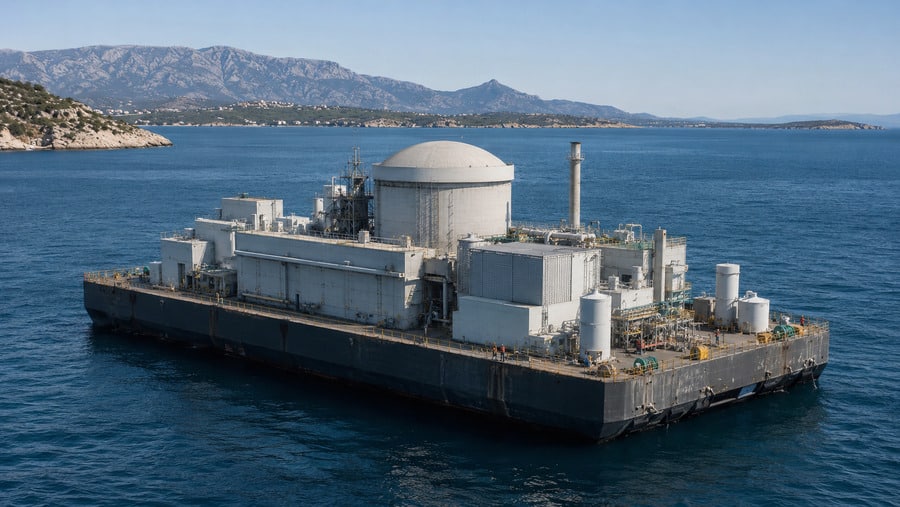
Floating Nuclear Power Plants, or FNPPs, are nuclear energy facilities in which one or more reactors operate on a floating platform or vessel. They can produce electricity, heat and, in some cases, potable water through desalination.
Unlike nuclear-powered merchant ships, which use nuclear energy for propulsion, FNPPs function as dedicated energy production facilities. They generally rely on Small Modular Reactors, smaller reactors designed for standardized factory production and transport to deployment sites.
The concept is not new. The US-built MH-1A Sturgis operated at the Panama Canal in the 1960s, while Russia’s Akademik Lomonosov has operated commercially since 2019. Russia also has up to four additional FNPPs under construction.
Since 2020, the sector has gained renewed momentum, with nuclear technology companies partnering with shipyards in East Asia, North America and Southeast Asia to develop standardized marine-deployed nuclear facilities.
The report argues that Greece’s geography and maritime profile make floating nuclear applications especially relevant. Greece has an extensive coastline, many inhabited islands and growing needs linked to desalination, port electrification and reliable low-carbon power.
FNPPs could generate electricity close to demand centers without requiring permanent land use or competing with renewables, agriculture or housing. They could also replace oil-fired units on non-interconnected islands and support coastal industrial hubs without placing additional strain on the grid.
The report also points to Greece’s maritime-industrial base as a potential advantage. As one of the world’s leading maritime powers, Greece has experience in shipping, shipyard operations and maritime regulation. Around 75 percent of total value added in FNPP projects is associated with the Balance of Plant, an area where Greek maritime and industrial capabilities could prove relevant.
Greece’s past exposure to nuclear energy has remained limited. The country has research and educational infrastructure, including the GRR-1 pool-type research reactor at NCSR Demokritos and the Exponential Graphite Pile at the NTUA Nuclear Engineering Laboratory.
During the early decades of civilian nuclear power, the Greek state worked with Ebasco, which advised the Public Power Corporation, known as PPC or DEI, on preliminary studies for a possible nuclear power unit.
The new report says Greece’s changing energy needs make a reassessment necessary. Nuclear energy could strengthen energy security, reduce dependence on imported fuels, support stable electricity generation and contribute to decarbonization.
It could also provide predictable long-term operating costs, support industrial competitiveness and create high-skilled jobs in construction, operations and advanced services. The report also links nuclear energy to strategic autonomy, arguing that reliable domestic power generation has become more important in an era of geopolitical energy risks.
The report’s PESTLE analysis ( Political, Economic, Social, Technological, Legal, and Environmental Analysis) finds that the biggest barriers to FNPP deployment in Greece are not primarily technical. Instead, the main challenges involve institutions, regulation, policy continuity and public acceptance.
According to the findings, Greece does not yet have policy, legal or regulatory frameworks that substantially address nuclear energy or FNPP deployment. This reflects a wider gap in European energy and maritime policy.
However, the report identifies no fundamental barriers to implementation. It suggests that Greece needs to build the necessary framework, rather than overcome an inherent feasibility problem.
The analysis also finds strong economic incentives, including Greece’s dependence on imported fossil fuels and rising electricity demand from industry and data centers. It describes FNPP technology as mature and commercially credible, rather than experimental.
At the same time, social acceptance remains a major challenge. Public support for nuclear energy in Greece remains limited and divided, with concerns focusing on radioactive waste, accidents and health impacts. However, the report notes that FNPPs appear to receive a more positive response than conventional nuclear plants.
Environmental benefits, including low emissions and limited land use, remain significant but undercommunicated in public debate.
The @deonpolicy Institute has published findings from the first feasibility study on maritime nuclear generation in Greece, derived from a research programme conducted in partnership with CORE POWER, Athlos Energy and @ABSeagle.
Find out more here! https://t.co/u0GZbiK1dD pic.twitter.com/Y0V6NhDgQ4
— CORE POWER (@COREPOWER10) May 27, 2026
The report says Greece needs clearer assessment and licensing pathways before any FNPP project can move forward. That process would require coordination among maritime, nuclear and energy authorities.
It also stresses the need to strengthen international cooperation and regulatory capacity. The report found no major legal or regulatory barriers, provided Greece develops the necessary institutional structures and works with experienced international regulators.
On the technical side, the report identifies no major obstacles linked to the maturity of the technology. However, it emphasizes that Greece would need to build local value chains, workforce capabilities and specialized expertise before deployment.
The report concludes that Greece’s ability to deploy FNPPs will depend on whether current political momentum turns into long-term institutional commitment.
Participants in the research identified a phased pathway that could lead to potential deployment between 2035 and 2040.
The first stage would focus on political alignment and preparation. This would include establishing a permanent interministerial coordination mechanism, preparing strategic documents such as a white paper, launching structured public engagement and mapping legal, liability and regulatory requirements.
The second phase would anchor nuclear energy institutionally by including it as a strategic option in Greece’s National Energy and Climate Plan. It would also involve a regulatory gap analysis for floating applications, cooperation with experienced international regulators and early siting and environmental screening.
A third phase would focus on risk reduction and pilot selection. Greece would need to choose a mature reactor technology, identify an appropriate offshore site, define the financial model, likely through public-private partnerships, negotiate long-term offtake agreements and accede to key international liability frameworks, such as the Convention on Supplementary Compensation.
The following phase would combine nuclear and maritime licensing, engineering and construction. It would also include shipyard and infrastructure upgrades, grid connections, emergency planning and a final investment decision.
The final stage would involve commercial operation of a pilot FNPP, followed by an evaluation of its technical, economic and social performance. Greece would then decide whether to scale up into a wider fleet serving islands, ports, industry or export-oriented applications.