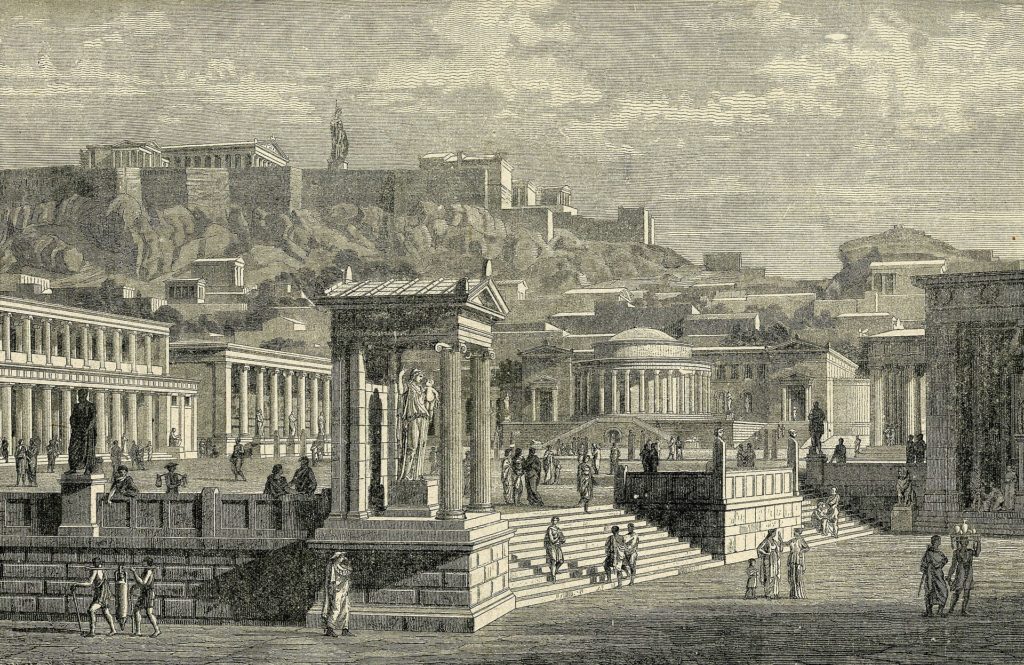
The transition from barter to currency in Ancient Greece was a giant step in the history of civilization. The change transformed trade, reshaped political authority, encouraged long-distance commerce, and altered the way Greeks understood wealth, value, and social relationships.
Before the invention of coinage, economic exchange in the Greek world relied on barter, gift exchange, weighed metals, and reciprocal obligations. Over time, however, the growing complexity of Greek society made bartering increasingly inefficient. By the 7th and 6th centuries BC, coined money emerged first in Lydia in Asia Minor and then spread rapidly into the Greek city-states. The rise of currency marked the beginning of a new economic order that would influence not only the world of Ancient Greece but the entirety of the Mediterranean.
In the earliest Greek communities, exchange depended primarily on barter. Goods were traded directly for other goods: grain for livestock, wine for pottery, or tools for cloth. Homeric society, as depicted in the Iliad and the Odyssey, reveals an economy in which wealth was measured mainly in cattle, land, weapons, and precious objects rather than in money. In the Iliad, for example, armor and tripods are frequently exchanged as gifts or prizes, demonstrating that value was tied to prestige and social status. Homer wrote that a skilled female servant might be “worth four oxen,” while another warrior’s armor was valued at “a hundred oxen.” These examples show that oxen often served as a unit of account even when no actual cattle changed hands.
The barter system functioned adequately in small agricultural communities, but it had serious limitations. Barter required what economists later called a “double coincidence of wants.” Each trader needed to possess exactly what the other desired at the same moment. This made large-scale trade cumbersome and inefficient. As Greek society expanded through colonization and maritime commerce during the 8th and 7th centuries BC, barter became increasingly impractical and coinage was introduced and prevailed.
The Greek philosopher Aristotle later explained the development from barter to currency in Ancient Greece in his Politics. He observed that exchange began simply within households and villages but became more complicated as communities grew larger. Aristotle wrote: “When the inhabitants of one country became more dependent on those of another, and they imported what they needed and exported the surplus, money necessarily came into use.” He further explained that people chose metals such as iron and silver because they were “intrinsically useful and easily applicable to the purposes of life.” Eventually, these metals were stamped “to save the trouble of weighing and to mark the value.”
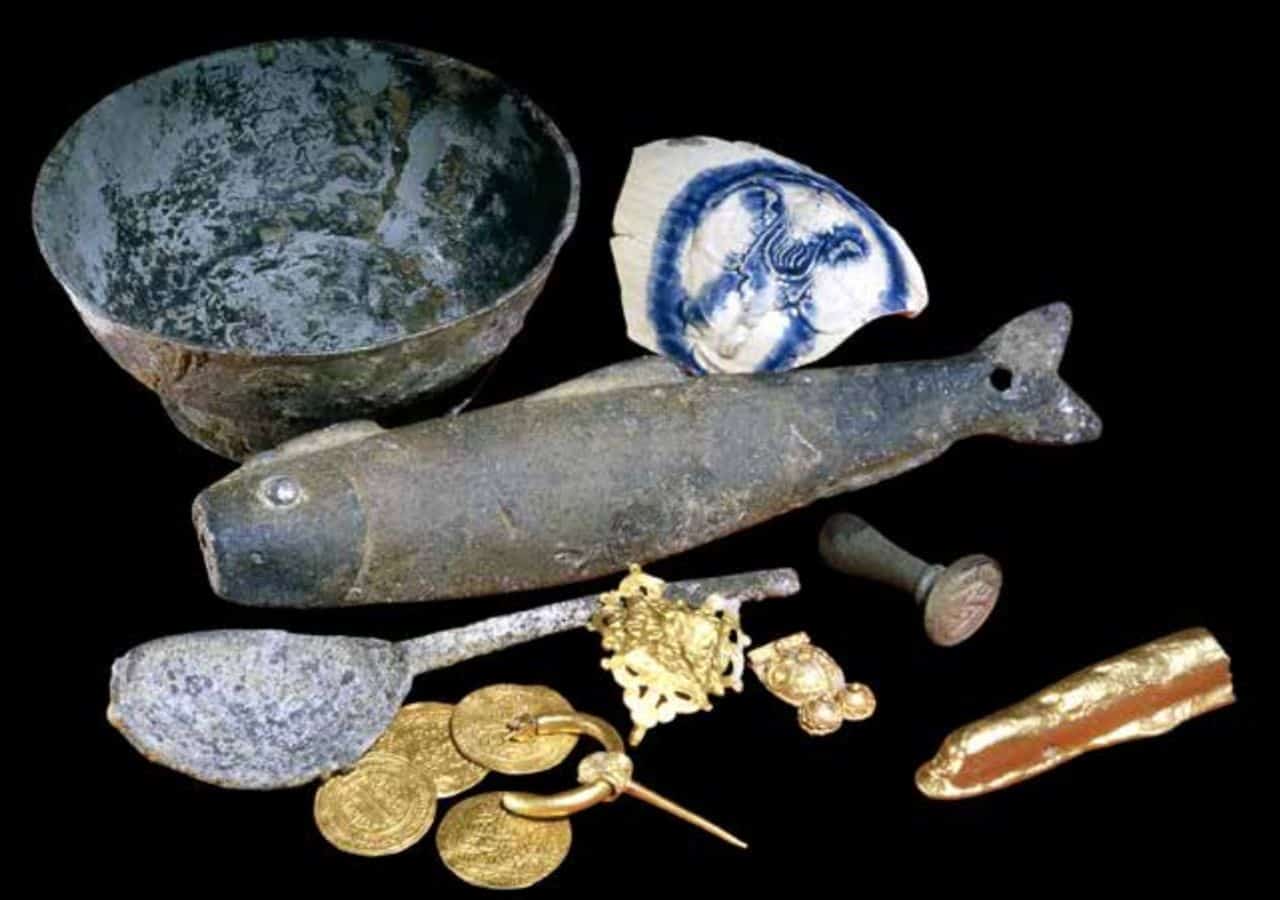
Aristotle’s description is significant because it shows that even ancient thinkers understood money as a practical response to the problems of bartering. At first, Greeks used weighed quantities of precious metals instead of coins. Silver, gold, and bronze circulated in the form of ingots or rings. Merchants weighed these metals during transactions, but this process was slow and often unreliable. Questions about purity and weight frequently resulted in disputes.
The decisive breakthrough came in western Asia Minor in the kingdom of Lydia during the late seventh century BC. Most historians believe that the Lydians were the first people to mint true coins. Herodotus famously declared: “The Lydians were the first men whom we know to have minted and used gold and silver coins.” These early coins were made from electrum, a natural alloy of gold and silver. By stamping metal with an official symbol, rulers guaranteed its weight and purity. This innovation removed the need to weigh metals repeatedly during every transaction.
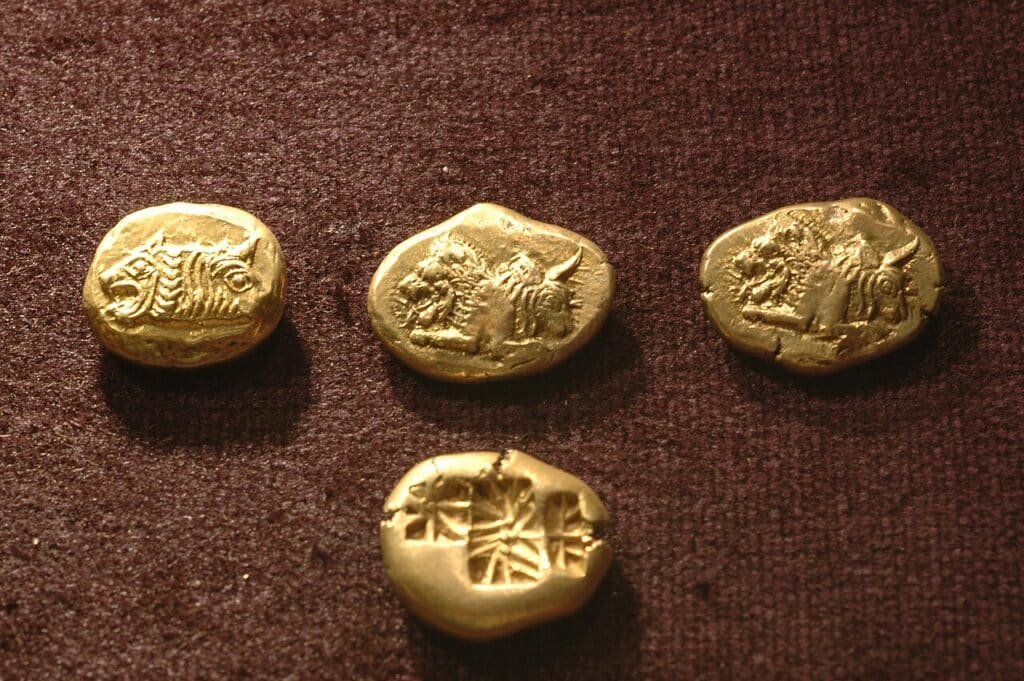
Modern historian Frank Holt describes the importance of the invention of currency in striking terms. He writes that merchants “could set aside their cumbersome scales, weights, and touchstones to accelerate their transactions by counting out, not weighing out, this new form of currency.” In other words, coinage simplified commerce dramatically. Instead of constantly testing bullion, traders could trust the authority represented by the stamp.
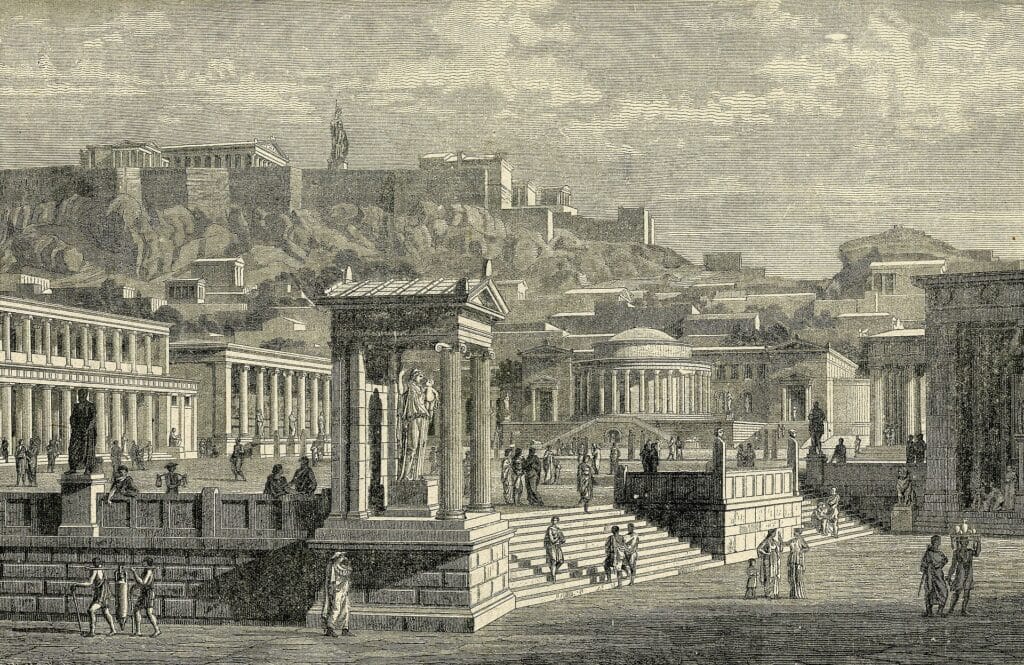
The Greeks quickly adopted coinage from Lydia. Greek cities in Ionia were among the first to mint their own coins, and mainland Greek states soon followed. Aegina, Corinth, and Athens became especially well known for their currencies. By the 6th century BC, coins circulated widely across the Greek world.
The adoption of coinage was closely connected with the rise of the polis, or city-state. Coins were not merely economic tools; they were symbols of civic identity and political power. Each polis stamped coins with distinctive images representing its culture and patron deities. Athens used the owl of Athena, Corinth used Pegasus, and Aegina employed the sea turtle. These symbols turned currency into a form of political propaganda.
The Athenian silver tetradrachm became particularly influential. The rich silver mines at Laurion allowed Athens to produce enormous quantities of high-quality coins during the fifth century BC. These “owls” circulated widely throughout the Mediterranean and became trusted in international trade. The strength of Athenian currency reflected the military and naval dominance of the city itself.
Coinage also contributed to the growth of democracy in Athens. In earlier aristocratic societies, wealth was tied primarily to landownership and noble birth. Money introduced a more flexible form of wealth. Merchants, craftsmen, and traders could accumulate resources independently of aristocratic landholding. This helped create a broader economic class with political influence.
Moreover, currency made taxation and military payments easier. Athens could pay rowers, soldiers, jurors, and public officials directly in silver coinage. This monetary system supported the functioning of democratic institutions. Some historians even argue that democracy depended partly on the widespread availability of coined money.
The historian Moses Finley emphasized that the ancient economy differed greatly from the modern capitalist world, yet he acknowledged the transformative role of coinage. Finley argued that Greek economic life was still deeply connected to social status and political structures. Nevertheless, money altered relationships within society by increasing commercial interaction and encouraging markets. According to Finley, societies of Ancient Greece did not possess the modern concept of an “economy,” but the spread of currency nevertheless created more complex systems of exchange and trade.
Coinage also revolutionized long-distance trade. Greek merchants traded olive oil, wine, pottery, grain, and luxury goods throughout the Mediterranean. Currency provided a standard medium of exchange that facilitated transactions between strangers who spoke different languages and belonged to different cultures. Trust in official coinage reduced uncertainty and encouraged commercial expansion.
The philosopher Xenophon recognized the international appeal of Athenian silver. In his work Ways and Means, he observed that in every market, merchants were eager to accept Athenian coins because of their reliable silver content. This statement illustrates how certain currencies gained reputations similar to strong international currencies today.
At the same time, the spread of coinage changed Greek attitudes toward wealth and morality. Earlier aristocratic ideals emphasized honor, heroism, and landownership. The increasing importance of trade and money occasionally led to anxiety among Greek thinkers.
Aristotle distinguished between the “natural” use of wealth and the unnatural pursuit of profit for its own sake. He criticized excessive money-making and warned that trade could encourage greed. In Politics, he argued that while exchange arose naturally from human needs, the accumulation of wealth without limit was morally dangerous. Similarly, Plato worried that commercial values might weaken civic virtue.
Greek literature often reflects this tension between traditional aristocratic values and the new currency economy. The poet Theognis of Megara complained bitterly that wealth allowed socially inferior men to rise in status. He lamented: “Money has ruined men.” His words reveal aristocratic resentment toward the changing social order created by commerce and currency.
Despite such criticisms, money became deeply embedded in Greek daily life. Markets expanded, wages became more common, and financial practices grew increasingly sophisticated. Greek bankers, known as trapezitai, accepted deposits, exchanged currencies, and provided loans. At times, temples acted as financial centers because they possessed large reserves of precious metals.
The use of coinage also affected warfare. Mercenary soldiers could now be paid systematically in cash, allowing rulers to recruit professional armies. During the Peloponnesian War, both Athens and Sparta relied heavily on monetary resources to sustain military operations. The relationship between military power and silver production became especially clear in Athens, where the Laurion mines funded the construction of the fleet that defeated the Persians at Salamis.
Historians continue to debate the broader significance of the Greek monetary revolution. Some scholars argue that coinage fundamentally transformed Greek society by encouraging rational calculation, market behavior, and economic specialization. Others believe that social and political traditions remained more important than economic forces.
The historian Richard Seaford has proposed that coinage even influenced Greek philosophy. In his book Money and the Early Greek Mind, Seaford argues that the abstract and universal nature of money encouraged new ways of thinking about equality, order, and the cosmos. According to Seaford, the emergence of coinage paralleled the rise of philosophy in cities such as Miletus and Ephesus. Although this interpretation remains controversial, it demonstrates how significant scholars consider the impact of currency and the shift away from barter in Ancient Greece.