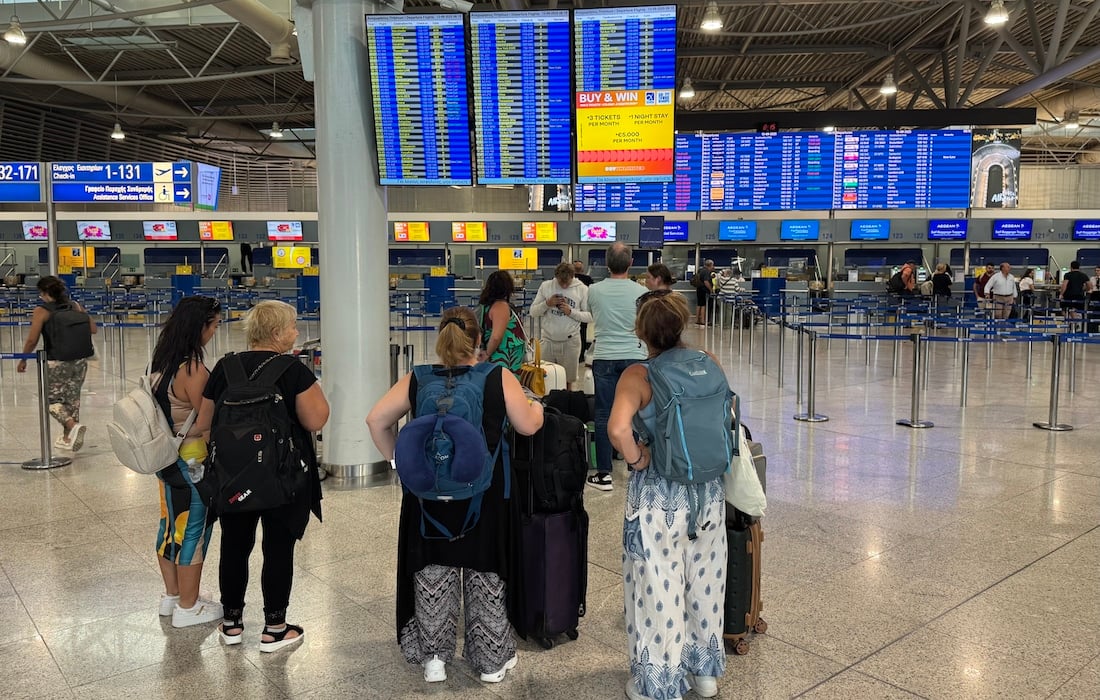
Greek tourism got through this spring’s Middle East turmoil with its optimism intact, but a new study warns that a longer aviation disruption could expose one of the sector’s deepest vulnerabilities: its dependence on air travel.
The report, published by the Economic Analysis Division of the National Bank of Greece as part of its “Business Trends” series, draws on the bank’s annual survey of Greek hotels. The survey took place in April and May, when the crisis reached its peak, oil prices sky-rocketed, and concerns over possible fuel shortages intensified.
Even then, Greek hotels expected another fruitful year. According to the study, the main concern is not just the immediate crisis but what might unfold if the next disruption persists for an even longer period.
The bank’s core concern is Greece’s exposure to aviation disruption. The country draws many visitors from distant markets and relies overwhelmingly on flights, making it more vulnerable than rival destinations that possess better road and rail networks and short-haul access. To measure that exposure, the study models two scenarios for the following tourism season.
In the more optimistic scenario, oil prices would remain at around $80 per barrel through the first half of 2027, up from about $70 in 2025. In such a case, the drag on tourism demand could amount to nearly two percentage points. On the other hand, in a less favorable scenario, a prolonged disruption would push average oil prices closer to $100 per barrel, which would widen the drag on demand to 5.5 percentage points.
This spring’s shock faded quickly. In April, oil briefly rose to $120 per barrel, and jet fuel prices doubled. Airlines absorbed part of the impact through hedging, and early fears of fuel shortages did not materialize. The study suggests a longer disruption could have produced a very different result, however.
Despite the uncertainty, hotels expected sales to rise by about 3 percent in 2026 following growth of 4.5 percent in 2025. That estimate now appears cautious. Since the survey was completed, the sector’s confidence index has improved as conditions have stabilized.
The broader European travel market also supports the positive outlook. European tourism is forecast to grow by three to four percent this year. Scheduled flights at Greek airports for the May-to-August period are up 3.6 percent, compared with about 1.6 percent across Europe.
Greece also benefited from the structure of its visitor base. European travelers account for about ninety percent of foreign overnight stays in Greece, compared with roughly eighty percent across the Mediterranean overall. As Europeans continued to favor nearby beach destination throughout the spring disruption, Greece’s robust position in sun-and-sea tourism matched that demand.
Nonetheless, the crisis did affect the sector. Higher oil prices raised transport costs and fueled inflation across Europe, reducing disposable income in several of Greece’s key source markets. Hotels felt the strain more sharply than the broader economy. According to the study, eighty percent of hotels reported cost pressure, while nearly half said the crisis affected demand and investment plans.
Among small and medium-sized businesses overall, seventy percent reported cost pressure, while thirty percent reported an impact on demand and investment. The figures show that strong demand does not fully protect Greek hotels from higher operating costs, weaker household budgets abroad, or uncertainty over future bookings.
Based on the study, it is clear that Greece needs to prepare prior to the next crisis hitting. The study calls for a crisis-management framework composed of clear triggers, established response protocols, and the ability to introduce targeted, temporary measures when necessary.
That recommendation comes as Greek tourism enters a period of transition. The government is moving to address long-standing weaknesses in spatial planning and infrastructure, while the industry itself shows signs of greater maturity.
Nearly half of hotels see the resilience levy, a charge aimed at upgrading local infrastructure, as a positive step. Many businesses are also working to attract visitors from more distant markets. That strategy could help Greece move further upmarket, but it also boosts the need for reliable flight access.