According to a new study, the ancient Sumerians actually believed gods rather than humans were responsible for inventing writing, meaning scholars have been misreading a 4,000-year-old Sumerian poem for decades.
The finding, published in Procedia – Social and Behavioral Sciences, challenges a long-standing scholarly consensus formulated around one of the oldest epic poems ever recorded.
Gong Yushu, a professor of Assyriology at the Oriental Literature Research Centre at Peking University, is the sole author of the study. Yushu re-examined the Sumerian narrative poem “Enmerkar and the Lord of Aratta,” first translated into English by S.N. Kramer in 1943. The poem dates to the Ur III period, roughly 2112 to 2004 BC, nearly a thousand years after the earliest known clay tablets from the ancient city of Uruk were produced.
The poem follows Enmerkar, the second ruler of the First Dynasty of Uruk, as he sends a messenger across seven mountains to a city called Aratta, demanding gold, silver, lapis lazuli, and other resources needed in the construction of temples.
Uruk, located in what is now southern Iraq, lacked all such resources. Kramer once called this standoff the first “war of nerves” in human history. As the exchange grew more complicated, the messenger could no longer memorize the messages.

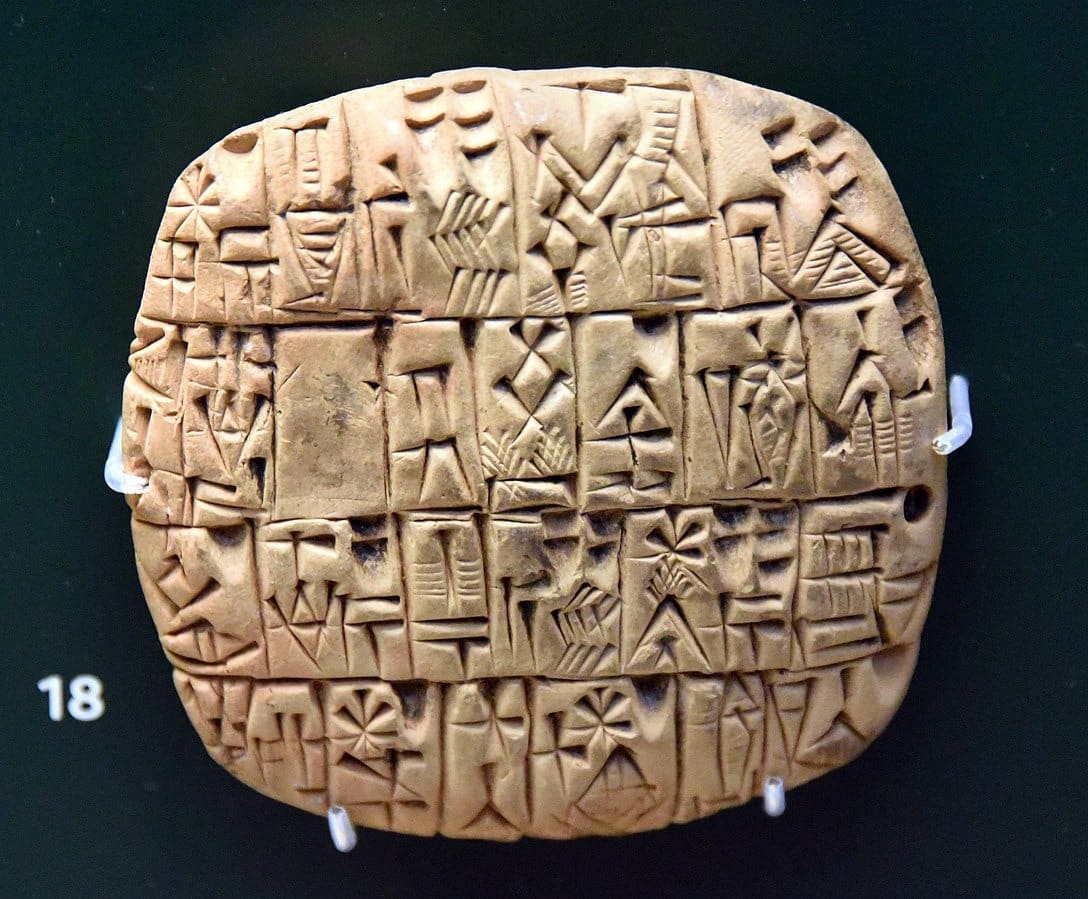
Enmerkar then pressed a message into clay, producing what the poem refers to as a new method of recording words on that specific material.
Most scholars, including Komoroczy, Vanstiphout, and Glassner, interpret that moment as the invention of writing itself. Yushu disagrees. According to the poem, it was not writing itself that did not previously exist but specifically the act of writing on clay. The Lord of Aratta then reads and comprehends the writing on the clay tablet without assistance. This, Yushu says, would only be possible if writing on other materials were already familiar to him.
A single line from the poem became the center of scholarly debate. Vanstiphout argued that the Lord of Aratta could not read at all and was simply baffled by unfamiliar nail-shaped signs.
Yushu counters that the line carried a double meaning, referring both to the nail-like appearance of cuneiform signs and the sharp, commanding tone of the message. It is also pointed out that cuneiform’s nail-like appearance evolved later on. The earliest signs from Uruk were more linear, meaning the poem’s author, writing centuries after the events, projected later script forms backward in time.

Four observations support Yushu’s argument. Writing materials, including ivory, wood, wax, leather, and papyrus, appeared later in Mesopotamia, and some may trace them to older traditions. Moreover, several proto-cuneiform signs, including those depicting donkeys, ibex, and curved or circular shapes, appear too complex to have originally been designed for clay.
Multiple scholars, including Lieberman and Schmandt-Besserat, have noted that the Uruk writing system seems too complex and sophisticated to represent a true beginning. Researcher Whittaker separately proposed that certain proto-cuneiform signs could possibly be traced back to a Proto-Indo-European writing tradition, adapted by the Sumerians through phonetic similarities.
A separate Sumerian text, “Inanna and Enki,” directly supports the divine origin argument. It describes the scribal art as a gift from the god Enki, later adopted by the goddess Inanna and presented to the people of Uruk.
Yushu reads this as firm evidence that Sumerians viewed writing as something created by gods rather than rulers. The study concludes that Enmerkar transformed writing by transferring it from an earlier, unidentified medium to clay, a shift that gradually altered the form of the signs over time.