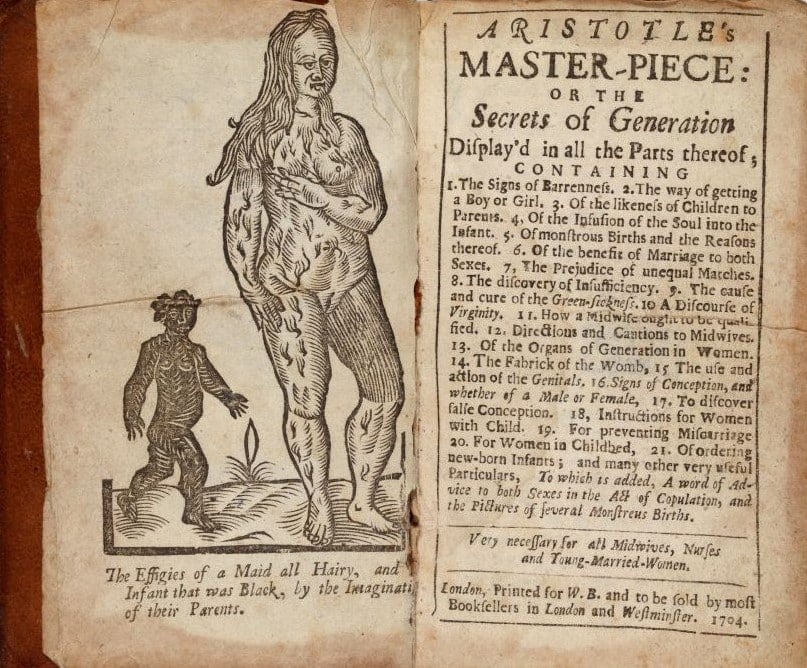
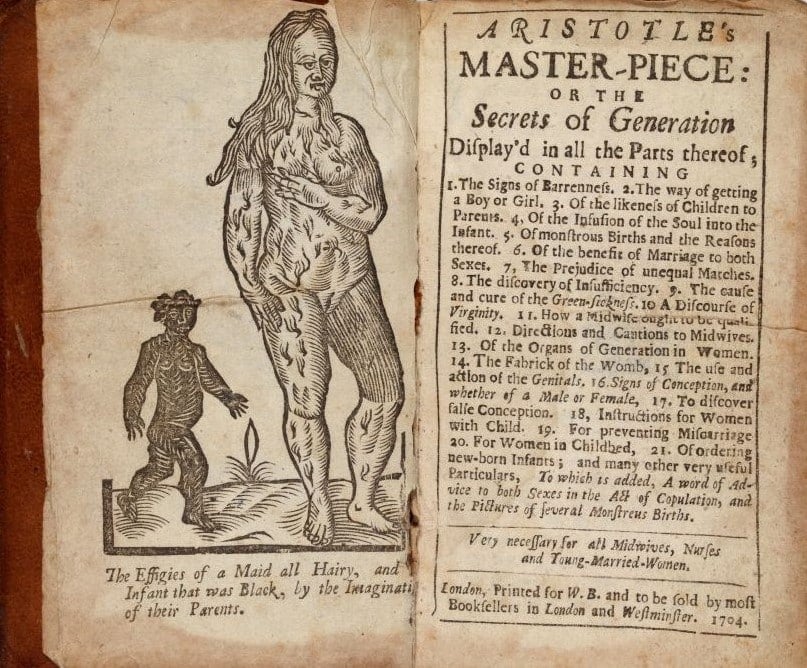
In 1684, a book titled Aristotle’s Masterpiece was published in England. Despite its title, it was a sex manual that also included advice on midwifery. The book proved widely popular in England from the early modern period through the 19th century.
It was falsely attributed to Greek philosopher Aristotle. For this reason, the writer is now described as a Pseudo-Aristotle, a label used for unidentified authors who deliberately adopted Aristotle’s name. It is sometimes claimed that the book was banned in Britain until the 1960s, although there was no formal legal mechanism for banning books in the UK. Even so, reputable publishers and booksellers may have become more cautious about circulating Aristotle’s Masterpiece, particularly after the Obscene Publications Act of 1857.
Aristotle himself did not write a sex manual in the modern sense nor was he the author of Aristotle’s Masterpiece. Nevertheless, the association between Aristotle and sexuality has a long history. His authentic biological writings include detailed discussions of reproduction, sexual difference, fertility, and human generation, while later writers repeatedly attached his name to works on sexual subjects he never authored. Over time, Aristotle became closely linked with sexual knowledge for nearly two thousand years.
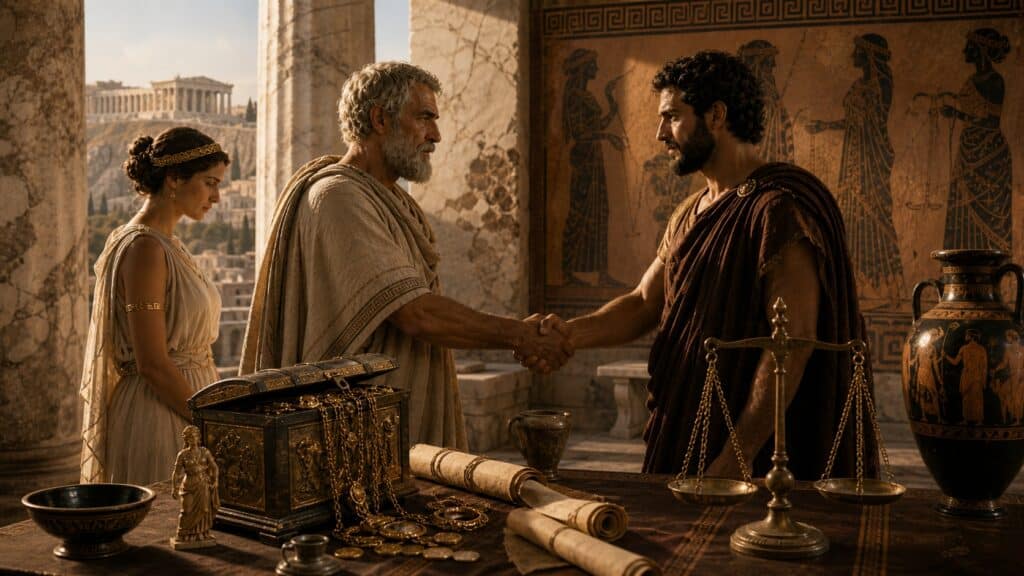
Aristotle (384–322 BC) was one of antiquity’s most prolific thinkers. His surviving works span logic, ethics, and politics, as well as physics, zoology, and biology. Among these are discussions of reproduction in works such as Generation of Animals and History of Animals. These texts examine conception, infertility, pregnancy, heredity, and the differences between male and female bodies. Aristotle approached these topics as a natural philosopher aiming to explain biological processes rather than as a writer of erotic literature or a sex manual.
Modern scholars emphasize that his interest in sex was scientific rather than practical. The historian of philosophy Marguerite Deslauriers notes that the great Greek thinker was deeply concerned with “the nature and value of the sexes and of sexual reproduction.” The work of Aristotle formed part of a broader inquiry into biology, metaphysics, and society, rather than an attempt to instruct readers in sexual behavior or produce a sex manual.
Nevertheless, he did address related topics in considerable detail. In his biological writings, he discussed female pleasure, conception, infertility, and reproduction. According to a National Geographic article, Aristotle recognized that women experienced sexual pleasure and even considered whether the female orgasm played a role in conception. The article notes that he discussed “the female orgasm” and that “women have pleasure in intercourse” to a degree comparable to men.
Part of the confusion surrounding Aristotle’s writings stems from a work known as Problemata (Problems), a collection of questions and answers on a wide range of topics, including sex. Some sections contain surprisingly explicit discussions of sexual intercourse and reproduction. However, many scholars consider much of this collection to be pseudo-Aristotelian, meaning it was written by later followers rather than Aristotle himself. The Open University explains that Aristotle’s Problems included “some of the most explicit discussions of the mechanics of sex and reproduction available in English at the time” although its authorship remains uncertain.
The most influential source of the myth, however, is Aristotle’s Masterpiece. This widely circulated English manuscript functioned as both a sex manual and a midwifery guide, while being falsely attributed to Aristotle to enhance its authority. Modern scholarship leaves little doubt about its inauthenticity. It was written by an anonymous author who used Aristotle’s name to attract readers and lend credibility to what was, in effect, a popular sex manual.
Several scholars have noted the cultural significance of this remarkable book. Historian Vern L. Bullough argued that “the writers of Aristotle’s Masterpiece were harbingers of a new age of sexual freedom.” This observation highlights the work’s broader cultural impact despite Aristotle’s having no connection to it.
Another scholar, Sarah Schuetze, described Aristotle’s Masterpiece in striking terms, writing that it was not merely a book on midwifery but also a sex manual. According to Schuetze, the text provided “frank explanations” of childbirth, sexual pleasure, and reproduction and also acknowledged female sexual pleasure, something that many later writers overlooked.
The wide reception of Aristotle’s Masterpiece demonstrates how powerful Aristotle’s name was in popular culture. The Open University notes that by the 17th century, “the name Aristotle in the title meant—nudge nudge wink wink—a book about sex.” This association did not arise because Aristotle wrote erotic manuals or a sex manual but because publishers repeatedly exploited his reputation as the ultimate authority on natural knowledge.
Ironically, the historical Aristotle would likely have been surprised by this legacy. His authentic writings include theories of reproduction that modern science has largely rejected. For instance, he argued that the male provided the formative principle in generation, while the female supplied the material for development. Yet these ideas emerged from careful observation and represented one of the earliest systematic attempts to understand reproduction scientifically. His discussions of infertility were detailed enough that modern historians of medicine continue to study them. One scholarly analysis notes that Aristotle examined the causes of infertility in both men and women and attempted to diagnose reproductive problems through observation and comparison.
Ultimately, whether Aristotle wrote a sex manual depends on how the term is defined. If it refers to a practical guide to sexual activity, the answer is clearly no. Aristotle’s Masterpiece was composed nearly two thousand years after his death by an anonymous writer. If, however, the question is whether Aristotle wrote extensively about sex, reproduction, fertility, and sexual difference, then the answer is yes. These subjects were central to his biological investigations and later shaped discussions of human reproduction.