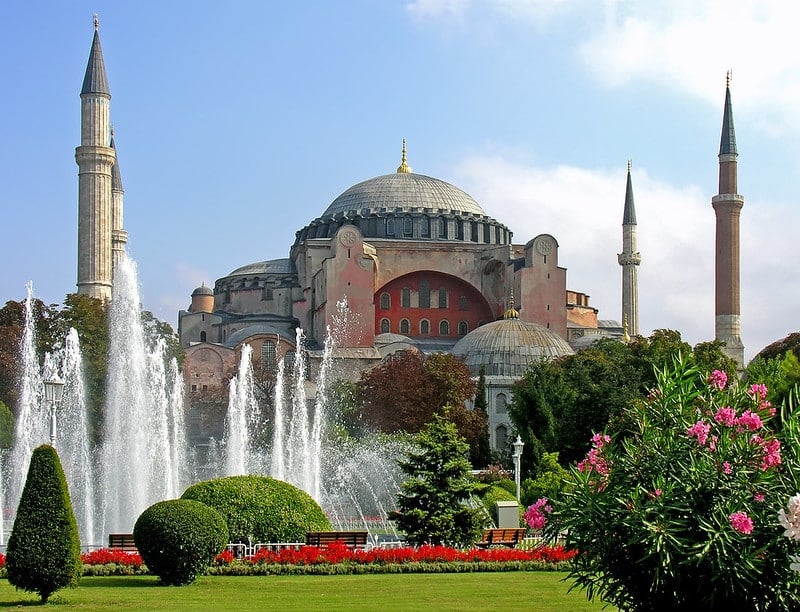
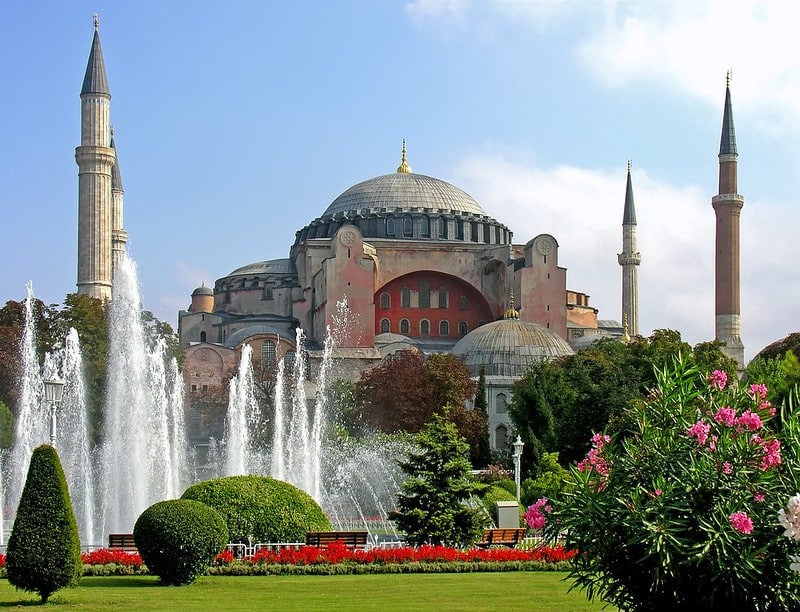
Two Greek tourists arrested in Istanbul after displaying a flag inside Hagia Sophia remain in pretrial detention, Greece’s Foreign Minister George Gerapetritis told parliament, as Athens continues efforts to secure their release through diplomatic and legal channels.
The incident took place on Orthodox Holy Thursday at Hagia Sophia. According to Turkish media reports, the two tourists, a woman traveling with a Greek passport and a man with dual Greek and Australian citizenship, entered the monument as part of an organized tour group.
Turkish reports said the pair unfurled a blue flag with a white cross, resembling a version of the Greek flag, along with the Byzantine double-headed eagle and the phrase “Orthodoxy or Death.”
Security camera footage reportedly showed the tourists passing through the required checks before moving to the upper level of Hagia Sophia, an area open to visitors. Once there, one of them allegedly removed the flag from inside a jacket, unfolded it, and posed for a photograph. The flag was then reportedly handed to another member of the group, who repeated the action.
Turkish media also reported that surveillance footage suggested others in the group may have been preparing to participate before security staff intervened.
According to Turkish media, the court ordered their arrest on a charge described as inciting public hatred or insulting a segment of the public. Gerapetritis told parliament that Turkish authorities are handling the case as one of incitement to hatred and hostility.
The Greek foreign minister stressed that the case does not concern only the display of the flag inside Hagia Sophia. He said Turkish authorities also focused on the written message “Orthodoxy or Death,” which they determined could fall within the scope of a criminal offense under Turkish law.
Gerapetritis was responding to a parliamentary question from Georgios Manousos, an independent MP originally elected with the far-right Spartans party.
Greek foreign minister said Greece’s consul general in Istanbul has been in contact with the two detainees and their lawyers since the day of the arrest. Greek authorities are also coordinating with Turkish officials in an effort to resolve the case.
Athens is working toward two possible outcomes. One is an expedited trial, which Turkish courts can accelerate when foreign nationals are involved. The other is the replacement of pretrial detention with conditional release.
Gerapetritis also referred to a previous incident in December 2024, when six cadets from the Hellenic Air Force Academy were detained after raising a Greek flag inside Hagia Sophia. They were later released following diplomatic intervention by Athens.
However, the foreign minister said the current case differs because of the written slogan that accompanied the flag display.
“They are in good health. We are in continuous communication,” Gerapetritis told MPs, adding that the Foreign Ministry is acting “with responsibility and respect, without grandstanding.”
Ayasofya’da bayrak açan 2 Yunan turist tutuklandı.
pic.twitter.com/mKcwWxVTJ3— DarkWeb Haber (@darkwebhaber) April 14, 2026
The incident carries particular sensitivity because Hagia Sophia in Istanbul, historically known as Constantinople, remains one of the strongest symbols of the Greek Orthodox world nearly six centuries after the Ottoman conquest and its conversion into a mosque.
From 537 to 1453, the church, known to the Byzantines as the “Great Church,” stood at the center of Eastern Christianity. More than a monumental structure, it served as the religious, political, and artistic heart of the Byzantine Empire. Historical accounts describe a vast sacred space that could hold thousands of worshippers, while hundreds of priests, deacons, and chanters conducted its liturgies.
Its importance, however, never rested on size alone. Builders placed Hagia Sophia in what many at the time saw as the “New Jerusalem,” and the monument came to symbolize both imperial power and the triumph of Christianity after centuries of Roman persecution.
The structure completed in 537 AD did not mark the beginning of Christian worship on the site. Tradition holds that Constantine I founded the original basilica around 325 AD on the remains of a pagan temple. His son, Constantius II, consecrated the cathedral in 360.
Fire damaged that early church in 404 during unrest that followed the second exile of St. John Chrysostom, then Patriarch of Constantinople. Authorities later rebuilt and enlarged it, and Theodosius II rededicated it in 415. The Nika riots, however, destroyed it once again in 532.