The story of olive oil from Lesvos, Greece stretches back through centuries of cultivation and production that strongly influenced the island’s economy, environment, and way of life. The unique flavors of the island’s olive oil anchor local cuisine, while its enduring traditions now inspire a growing number of agrotourism and food tourism experiences.
By Lisa Radinovsky, editor of Greek Liquid Gold
“Olive cultivation on Lesvos dates back to antiquity,” with “olive oil already a key agricultural product” in ancient times, explained Vasileios Gkinopoulos (Sigri Olive Mill). “The island’s fertile volcanic soils and Mediterranean climate proved ideal for olive trees, leading to the establishment of extensive groves” on Greece’s third largest island.
Its location in the northern Aegean Sea, near the Black Sea, positioned Lesvos (also known as Lesbos) at a key point in Mediterranean trade routes for centuries. After the Ottoman conquest of the island in 1462, Thanasis Kizos and Maria Koulouri (University of the Aegean) wrote, there was a gradual increase in the number of olive groves and mills, and a rise in olive oil production in Lesvos. This contributed to major economic developments that fueled a population increase in the 18th and 19th centuries.
Intense industrialization of the island’s olive oil industry began in the 1880s, when steam-powered olive presses started replacing animal-powered olive mills. At the end of the 19th century, Lesvos was exporting 10 million kg of olive oil annually—similar to what the island produces in a good year now. Evridiki Sifneos reported that Lesvos olive oil was exported to “port and inland markets of the Asia Minor coast, the Aegean islands and the Black Sea.”
As Kizos and Koulouri explained, this changed after “a major economic crisis that broke out in 1922, when refugees from Asia Minor were ‘exchanged’ with Muslim inhabitants of the island and the borders for all transactions, movements and investments were closed down.” Moreover, transportation improvements (such as steamships and trains) that made long sea journeys and land trips easier reduced traffic to Lesvos, concentrating most economic activity on the European continent. The result: “the closing of almost all industrial and trading activities on the island and a major population exodus.”
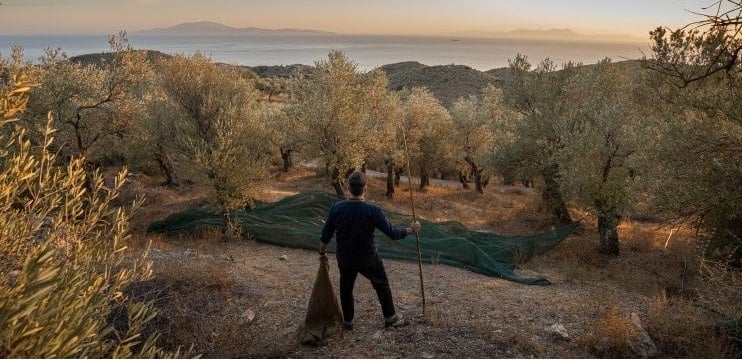
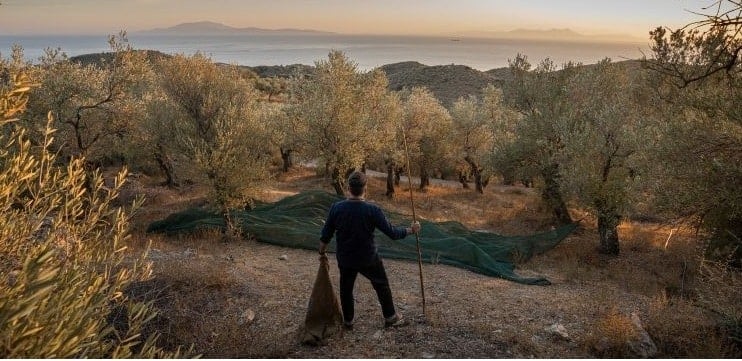
Since then, Kizos and Koulouri noted, olive oil production in Lesvos has fluctuated. By the late 20th century, many olive groves that are hard to access and/or less productive were being completely or “‘mildly abandoned,’ which means that only when production is satisfactory are the olives collected and little other cultivation management is practiced.” Many traditional structures have been left to deteriorate. On the other hand, agriculture has intensified on the plains.
Today, olive oil remains one of the most important agricultural products on the island, along with cheese and ouzo. Although Kizos mentioned that cheese contributes greater economic value, “olive oil affects more families and people,” and “for some areas and people it is their basic livelihood.”
Statistical data provided by Professor Kizos* demonstrate that there are approximately 8,500,000 olive trees on Lesvos, with around 60% of them managed every year. The official registry shows that there are 91,745 olive groves on the island. As Kizos added, data indicate that the annual olive oil production of Lesvos averages around 8500 metric tons/year, varying significantly from 3000 to 12,000 tons annually.
Bastian Jordan (Jordan Olive Oil) shared a common concern: “much of this oil has historically been sold in bulk to middlemen at commodity prices, which keeps producers in a cycle of low margins. That’s slowly changing as more Lesvos producers bottle under their own name.”
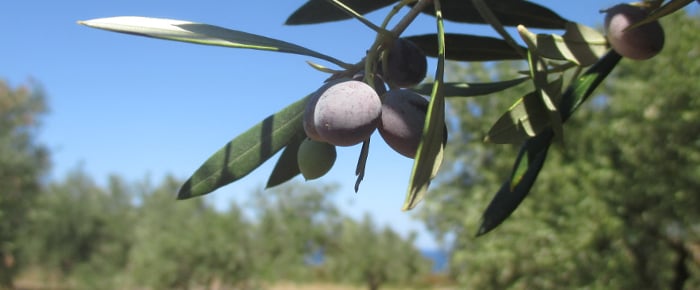
Increasing numbers of producers are creating brands with careful attention to the unique flavors Lesvos offers. The most common olive varieties on this North Aegean island are Kolovi (Mytilinia) and Adramytini (Adramitini, Adramytiani). Konstantinos Xanthopoulos (Papadellis Olive Oil) pointed out that many believe “Kolovi olives are found only on the island,” while “Adramitiani is also on the west coast of Turkey.”
Numerous variables affect the aromas and taste of an olive oil. Overall, many describe Kolovi extra virgin olive oil (EVOO) as more robust, and Adramitiani EVOO as milder or less pungent, with both often considered less intense than Greece’s predominant Koroneiki variety EVOOs. As Gkinopoulos stated, the extra virgin olive oils of Lesvos are “characterized by a delicate, balanced profile.”
Jordan notices in his company’s Kolovi extra virgin olive oil “a peppery finish and medium bitterness. Aromas of green tomato, fresh herbs, sometimes a slightly floral note.” Giannis Xypperas (Polykarpos Dimitra) finds his family business’s Kolovi EVOO reminiscent of “green fruits, fresh-cut grass, with a very fruity taste.” On the other hand, Jordan views Adramytini extra virgin olive oil as a “mild, buttery oil with almost no bitterness. Aromas of fresh grass, almond, and sometimes a light artichoke note. Very approachable for people who are new to quality olive oil.”
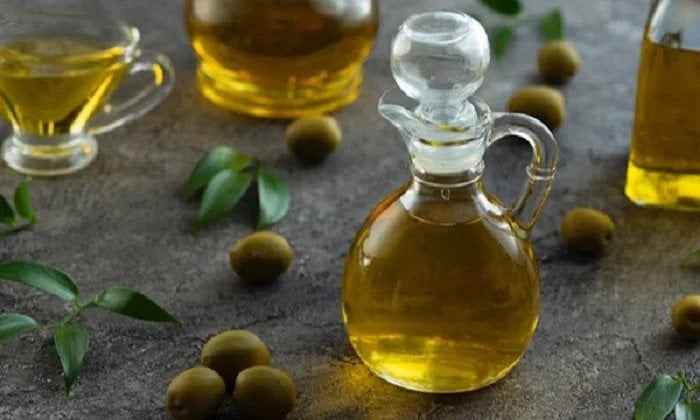
Of course, the people of Lesvos grow up with high-quality olive oil. As Constantinos Kolyvas (Aegean Agrofood) said, “everything is done in olive oil, even frying potatoes.” Xanthopoulos added, “it’s the main thing we use for cooking and for salads, the basic ingredient for baking and cooking.” Panagiotis Xypperas (Polykarpos Dimitra) agreed: “you cannot find a meal without it.”
Asked about local dishes rich in EVOO, Jordan mentioned Ladotyri (meaning “oil cheese”) Mytilinis. This unique PDO product is a sheep’s milk or sheep and goat milk cheese that is “shaped into small rounds, and then submerged in olive oil for months. The oil both preserves and flavors the cheese. It’s served sliced as a meze, often with tomatoes and bread. The olive oil used for aging takes on a sharp, complex flavor and is used as a condiment itself.”
Gkinopoulos suggested that “many traditional seafood preparations complement the island’s fine extra virgin olive oil exceptionally well.” He finds “the famous Kalloni sardines” especially noteworthy. “Whether cured or grilled fresh, they are traditionally served drizzled abundantly with Lesvos extra virgin olive oil, lemon juice, and oregano.”
Tourists enjoy the EVOO of Lesvos in delicacies such as these. They can also explore the olive oil culture of this Greek island in other ways. As Jordan pointed out, “Lesvos has some of the most dramatic olive landscapes in the Mediterranean, with ancient trees, stone terraces, and groves that stretch unbroken for kilometers.” While “the infrastructure to turn that into a tourism product is still emerging,” significant progress has been made in recent years, with government-certified attractions drawing visitors from several countries.
For example, Ioannis Protoulis (Protoulis Master Olive Oil Makers) is proud of promoting the olive oil of Lesvos and the culture of the olive with a tasting and food pairing experience and an educational, interactive guided tour of a renovated mill that dates back to 1920. In addition, traditional facilities have been converted into such destinations as the Museum of Industrial Olive Oil Production in Agia Paraskevi and the restored late 19th century Vranas Olive Press.
These developments support Gkinopoulos’s assertion that “olive oil is becoming an increasingly important element of tourism on Lesvos, enriching the visitor experience and promoting sustainable agrotourism.” Some events also go beyond typical mill and grove tours, tastings, and explanations to offer a deeper educational element.
For instance, as Gkinopoulos explained, the biennial ELIA Lesvos Confest that is organized by the Eleas Nisos (Olive Island) Lesvos Cultural Association “integrates science, gastronomy, and heritage. Through panels, talks, and workshops, it explores the relationship between EVOO and topics such as health, nutrition, technology, the environment, branding, tourism and art.”
One of the remarkable true stories shared at the 2024 ELIA Lesvos Confest focused on Faros Estate in Sigri. According to Gkinopoulos, “what was once a deserted area suffering from desertification has been transformed into a thriving 200-hectare oasis of biodiversity.” Organic groves featuring 12 different olive cultivars provide “a vibrant habitat for thousands of birds and other wildlife, while producing exceptional extra virgin olive oil at Sigri Olive Mill.”
On other parts of the island that did not suffer desiccation, Kizos said, the typical low-input, traditional Lesvian olive grove “is a forest ecosystem which maintains very high rates of biodiversity, both above the ground as well as in the soil.” The olive groves of Lesvos thus help mitigate the impact of climate change.
One “truly unique” feature of the hilly and mountainous olive growing regions in Lesvos, Kizos told Greek Liquid Gold, is “the terraced landscape with the individual terraces around the trees” (pocket terraces) in combination with the step terraces that create giant flat “steps” on a slope. While Kizos and Koulouri have written that traditional structures such as terraces, stone storehouses, and fences have generally been left to deteriorate, there are exceptions. To illustrate: Giannis Xypperas reported that his family business is working to preserve some of the centuries-old setia, “which are essentially stone walls designed to retain rainwater” and prevent erosion on the terraces.
Bastian Jordan described a visit with an elderly farmer in a mountain village in the late 1990s. “He told us that during the German occupation in World War II, when there was almost nothing to eat, the olive trees kept the village alive. People ate olives, used the oil for everything–cooking, lighting, medicine, soap. He said, ‘the trees don’t care about wars. They just keep giving.’ That captures something real about the relationship between the people and the trees on Lesvos. These aren’t commercial plantations–they’re family trees in the most literal sense, passed down through generations.”
Today, the island’s enduring olive oil tradition continues to support Lesvos’s economy and environment, define its culture and cuisine, and inspire new agrotourism experiences.
Originally published on Greek Liquid Gold: Authentic Extra Virgin Olive Oil (greekliquidgold.com). See that site for recipes with olive oil, photos from Greece, agrotourism and food tourism suggestions, and olive oil news and information. To get that news right in your inbox, sign up for the free monthly Greek olive oil newsletter at https://greekliquidgold.com/newsletter-signup/ (and then check the box in the confirmation email).”
Related: Botanical Park of Crete: Rooted in Fire, Inspiring Hope