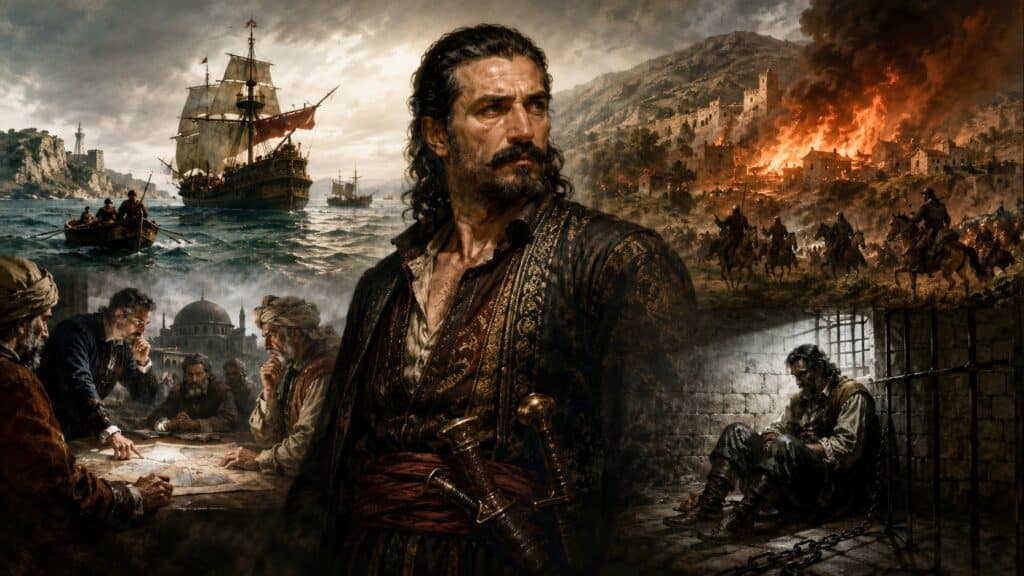
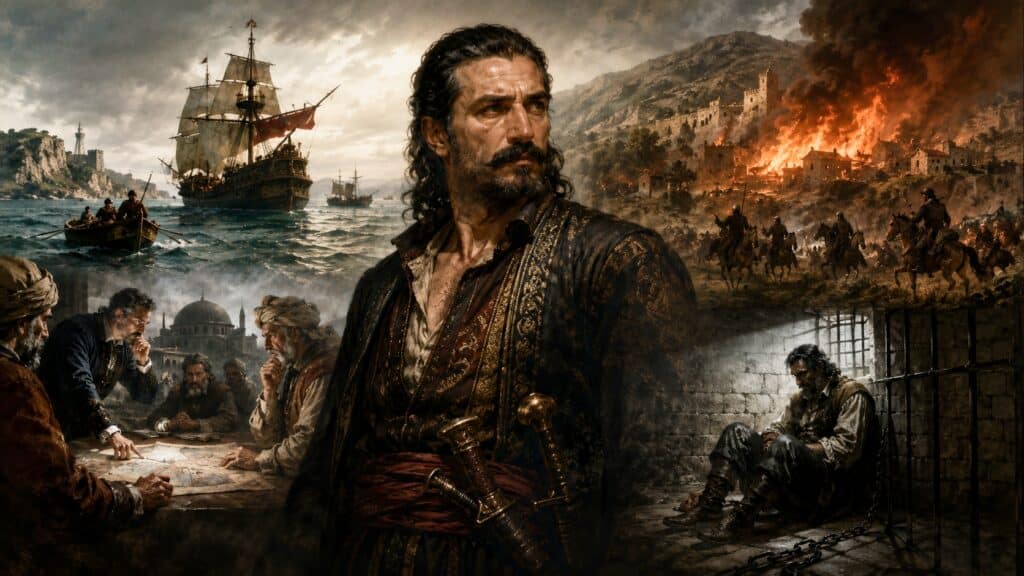
As smoke curled over the hills of the Peloponnese, many villagers were aware that the danger was not coming from powerful, invading armies but from one particular man, Limberakis Gerakaris, a Greek pirate—not your typical man of the 17th century by any means.
Gerakaris wasn’t a loyal servant of the Ottoman Empire or the Russians nor was he an ideologue rebel with a deep cause for the liberation of the nation. He was something that only a true Greek pirate can be: a survivor, a strategist, and, depending on who you asked, an absolute menace who turned an already fragile region into a complete and total chaos.
So how does one born in the Greek territories of the Ottoman Empire go from a child to a prisoner, power broker, and ultimately, someone whose name among thousands of people was whispered with fear?
Gerakaris’ impressive life story began in a brutal prison in Constantinople, known at the time by the Ottomans as Konstantiniyye. At that point, his future didn’t look especially promising. Effectively, he was just another rebellious Maniot Greek, who got captured by the Turks, got locked away and, presumably, was destined to be forgotten. However, this would not be the case with Limberakis Gerakaris. The Ottomans, rather than keeping him behind bars, made a calculated gamble. They not only released him but decided to hand over authority to him, naming him Bey of Mani.
Of course, one might wonder why this would be. The answer to this can be found in the nature of Mani and the Maniots. Infamously for the Ottomans, Mani wasn’t easy to control. Its people were fiercely independent, bound by clan loyalties and long memories of feuds. Outsiders struggled there. Gerakaris, however, knew the terrain, and he was familiar with the people and the dynamics of the clans. The Greek pirate knew who could be controlled and who couldn’t. He was well aware of what Mani was inside and out, both socially and physically. Understandably, the Ottomans didn’t easily arrive at this decision. It was a very risky move and, in hindsight, maybe a telling one.
Instead of calming the region, Gerakaris leaned into its chaos. He didn’t try to smooth over rivalries between the Maniot clans. He weaponized them to his own benefit. Old grudges became political tools for him. Alliances shifted like sand, and just like that, a man the Ottoman Empire hoped would stabilize Mani to Constantinople’s favor, began making its reputation even worse for the Muslim conquerors. Before titles and politics, Gerakaris had lived a very different life, one that shaped his character and was defined by the unpredictable waters of the Mediterranean.
The 1600s Aegean wasn’t exactly governed by the rules of free navigation. It was a place where trade, war, and piracy coexisted. Gerakaris actually thrived in such an environment. Raiding ships, switching allegiances in a heartbeat, taking what he could when the opportunity arose. This was a gold mine for him—a system and a way of life. Even after he was pronounced Bey for the Ottomans, that mindset didn’t vanish from Limberakis Gerakaris’ life. If anything, it became more pronounced. Authority, for him, was about leverage, control, and financial opportunity. He ruled the way he had lived: fluidly, unpredictably, and always with an eye on what benefited him most.

By the time conflict erupted between the Republic of Venice and the Ottoman Empire over the Peloponnese in 1684, Gerakaris found himself in a precarious position. He understood both sides and how Venetians and Ottomans felt, but he belonged to neither. One moment, he was backing the Ottomans, the very power that had elevated him to the local governor. The next, he was cooperating with Venetian forces, who saw him as a useful (if slightly alarming) ally. Was this betrayal to the Ottomans, a clever strategy, or just a survival instinct of a Greek trying to navigate a world of foreign powers over his head? Probably all three.
For the people residing in the Peloponnese, however, the effect was constant uncertainty. Lines between friend and foe blurred beyond recognition for people, and, in all the confusion, Gerakaris operated freely, often tipping the balance in ways that deepened the chaos rather than resolving it. At the height of his influence, Gerakaris made the fighting between the Venetians and the Ottomans feel personal.
Raids became routine, numerous villages were burned, and countless families were uprooted. Fields, already strained by constant conflict, were abandoned or destroyed. The unfortunate truth is that much of the suffering stemmed from within, as Gerakaris consistently provided both sides with information, wreaking mayhem while ensuring he himself survived. Greek communities, already caught between Venetian and Ottoman ambitions, had to contend with someone who knew their land intimately and exploited it. To some, Gerakaris might’ve looked like a man doing whatever it took to survive in a brutal age of conflicting interests and foreign rulers. To others, he crossed a line, again and again, until survival looked a lot like opportunism at everyone else’s expense.

Sometimes the problem is that the very traits that make people like Limberakis Gerakaris useful eventually also make them risky pawns. The Venetians, who had once tolerated and maybe even encouraged his actions, began losing patience with him, as his raids became all the less selective and his loyalties even harder to predict.
In short, he became a liability. So they acted. Gerakaris was arrested and shipped off to Italy, far removed from the rugged landscape of Mani, where he had established his reputation. There, confinement became his new reality. For a man who thrived on movement and unpredictability, captivity must have felt like a different kind of defeat. Hence, what do we make of Limberakis Gerakaris? Was he a local Greek hero who fought for the interests of Mani, an opportunistic villain, or something in between? The honest answer is it depends on where you stand.
The Greek pirate was a product of a fractured world that modern Greeks know little about. The region in the 17th century was a place where loyalty could shift overnight and survival often came at a moral cost. In a place like Mani, where identity and independence ran deep into the consciences of its people, someone like Gerakaris could be both a defender and a traitor—and maybe both were equally true of him as well. History sometimes has a way of putting forth such people with his likeness who are complicated, contradictory, and a little unsettling. These are figures who didn’t just live through turbulent times but amplified them.
Gerakaris ultimately died in captivity in Brescia, Lombardy in 1710.