
The presidents of the US and Iran signed a bilateral agreement remotely on Wednesday night, aiming to end the war in the Middle East. The deal includes reopening the Strait of Hormuz, a $300bn plan for Iran’s “reconstruction”, and the US terminating “all types of sanctions” on Iran.
But the issue of Iran’s nuclear program, the main reason stated by the US for the conflict, is still to be negotiated over an extendable 60-day period.
The “Islamabad Memorandum of Understanding,” which also encompasses the Lebanese front, was signed by US President Donald Trump during his official visit to France.
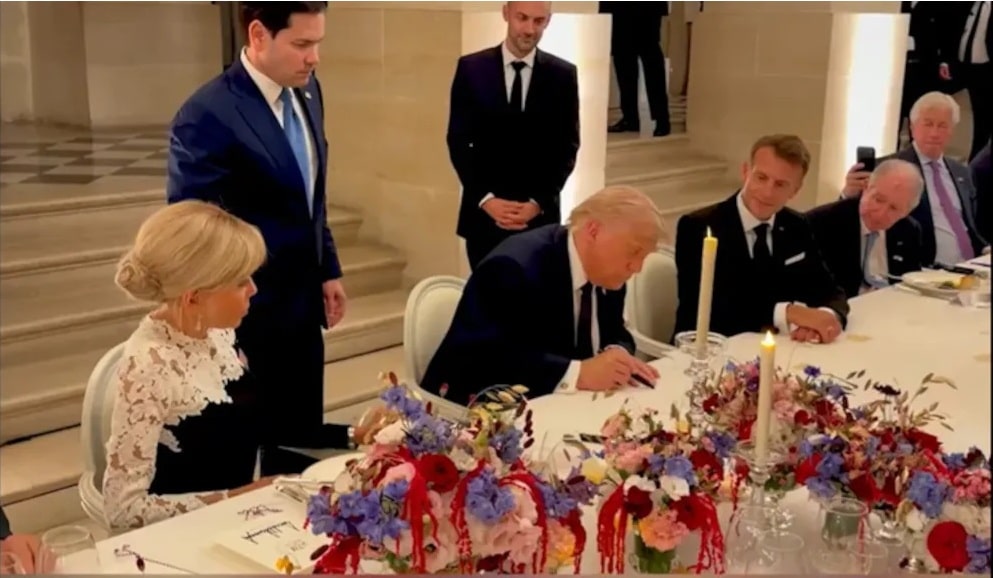
“I just signed it,” the US president told reporters as he left a state dinner hosted at the Palace of Versailles. The White House later released a video on X showing Trump signing the document with a marker. Seated beside him, French President Emmanuel Macron offered his congratulations before Trump handed the document to US Secretary of State Marco Rubio, who was standing behind him.
President Donald J. Trump has SIGNED the Iran Memorandum of Understanding at Versailles in France.
pic.twitter.com/JQ6qlbvFAF
— The White House (@WhiteHouse) June 17, 2026
Meanwhile, Iranian Foreign Ministry Spokesperson Esmaeil Baghaei announced that the text was also signed by Iranian President Masoud Pezeshkian. The official IRNA news agency broadcasted photographs showing President Pezeshkian signing the document.
The presidential signatures ensure that the Strait of Hormuz will fully reopen “without delay” and the US military blockade on Iranian ports will be lifted “immediately,” Pakistani Prime Minister Shehbaz Sharif confirmed in the early hours of Thursday.
Sharif also confirmed that an event will be held this Friday in Switzerland to mark this major milestone and kick off “technical talks” between the parties.
The text of the agreement, read to reporters by a US official on Wednesday, stipulates that Washington will suspend sanctions blocking Iranian oil sales effective from the moment of signing. The US has also agreed to lift all remaining sanctions against Tehran upon the conclusion of a final agreement following a 60-day negotiation period.
During these 60 days, both governments will discuss the creation of a “mechanism to process” Iran’s enriched uranium stockpiles using a dilution method “under the supervision of the IAEA” (International Atomic Energy Agency). The US official described this specific provision as a “major victory” for Washington.
According to the same source, Iran will allow the full restoration of maritime navigation through the strategic Strait of Hormuz within 30 days. The de facto closure of the strait since the outbreak of the war had severely disrupted the global economy.
Furthermore, the US has pledged that once a final agreement is reached, it will coordinate with “regional partners”—specifically the Gulf monarchies—to facilitate the release of $300 billion in frozen assets for Iran’s reconstruction and economic development. This measure will not involve any direct US financial contribution.