
Ancient DNA from thousands of years ago is rewriting what scientists know about Europe’s megalithic architecture and the people who built it.
A new study published in Science shows that the individuals buried in these massive stone monuments were not always blood relatives. Social bonds, it turns out, played a far more powerful role than biology in shaping who lived and died together.
Researchers analyzed genetic material from 203 individuals buried across six megalithic grave complexes in Central Europe. The sites belonged to two archaeologically distinct groups: the Western Funnel Beaker and the Wartberg cultures. Despite being considered separate, the genetic data revealed they formed one largely unified population.
Nicolas Antonio da Silva, lead author and researcher at the Institute of Clinical Molecular Biology at Kiel University in Germany, says the findings challenge long-held assumptions about prehistoric communities.
The results reveal that kinship and community in Neolithic Europe were organized in ways that defy earlier assumptions.
One of the most striking discoveries involved a father and son buried in different tombs roughly 250 kilometers (155 miles) apart. The father was found at Niedertiefenbach in central Germany. The son was buried at Sorsum, further northeast.
Whether the son had settled there permanently or was merely visiting remains unknown. But the discovery confirms that people traveled great distances over the course of one generation, even before domesticated horses existed in the region.
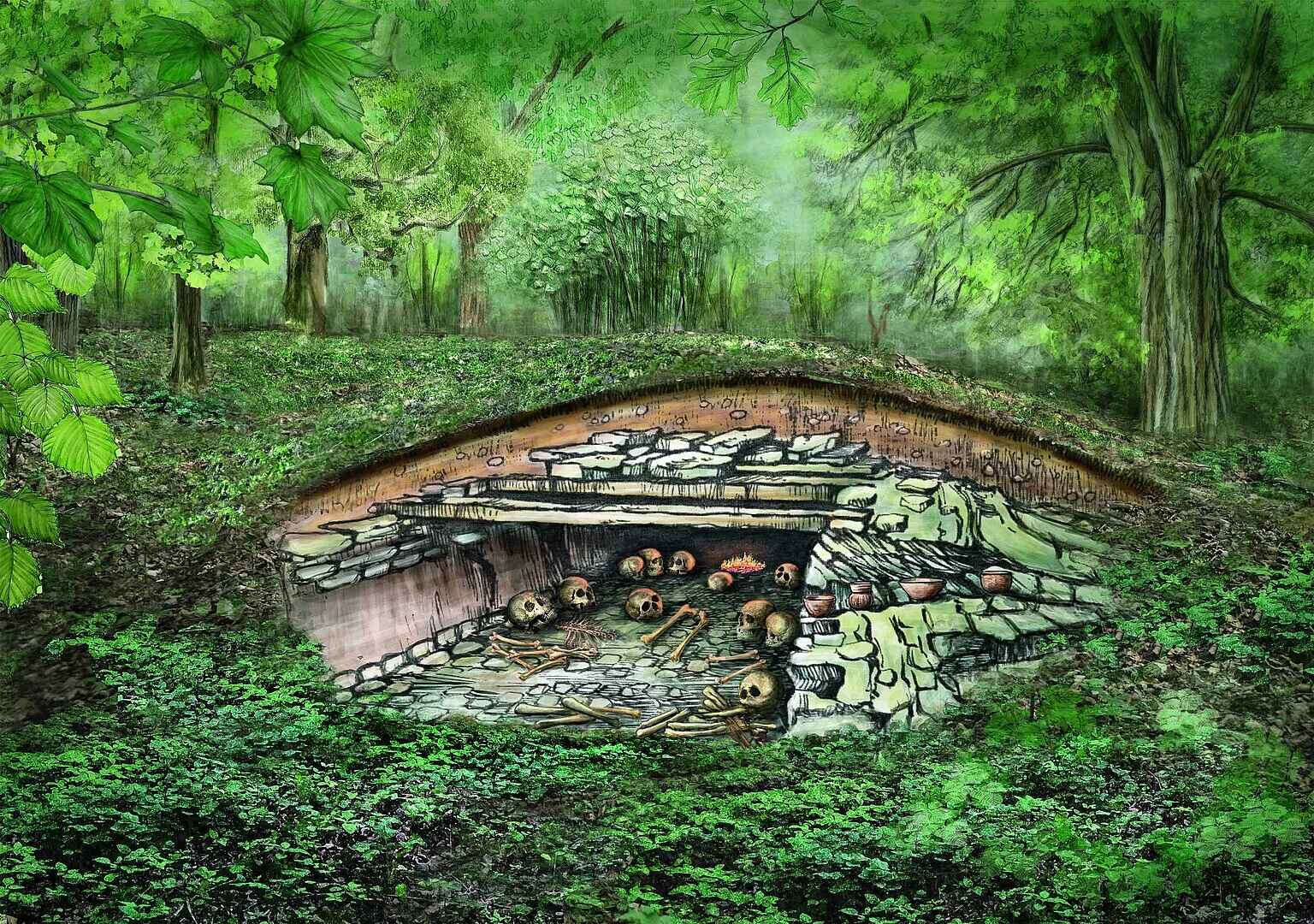
Professor Ben Krause-Kyora, who coordinated the study at Kiel University, notes that more than 5,000 years ago, people in Central Europe already lived in communities with complex, fluid family structures.
The data also shows that female members of these communities moved across especially wide geographic ranges, a finding that contradicts earlier assumptions about limited movement during the Neolithic age.
The communal burial chambers were not reserved for close relatives. Researchers identified first- and second-degree relatives buried at sites up to 225 kilometers (140 miles) apart, suggesting the tombs served broader social communities rather than just nuclear families.
The team also found little genetic connection between the Wartberg communities and other megalithic groups in Western Europe. Researchers concluded that the widespread tradition of building stone monuments spread through cultural exchange rather than migration.
Professor Johannes Müller, prehistoric archaeologist at Kiel University and co-author of the study, says the evidence calls for a deeper reconsideration of how early communities were structured and how far their members ranged across the prehistoric landscape.