

ChatGPT is helping Greek-speaking students with learning disabilities sharpen their academic writing, according to a new study out of Cyprus. Researchers found that structured, guided use of the AI tool improved essay quality and eased writing anxiety, with the biggest gains showing up among students who struggle most with traditional writing tasks.
The study was led by Elena C. Papanastasiou of the University of Nicosia’s School of Education. It was published in the journal Computers and Education: Artificial Intelligence.
Researchers followed 26 first-year students in a teacher education program, including five with learning difficulties. All students were native Greek speakers.
Students completed the same writing prompt three times, under three different conditions. First, they typed an essay with no outside help. Next, they used ChatGPT to revise that essay. Finally, they worked in groups to build a shared prompt and used it to refine their writing further.
Scores rose steadily across all three attempts. Instructors rated writing quality higher each time, and the biggest jumps came in grammar, sentence structure, and clarity.
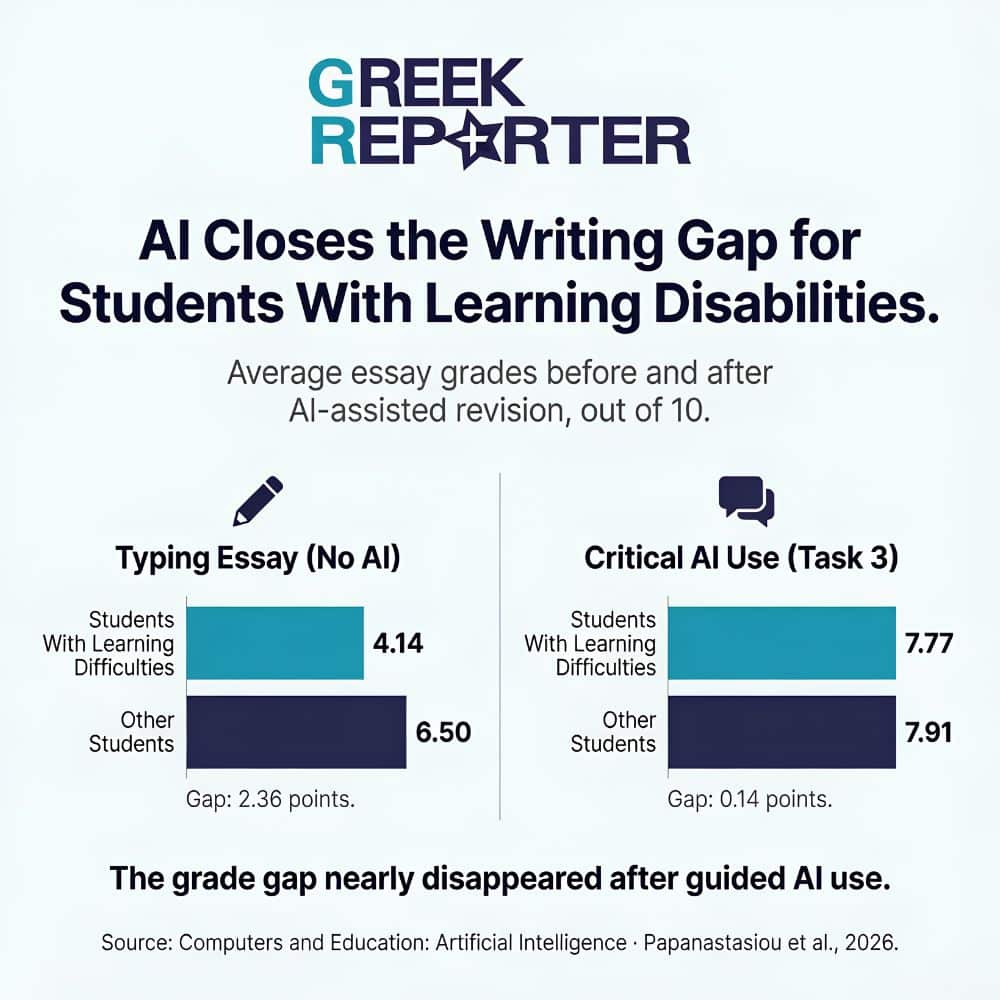
Students with learning difficulties saw the sharpest improvement. Their grades roughly doubled between the first and third writing tasks, closing a gap that had separated them from their classmates.
The findings also touched on trust and privacy. Students with learning difficulties felt more confident that AI-assisted tasks protected their personal data than their peers did.
Researchers suggested this may be because AI lets these students mask certain writing struggles, sparing them from feeling exposed in front of instructors or classmates.
Not every result favored technology. Students overall rated the plain typed essay, not the AI-assisted ones, as the most accessible option. Researchers attributed this to limited familiarity with AI at the time of the study, rather than any real drawback of the tool itself.
Language limits also surfaced. ChatGPT sometimes produced awkward or incorrect Greek phrasing, including grammar errors and word choices that shifted meaning.
Researchers noted that Greek-speaking students working with ChatGPT still needed to check the AI’s output carefully, since the tool remains less refined in Greek than in English.
Researchers called for stronger AI literacy training in teacher education programs, so future educators understand both the benefits and limits of the technology.
They cautioned that the sample was small and mostly female, and said larger, more diverse studies are needed before drawing broader conclusions about AI’s role in the classroom.