At the Battle of Sepeia in 494 BC, the final burning of the Sacred Grove of Argos stands out as one of the most grimly fascinating moments in Greek history. The smoke must have been visible for miles—thick, dark columns rising from what should have been safe ground, and with it went the better part of an entire generation of Argos. What unfolded was closer to the deliberate annihilation of a rival than a conventional engagement.
The long-standing hostility between Sparta and Argos stretched back well over a century by this point. The people of Argos had a pride grounded in their legendary ancestry, tracing their lineage to Diomedes and claiming Agamemnon’s legacy as their own. In their view, they were the natural masters of the Peloponnese.
Sparta, on the other hand, under the restless and hard-to-define leadership of Cleomenes I, saw things very differently. Cleomenes was no typical Spartan king. Ancient sources often describe him as unusually cunning and willing to bend or break rules, and his campaign against Argos reflected a ruler who found convention largely inconvenient.
Before the Battle of Sepeia unfolded, the Delphic Oracle had already unsettled Argos. The prophecy was cryptic in the way Delphi usually was, telling of something about the female conquering the male and Argos drowning in mourning. It was ominous enough to worry about and vague enough to argue over. Even so, the warriors of Argos decided to march.
Cleomenes’ first clever move was logistical. Rather than pushing through the well-defended land routes at the Isthmus of Corinth, exactly what the Argives would have been watching, he loaded his troops onto ships and crossed the Argolic Gulf, landing directly in Argos’ territory. It was the kind of maneuver that forced the enemy to react rather than prepare.
When the two armies finally squared off near Tiryns during the Battle of Sepeia, the commanders of Argos adopted a sensible strategy. They would mirror everything the Spartans did. When a Spartan herald called an order, the men of Argos repeated it in unison. It was defensive, careful, and it might even have worked against a more conventional opponent.
Cleomenes spotted the pattern almost immediately. His response was simple and brutal. He ordered his men to seize their weapons and attack at full speed when the herald sounded the signal for the midday meal—and this is exactly what they did. When the Argives set down their spears and reached for their food, the Spartans struck at a dead run.
The slaughter of the unprepared front ranks was swift. The survivors scattered and took refuge in the nearest place they believed would offer protection: the Sacred Grove of the hero Argus. It is at this point the story stops being about military tactics and becomes something else entirely.
Within the grove, the men of Argos had every reason to believe they were safe. The unwritten rules of Greek warfare were clear when it came to sanctuaries—these spaces were not to be violated. The gods were watching, and even the most aggressive commanders typically respected that boundary, if not out of piety then out of a very practical fear of divine retribution.
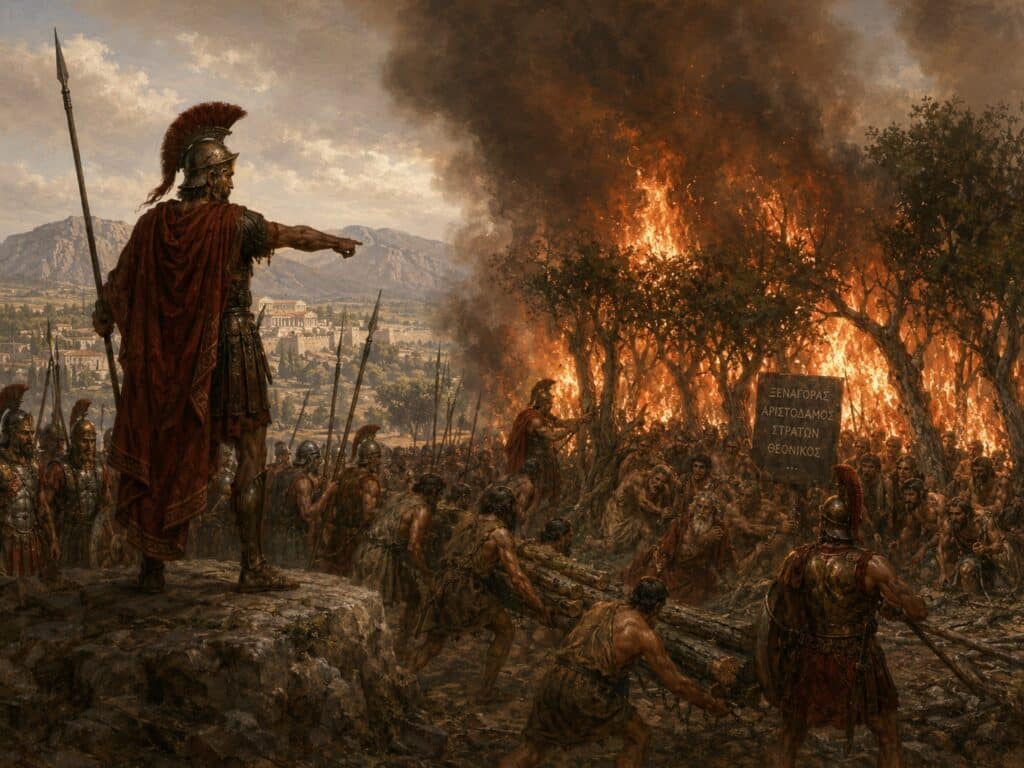
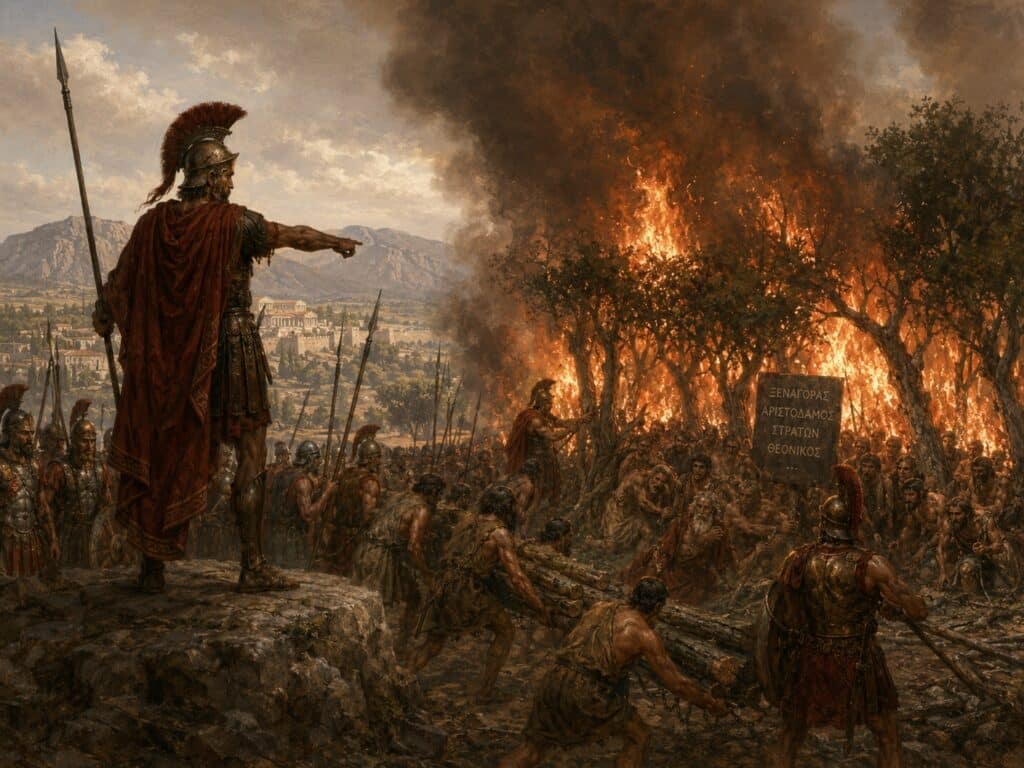
Cleomenes was not one to be constrained by such concerns, however. He had deserters who could identify the men hiding among the trees, and he began calling out individual Argive aristocrats by name. He told each one that their ransom had been paid and their families were waiting, but this was a lie. As each man stepped out, relieved, he was killed out of sight of those that remained inside. The process was methodical and, for a time, effective.
When the survivors finally realized what was happening, they refused to budge. Cleomenes then escalated the assault, ordering his helots to bring wood to the treeline and set the entire grove ablaze. Around six thousand Argive men were killed—most of them fighting-age citizens, the hoplites who would have become fathers, magistrates, and soldiers for the next generation. Even in an era accustomed to violence, the ancient world was genuinely shocked. Burning a sacred grove was the kind of act widely believed to invite divine catastrophe.
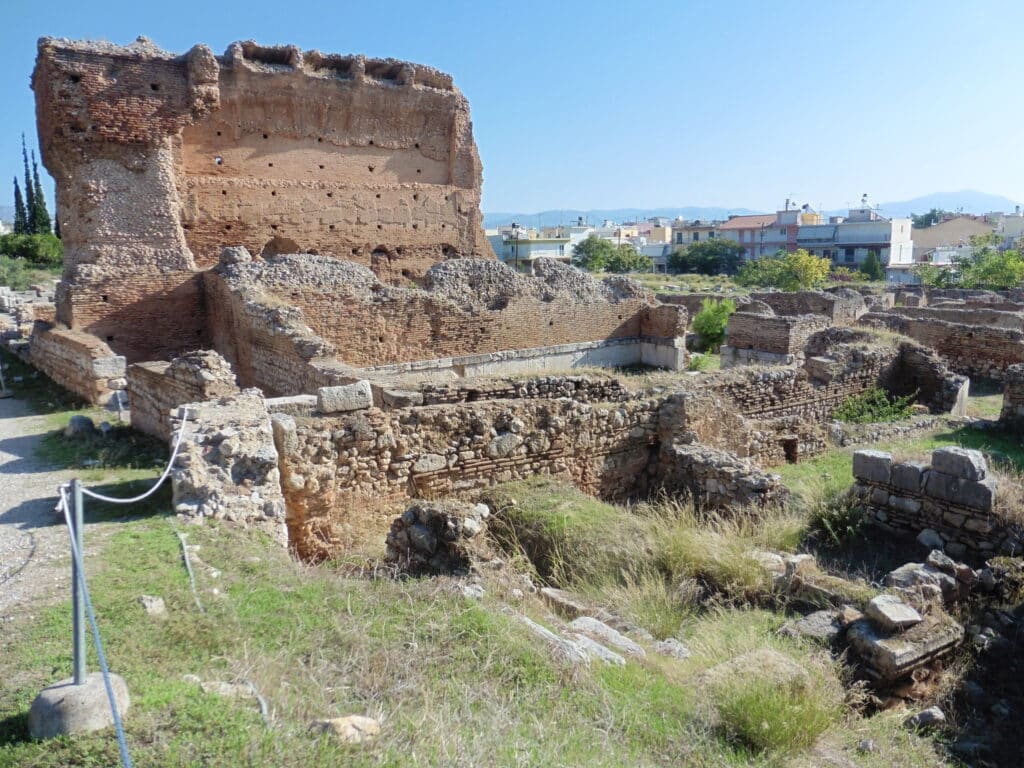
In Argos, the survivors faced an impossible situation. The city still had to function and defend its walls despite the devastating losses. In response, the widows, elders, and civic authorities took the extraordinary step of extending citizenship to the perioikoi and higher-status serfs, those who had long existed on the margins of Argive society. According to one of antiquity’s most enduring accounts, the poet Telesilla went even further, organizing the women, elderly, and enslaved to help defend the city walls. Whether Cleomenes decided the city was no longer worth the effort or simply had no desire to fight such defenders, he ultimately withdrew without sacking Argos.
The aftermath of the Battle of Sepeia shaped Greek history in ways that far outlasted Cleomenes himself. Ironically, the Spartan king died not long afterward in circumstances ancient sources describe as madness and self-mutilation—a grim end that many have viewed as its own form of nemesis.
When Xerxes invaded Greece fourteen years later, Argos remained neutral. Many contemporaries condemned the decision as pro-Persian treachery, while Herodotus, characteristically, left room for interpretation. A more straightforward explanation, however, is that Argos simply lacked the manpower. A city that had lost much of its fighting-age population at the Battle of Sepeia was in no position to wage another existential war.
That neutrality—whether viewed as cowardice, pragmatism, or something in between—strained relations between Argos and the rest of the Greek world for a generation. It also transformed Argos’ hostility toward Sparta into a lasting political reality. When the Peloponnesian War eventually divided the Greek world between Athens and Sparta, Argos sided with Athens without hesitation. It was not because the city held any special affection for Athens but because Sparta had burned its sacred grove, and the memory of that atrocity endured.
Cleomenes achieved his immediate objective. Sparta stood unchallenged in the Peloponnese, the Peloponnesian League was consolidated, and Argos was effectively neutralized. Yet in securing that victory, he also created an enemy whose resentment endured long after his own lifetime and that of his successors. Some victories carry consequences that outlive the victors. The grove was gone, but what it represented survived, and Sparta continued to pay the political price long after the ashes had cooled.